


The US Capitol houses the legislative branch of the American government. The Senate occupies the building’s north wing, and the House of Representatives is housed in the south wing.
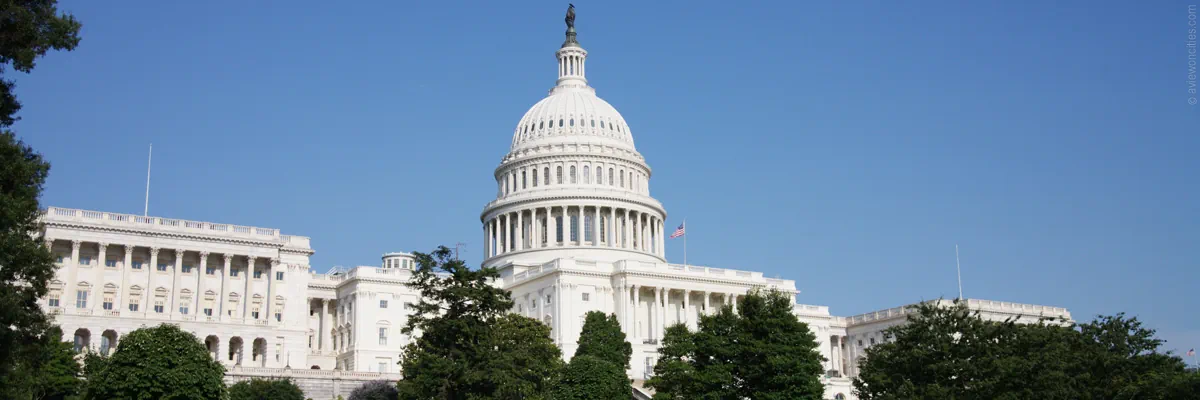
Construction
Construction of the Capitol started in 1793, two years after an area ceded by Maryland was selected as the District of Columbia, site of the new capital. The original design was created by Dr. William Thornton, a Scottish physician. His design called for a domed building flanked by a southern and northern wing. The construction of the sandstone building was supervised by James Hoban, the architect of the White House. He would be followed by many more architects over the course of the next two hundred years.
British Troops
Construction progressed slowly and in 1800 Congress met in the new – unfinished – Capitol for the first time. Until then, they had met in eight different cities, the last one being Philadelphia. In 1814, when construction was still going on, the Capitol was set on fire by British troops. A rainstorm prevented the complete destruction of the building, and construction resumed the next year. The building was finally completed in 1826 by Charles Bulfinch, a Boston architect known for his design of the Massachusetts State House.
Expansion
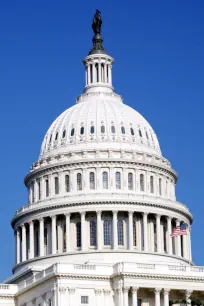
The addition of new states soon made the Capitol too small for the increasing number of senators and representatives. In 1851 the Capitol was extended after a design by the Philadelphia architect Thomas U. Walter. He added new wings and used marble instead of the already deteriorating sandstone for the extensions. The existing dome had become too small in comparison to the wings, and in 1856 the dome was removed. A new, large cast-iron dome was constructed. In 1863 the bronze ‘statue of freedom’ was installed on top of the majestic dome.
The Capitol continued to be modified and extended. In 1881 construction of the terraces started. Designed by the landscape architect Frederick Law Olmsted – also known for his design of Central Park in New York City – the terraces added more than one hundred rooms to the already large building.
The next major expansion of the building was the east front extension, constructed between 1958 and 1962 under the supervision of architect J. George Stewart. During the second half of the twentieth century, several renovation projects were undertaken, the last one was completed in 1993.
Despite the large number of architects and modifications, the US Capitol’s architecture is surprisingly homogenous.
An enormous building
The neoclassical building’s size is impressive: it is 751 feet / 229 meters long and 350 feet / 107 meters wide. The dome including the 19-foot-tall statue reaches a height of 188 feet or 57 meters. The building contains some 540 rooms spread out over five floors. Some of the most notable of these rooms are the rotunda, a large domed room in the center of the Capitol and the National Statuary Hall, where statues of prominent citizens are displayed.
Tours
Self-guided tours to the US Capitol are not allowed anymore, but you can still take a free guided tour.
The Capitol is located on top of a hill, now known as the Capitol Hill, on the east side of the National Mall.