


Now a naval base and technology center, Venice’s Arsenale was the largest shipyard in the world. It played a major role in the city’s naval warfare since the early twelfth century.
The First Arsenal
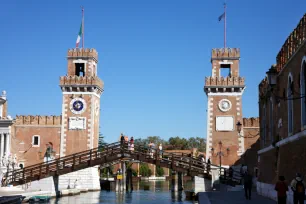
Believed to have been built during the reign of Ordelafo Faliero, the 34th Doge of Venice, who waged war with the Hungarians during his reign, Venice’s arsenal had its beginning as a state ship yard that maintained privately-built naval ships.
In 1320, the Nuovo Arsenale was built, provided much more space than the original Byzantine-style structure. With the addition of the Nuovo Arsenale, the state had a place to build and maintain navy and merchant ships, all in one location.
Mass Production
Venice’s Arsenale, which covers 32 hectares, quickly became known for its unique shipbuilding techniques. Here, workers developed the frame-first system of building ships (as compared to hull-first) and they employed production line techniques that were not seen again until several centuries later during the Industrial Revolution. By the early sixteenth century, when the yard was at its busiest, it is believed that about 16,000 employees – known as arsenalotti – worked on the Arsenale’s production lines, and the facility was long at the center of the Venetian economy. The efficient production techniques made it possible for the arsenalotti to build a galley in less than 24 hours!
As early as the fourteenth century, firearms were being built at the Arsenale, including bombards, and at a later date, small arms like crossbows and then guns were made there.
Around 1500, another section of the arsenal was added – the Novissimo Arsenale – which housed an assembly line for the construction of hulls.
The Arsenale was also responsible for the development of the galleons, enormous sailing ships with oars, sporting guns mounted on wheeled chariots. They were known to be “floating fortresses” though their size made them slow and difficult to maneuver. They were used in a few major naval battles.
Architecture
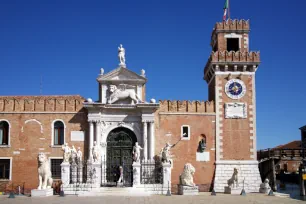
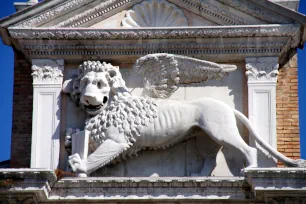
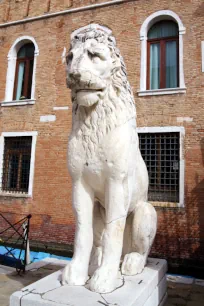
The most stunning architectural feature of the Arsenale is the Porta Magna – or main gate – which was added to the facility in 1460. This was the first Classical Revival structure to be built in the city of Venice and set the tone for many other buildings. It is thought to have been designed by Antonio Gambello from a design by Jacopo Bellini. Near the ornate entrance, you’ll find two lions statues taken from Piraeus in Greece, added more than two centuries after construction of the gateway was complete.
Later Years
During the rule of Napoleon, parts of the gateway and other sections of the arsenal were destroyed. It was later rebuilt, but after 1900, most shipbuilding was moved to private yards. Further destruction of the yard occurred during World War II.
Today, the Arsenale is mostly used by the Italian army and is not accessible to the public except for some parts that open up for exhibitions during the Biennale.
- Next: Lido
- More Sights & Attractions in Venice