

The State Hermitage Museum is one of the largest and oldest museums in the world and an absolute must-see for any visitor to St. Petersburg. The museum was founded in 1764 by Catherine the Great, empress of Russia, and opened to the public in 1852.
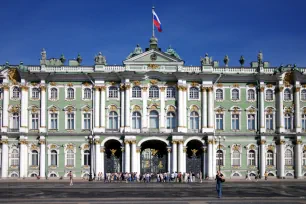
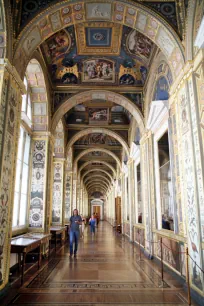
Not only does the Hermitage boast one of the world’s greatest art collections, the museum is also worth a visit for its sumptuous interior. The Winter Palace in particular is magnificent, with its marvelous Jordan Staircase and the dazzling splendor of the many state rooms.
Catherine’s Art Collection
The collection of Catherine the Great began with the purchase of more than two hundred paintings from Berlin art merchant Johann Ernst Gotzkowsky. This collection consisted of a plethora of impressive works by artists such as Rembrandt, Rubens, van Dyck, Raphael, Holbein, Titian, and several others. Historians say that during her lifetime, Catherine the Great acquired 4,000 paintings by the Old Masters, 38,000 books, 10,000 engraved gems, 10,000 drawings, 16,000 coins and medals and a natural history collection filling two galleries. By amassing this large collection, Catherine the Great aimed to enhance the international reputation of the Russian imperial court. At the same time, it was a display of power and wealth, sending an important political symbol to rival empires in Europe.
As the years went on, the collection continued to grow, added to by other tsars and by donations made by individuals. Some works were purchased from the Papal Government and others were acquired when several palaces of the Russian Tsars and a number of private mansions were being “nationalized” and their art works redistributed among several Soviet state museums.
The Hermitage Buildings
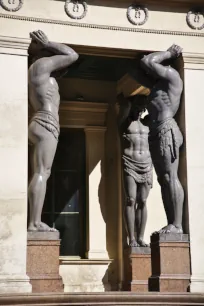
Extensions were continuously built to Catherine’s Winter Palace in order to accommodate her growing collection of works of art. Initially the collection was housed in the Winter Palace, but in 1771-1787 Catherine had the Small Hermitage built to showcase her collection. Soon, the Great Hermitage (1771-1787) was added to the east of the Small Hermitage and finally the New Hermitage was built in 1839-1851. In 1852, the New and Great Hermitage were opened to the public by tsar Nicholas I. After the Russian Revolution in 1917 the Winter Palace was added to the Hermitage Museum. After the Second World War, the museum has continued to expand, adding not only to its collection but also adding more buildings to the museum complex.
The Museum’s Collection
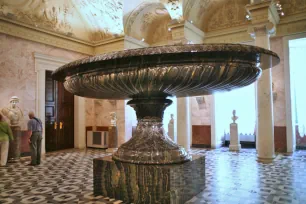
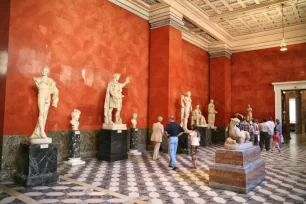
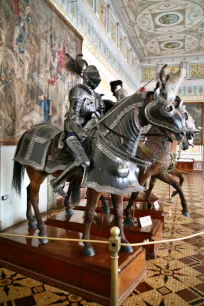
The permanent collection at The Hermitage includes about three million works of art that span the centuries, from paleolithic to contemporary. The museum is so large that it is impossible to visit all the galleries in one visit, but tickets for multiple days are available.
The museum’s galleries cover Prehistoric Art, Antiquity, Ancient Egypt, Western European Art – with a large collection of Italian, Flemish, Dutch, Spanish and French paintings -, a numismatic collection, Oriental Art and Russian Art.
Highlights of the Hermitage collection include a golden Scythian Stag from the seventh century BC. The museum also has hundreds of artifacts from Peter the Great, such as a sundial. Also, don’t miss the Kolyvan Vase, an enormous nineteen-tonnes-weighing vase from the nineteenth century known as the Tsarina of Vases. Very popular with tourists is the outstanding display of impressionist art from artists such as Monet and Renoir.
Highlights from the antiquity include the Tauride Venus (a second-century Greek statue) and the Gonzaga Cameo (a Hellenistic engraved gem). The collection of paintings includes works from Rubens, van Dyck, Rembrandt, Raphael, Carravagio and Leonardo da Vinci.
Detailed information on many more exhibits and artifacts can be found at the museum’s informative website.