


Drottningholm Palace, the official residence of the Swedish royal family, was built in the seventeenth century as a Baroque summer palace. It is one of the most magnificent palaces in Northern Europe, famous for its unique Court Theater and Chinese pavilions.
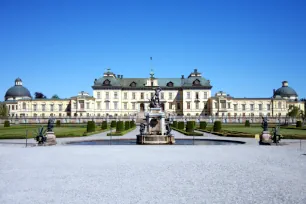
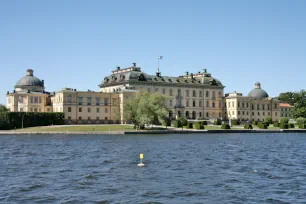
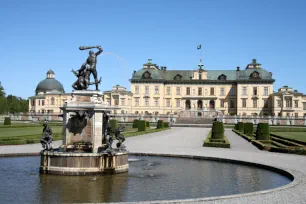
The palace stands on the island of Lovön on the banks of Lake Mälaren. A boat trip brings visitors in about fifty minutes from Stadshuset in Stockholm’s city center to the royal domain of Drottningholm.
Construction
In the sixteenth century, Catherine the Jagiellonian, wife of King John III, had chosen the island of Lovön as the site of a summer palace. This led to the name Drottningholm, Swedish for Queen’s islet.
The palace, completed in 1580, was designed by the Flemish architect Willem Boy in Renaissance style. In 1661 a fire destroyed the palace and the following year queen consort Hedwig Eleonora, widow of King Charles X Gustav, commissioned architect Nicodemus Tessin the Elder with the construction of a new palace. Tessin based his designs on the prevailing Baroque style of contemporary French and Italian palaces. After his death in 1681 the project was completed by his son Nicodemus Tessin the Younger.
Interior
Most of the interior decorations were designed in a Baroque style. When Hedwig Eleonora died in 1715 many of the rooms were not finished. After queen consort Louisa Ulrika became owner of the palace in 1751 she hired accomplished architects such as Carl Hårleman and Jean Eric Rehn to complete and remodel the interiors.
Most impressive is the Great Staircase which dominates the center of the palace. Large statues of the nine muses are placed on the balustrade of the staircase, which was designed by Tessin the Elder. The walls of the stair hall are decorated with trompe-l’oeil paintings by Johan Sylvius and the ceiling features a large painting by David Klöcker Ehrenstrahl.
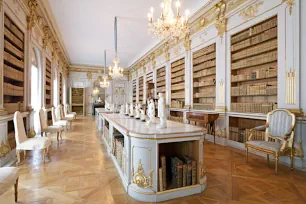
One of the most interesting rooms is the chamber of Hedwig Eleonora, designed by Tessin the Elder and completed in 1683. Also of note is the elegant royal library, decorated by Jean Eric Rehn for Queen Louisa Ulrika.
Large paintings in the galleries of King Charles X and Charles XI show scenes from historic events, respectively the crossing of the Great Belt (Denmark) in 1658 and the Battle of Lund, Sweden in 1667.
Court Theater
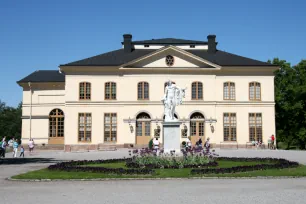
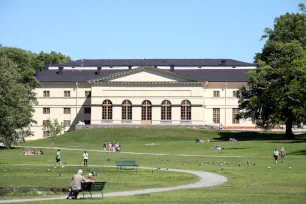
From a historical perspective, the most important building at Drottningholm is the court theater, the oldest theater building in the world with its original painted stage material and stage machinery intact. It was built in 1766 in a neoclassical style for Queen Louisa Ulrika and replaced an earlier theater that burned down in 1762. The interior was redesigned during the reign of her son, Gustav III, a keen supporter of theater and opera who even received the nickname ‘theater king’.
After the death of Gustav III in 1792, his successors preferred to stay in the Royal Palace and the Court Theater fell into disuse. In 1922 historian Agne Beijer rediscovered the theater with its unique eighteenth-century century scenes. He was the driving force behind the creation of the museum opposite the theater building. He was also responsible for the restoration and rehabilitation of the theater, which to this day is still used for theater performances. Even the eighteenth-century mechanisms to change the scenes and the machine to create thunder and wind effects are still in use.
The Park
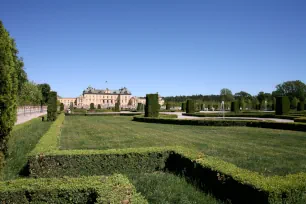
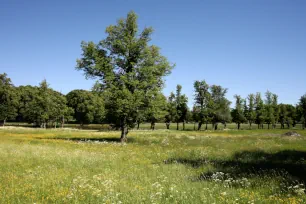
Two differently styled gardens form the park of Drottningholm Palace. The oldest garden is the Baroque garden, which was designed together with the palace. The garden is laid out in a formal French style. The statues that embellish the garden were created by Renaissance sculptor Adriaen de Vries and were taken from cities captured by the Swedish army. The large Hercules Fountain was originally made for Fredensborg Palace in Denmark; most of the other statues were booty taken from the Wallenstein Palace in Prague.
The largest part of the park is laid out in a less formal, landscaped style. Winding paths and a large, irregularly shaped pond contrast with the formal layout of the Baroque garden. It is decorated with copies of ancient statues that King Gustav brought home from his trip to Rome in 1783. The originals are in the Gustav III Antikmuseum in the Royal Palace.
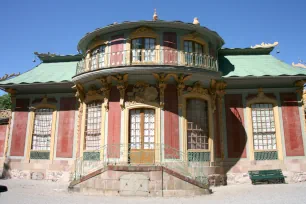
Kina Slott
The most interesting building in the gardens is the Kina Slott (Chinese Palace). In 1753, at her 33rd birthday, Queen Louisa Ulrika received a wooden Chinese pavilion as a birthday gift from her husband, king Adolf Frederick. It was secretly constructed in Stockholm and transported in pieces to Drottningholm, where it was reassembled. Ten years later the fragile wooden pavilion was replaced by the current group of four small pavilions, magnificently designed by Carl Fredrik Adelcrantz in Rococo style with elements that were considered typically Chinese. At the time Europe’s royal families were intrigued by Chinese culture and almost all royal pleasure castles had a Chinese pavilion.
More sights
There are several other interesting structures in the park. Before his death in 1792 Gustav III planned to build a number of romanticized exotic buildings in Drottningholm park. Most were never realized, but some were effectively built.
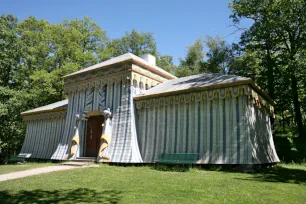
One of these is a brick neo-medieval tower, the Götiska Tornet (Gothic Tower), which stands on top of a hill in the northwest corner of the park. Another curiosity from Gustav III’s time is the Vakttältet (Turkish tent), a wooden structure built in 1781 to house the royal dragoon guards.
- Next: Stadshuset
- More Sights & Attractions in Stockholm