


Located in the southern bend of the Tiber as the river makes its way through the city of Rome, Tiber Island is a small boat-shaped isle that has been associated with healing since the era of the Roman Republic.
The Island
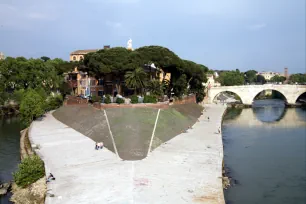
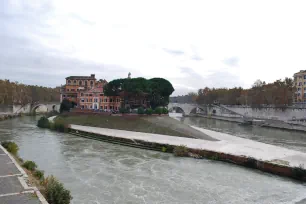
The island, which measures about 270 meters (885 feet) in length and 67 meters (220 feet) in breadth at its widest point, was important in the early Roman period since it facilitated the crossing of the river.
It is connected to the main land by two bridges that have existed since the antiquity: the Ponte Fabricio, which travels from the northeast part of the island towards the Theater of Marcellus on the left bank, and the Ponte Cestio, which connects the island to Trastevere, a neighborhood on the right bank.
The Island in the Antiquity
Creation of the Island
Legend has it that Tiber Island was formed when Roman citizens expelled the last of the Tarquin Kings (Tarquinius Superbus or Tarquin the Proud). In anger, the insurgents threw wheat sheaves they had stolen from the king into the river. Dirt and silt accumulated around the wheat and soon formed an island.
In reality, however, the island was formed long before the Etruscans ruled over Rome, probably by natural means due to the river becoming wider and its current less strong.
Island of Healing
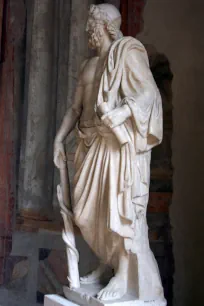
The history of the island is closely associated with Aesculapius, the Roman version of the Greek god of medicine and healing Asclepius.
In 293 BC Rome was hit by a plague and the Romans decided to send a delegation to the Greek city of Epidaurus to bring home a sacred snake, the symbolic attribute of Asclepius. When the delegation returned home, their boat ran aground near the Tiber Island, but the snake was able to escape the sinking ship and curl around a tree branch, safely reaching the island. Today, the image of a snake entwined around a staff is still widely used as a symbol for medicine.
The Romans decided that the snake had selected the island as the place for a temple dedicated to Aesculapius. Following the completion of this temple in 291 BC, other shrines were constructed on Tiber Island, including one to the river god Tiberinus and another to Bellona, a goddess of war.
Ever since the construction of the Temple of Aesculapius, the island has been associated with healing. Despite the legend telling otherwise, the island was most likely chosen as a place of healing because it was secluded from the mainland and thus the ideal place to treat people with contagious diseases. In the antiquity, people with no hope of recovery were placed in the Temple of Aesculapius and during the Middle Ages, people who suffered from the plague were exiled and buried here. The hospital of the Fatebenefratelli (do-good-brothers) that was built on the island in 1584 to treat the plague patients still exists to this day.
A Boat in the Tiber
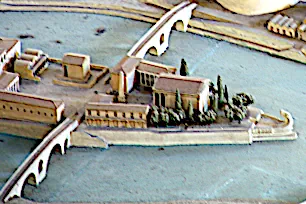
The island’s boat-like shape combined with the legend of the snake gave the Romans the idea to give the island the appearance of a boat by enclosing it with a travertine embankment wall.
The western tip resembled the stern of a ship, and the eastern tip of the island was built like the prow of a trireme. The image of a boat was further enforced when an Egyptian obelisk was placed in front of the temple of Aesculapius. The obelisk acted as the ship’s mast, and the temple resembled a steering hut.
The Island Today
Today little remains of the ancient Roman buildings, although some remnants of the travertine boat construction have survived, including a relief decoration of the snake of Aesculapius. The most important buildings on the island date from medieval times, including the aforementioned hospital, a church dedicated to saint Bartholomew and a fortified tower.
San Bartolomeo all’Isola
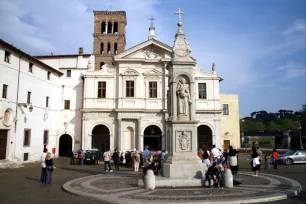
In 998 AD, Emperor Otto III ordered the construction of a church on the foundations of the Temple of Aesculapius. The church, which was built with materials taken from ancient structures, was dedicated to saint Adalbert, the former bishop of Prague and a friend of the emperor. The remains of Adalbert, who died in 997, were transferred to this church to be venerated as a relic. The emperor also brought the remains of the apostle Bartholomew to this church. Adalbert was seen by the Romans as a foreign saint, so in the twelfth century the church was rededicated to saint Bartholomew.
The church was rebuilt in the early twelfth century, but its current appearance dates from around 1624 when it was reconstructed by Martino Longhi the Younger after the church had suffered significant damage during the flood of 1557.
Only the twelfth-century campanile, in Romanesque style, was left untouched. The front facade is Baroque. Inside is a small fountain from the Ottonian era that was probably placed on top of the ancient fountain of the Temple of Aesculapius. The statues around the fountain depict Jesus, Bartholomew, Adalbert and Otto III.
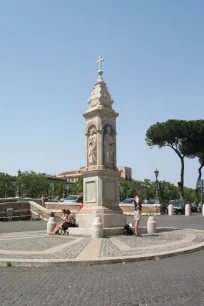
In front of the church is a small piazza with in the middle the Colonna Infame (Column of disgrace). Until the mid-nineteenth century, the people who had not fulfilled their Easter duties were shamed by having their names posted on this column. Opposite the church is the hospital of the Fatebenefratelli.
The Bridges
The two bridges that have connected the island with the rest of Rome since the antiquity are still more or less intact two thousand years after their construction.
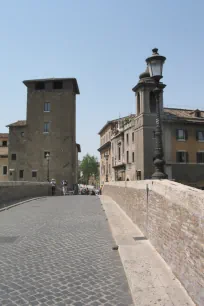
The oldest surviving bridge is the Ponte Fabricio, built in 62 BC as the Pons Fabricius to replace a wooden bridge. On the parapets of the bridge are two pillars with marble herms that show a four-faced Janus, the god of the beginning and end. That explains why the bridge is commonly known by the locals as the Pont dei Quattro Capi (bridge of the four heads). The bridge is guarded by the medieval Torre dei Caetani, a fortified tower that was built in the tenth century and later incorporated into the complex of the church of St. Bartholomew.
On the opposite side, the Ponte Cestio connects Tiber Island with the Trastevere neighborhood. This bridge was built in 42 BC as the Pons Cestius. Only the central arch is still original.
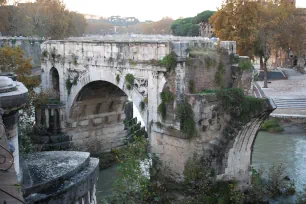
From the two bridges you can see the remains of an even older bridge, the Pons Aemilius, which was first built in 179 BC. In 142 BC, it was rebuilt as the first stone bridge in Rome. The bridge was destroyed during the flood of 1598, when water rose to almost twenty meters (65 ft) above sea level. It was never repaired, and the single surviving arch is now known as Ponte Rotto (broken bridge). You can still see a beautifully sculpted relief of a dragon, the heraldic symbol of Pope Gregory XIII, that was added in the sixteenth century.