


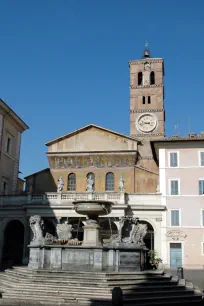
The basilica of Santa Maria in Trastevere, originally from the early third century, is one of the oldest churches in Rome. It is best known for its magnificent mosaics from the twelfth and thirteenth century that decorate the building’s interior and exterior.
The Basilica of Santa Maria in Trastevere was possibly even the first church in Rome where a public mass was held. Before the third century, masses were often held in secret in underground catacombs.
History
The basilica is said to be the first church dedicated to Mary, the mother of Jesus. Undisputedly one of the oldest churches in the city, its basic floor plan and wall structure date back to the mid-fourth century.
The first church on this site was believed to have been built in 220 by Pope Callixtus I. The site was chosen because, according to legend, a stream of pure oil flowed from the earth here in 38 BC, an event that was later described as an announcement of the coming of Christ. According to another version of the legend, the oil flowed on the day of the birth of Christ. The inscription ‘fons olei’ (Latin for oil well) on the floor near the altar marks this spot.
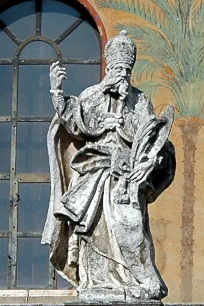
The church was restored in both the fourth and eighth centuries and in 1140, under Pope Innocent II, was re-erected on its old foundation and built in a Romanesque style, though its original basilica plan remained. Many of the materials used in the rebuilding of Santa Maria in Trastevere were from the ancient Baths of Caracalla. Some minor remodeling was done in the eighteenth century, including the addition of a portico in 1702. The portico, created by Carlo Fontana, is adorned with statues of four popes.
Mosaics
The most attractive part of this church are the many authentic mosaics that were added in the twelfth and thirteenth century.
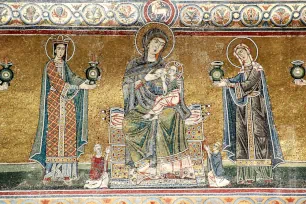
The mosaics on the facade depict Mary and ten women. The women with burning lamps were virgins, while the others were widows. The two tiny people at the foot of Mary represent the financiers of the church building.
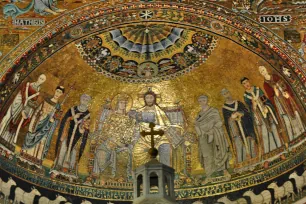
The restored mosaics on the apse vault and the triumphal arch date from about 1140. The triumphal arch mosaic depicts the four evangelists, the prophets Isaiah and Jeremiah, caged birds representing sin, seven candlesticks, and a Chi-Rho (Christogram).
The apse vault represents the coronation of Mary, who is shown seated on a throne beside Christ. They are flanked by saints and Pope Innocent II, who holds a model of the church. Below them are lambs and scenes from the life of Mary, created in 1291 by Pietro Cavallini. Cardinal Bertoldo Stefanischi, who provided the funds for the creation of the mosaic, is shown in a scene below, where he is kneeling before the figure of Mary and the apostles Peter and Paul.
More Inside
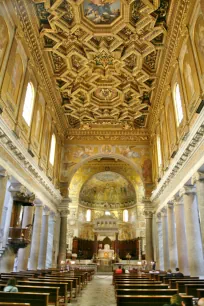
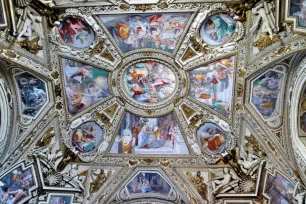
There’s much more to admire in the church than just mosaics. Look up, and you’ll see the gilded wooden ceiling, beautifully decorated with a painting of the ‘Assumption of the Virgin’, created in 1616 by Domenichino. Look down, and you’ll see a marble patterned floor, authentic Cosmatesque.
The twenty-two ancient Ionic columns that support the nave were once decorated with figures of Egyptian gods. Unfortunately, they were removed in 1865 on the order of Pope Pius IX, who considered them too pagan.
The most interesting chapel in the church is the Avila Chapel. The Baroque chapel, created in 1678-1685 by Antonio Gherardi for his patron Francesco Avila, has a dome-like ceiling adorned with angelic statues.
Piazza di Santa Maria in Trastevere
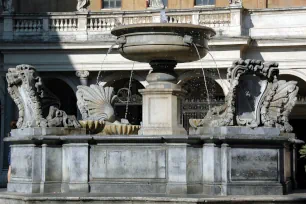
The church is located at a small square, the Piazza Santa Maria in Trastevere. The square is at the heart of Trastevere, a neighborhood on the west bank of the Tiber, just south of the Vatican.
In front of the church, at the center of the square, stands an attractive octagonal fountain. The current version dates from 1692 and was created by Carlo Fontana. It replaced an older fountain that was probably installed here as early as in the eighth century by Pope Adrian I. The fountain is a popular gathering place for locals.
- Next: Gesù
- More Sights & Attractions in Rome