


The Porta Maggiore was built during the construction of one of Rome’s aqueducts in the first century AD. In the third century, the gate became part of the city walls. Right beside the gate is the famous Baker’s Tomb.
Its Construction
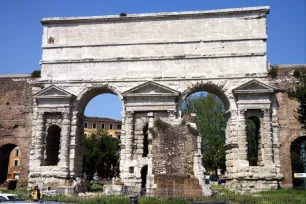
First known as Porta Praenestina, the gate now known as Porta Maggiore was built in 52 AD by order of Emperor Claudius. It was created as a double archway and supported two aqueducts that converged here – the Aqua Claudia and the Anio Novus. The youngest of the two aqueducts, the Aqua Claudia, was built on top of the pre-existing Anio Novus.
Two ancient roads ran through the archways: the Via Praenestina, which was the eastern road that led to the town of Palestrina (formerly Praeneste); and the Via Labicana, which traveled southeast from the city.
Architecture
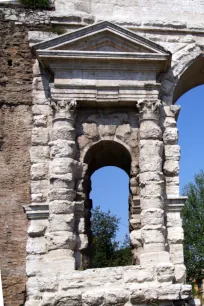
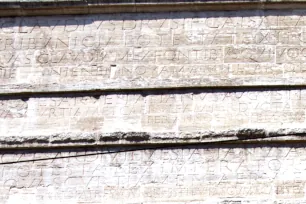
The monumental gate is fashioned from white travertine and decorated with Corinthian columns that support classical pediments. If you look closely, you can see that only the capital – the uppermost part of the column – is beautifully carved. The shaft and base consist of rough unfinished stones. This was done on purpose; at the time, it was a fashionable architectural statement. The large attic features inscriptions that offer praise to Claudius, Vespasian, and Titus, all of whom were involved in working on the great aqueducts of Rome. The inscriptions also offer some details as to the origin and length of the ancient aqueducts.
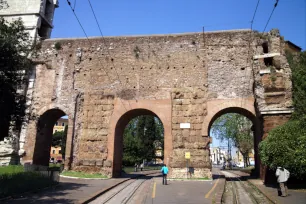
The enormous size of the gate gives one a good idea of the massive scale of the public works in the early days of Imperial Rome.
Integration into the Aurelian Wall
In 271 AD, the Emperor Aurelian made the gate a part of his Aurelian Wall. Experts refer to this as an early example of “architectural recycling”.
Honorius added to the walls in the fifth century, and at this particular site, a guardhouse was built. Visitors can still view a portion of this later addition, though the upper portion of the guardhouse has been moved to the left side of the Porta Maggiore.
It wasn’t until later that the gate actually became known as Porta Maggiore (Great Gate), possibly designated as such because it is the most impressive of the original gates of the Aurelian Wall. Another possible explanation for the name is that one of the roads that runs through the gate leads to the Basilica di Santa Maria Maggiore, the largest and most important church dedicated to Mary.
The Gate Today
Today, Porta Maggiore remains a historic site but the square on which it is located – Piazza di Porta Maggiore – is also a hub of transportation for the city of Rome. Buses and trams stop here, and the gate is surrounded by heavy trafficked roads.
The Baker’s Tomb
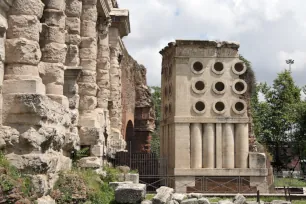
One of the most interesting tombs in Rome is located just outside the Porta Maggiore. The Baker’s Tomb, erected in the first century BC by a wealthy baker named Marcus Virgilius Eurysaces, pays tribute to the baking profession as it is built in the shape of a large oven. Look for reliefs that depict grinding, baking, and other processes that were part of the trade.
Eurysaces was a former slave who had saved money to buy his freedom and start a bakery. He employed several slaves who worked for him. His tomb, built for himself and his wife Atistia, was erected just outside the city borders as Roman custom forbid cemeteries inside the city. The richest people built elaborate tombs close to the city borders.