


Piazza Farnese is a square in the heart of medieval Rome. The square is defined by Rome’s largest Renaissance palace, the Palazzo Farnese, built in the sixteenth century for cardinal Alessandro Farnese.
The Piazza
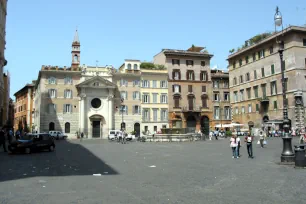
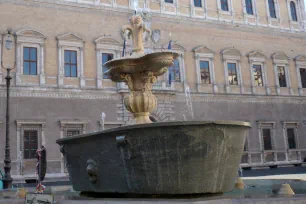
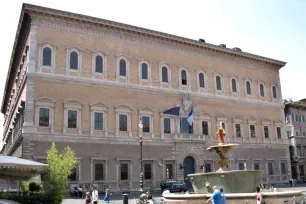
The piazza is a beautiful, typical Roman square. It is situated just an alley away from the more hectic Campo de’ Fiori. In the past, both squares combined to form one large open space.
The two fountains at the center of the square were created from granite bathtubs taken from the ancient Baths of Caracalla. Each fountain is crowned with a stone sculpted iris, the symbol of the Farnese family who were responsible for the Farnese Palace that gives the square its name.
Palazzo Farnese
The piazza is dominated by the Palazzo Farnese, a Late Renaissance palace commissioned by cardinal Allessandro Farnese, who would later become pope Paul III.
Construction started in 1514 after a design by Antonio da Sangallo the Younger. When he died in 1546 Michelangelo took over the project and added several new elements to the design such as the three-meter-long cornice. Michelangelo also started implementing a plan to connect the palace with Villa Farnesina across the river, also owned by the Farnese family. It was never completed, and the only section that was built is the elegant bridge across Giulia Street.
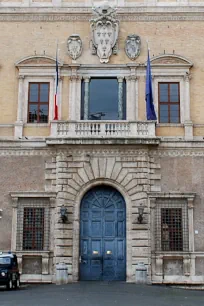
After Michelangelo died in 1564 the Farnese Palace was finished by Giacomo della Porta who worked on the building until 1589.
Much of the structure was built with materials taken from the Baths of Caracalla and the Colosseum. Many of the Colosseum‘s outer arches were destroyed in the process.
After the Farnese line died out in the eighteenth century, the palace fell into the hands of the Bourbons. In 1874 the French Embassy moved into the palace. Until 2012 this meant the palace was closed to the public, but after a temporary exhibit proved enormously popular, the palace decided to organize guided tours.
Chiesa di Santa Brigida
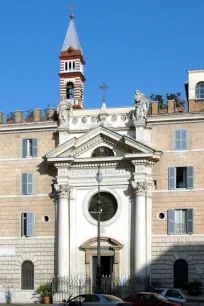
To the right of the Farnese Palace is a small Swedish church dedicated to Saint Bridget of Sweden, who travelled to Rome in 1350 where she started a new order.
In 1354 Bridget moved to a house on the Farnese square, where she lived until her death in 1373. The house was later converted into a church dedicated to the Saint. The current Baroque facade dates from the seventeenth century.