


Piazza del Popolo is a harmonious oval square situated near the Borghese Park. Three churches border the square, but the eye-catcher is an ancient obelisk from Heliopolis, Egypt.
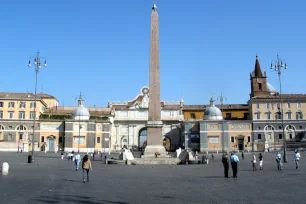
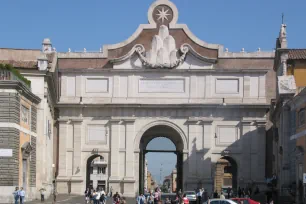
On the north side, the square is dominated by the Porta del Popolo, which leads to the Via Flaminia. The Via Flaminia was built in 220 BC to connect Rome with the Adriatic coast and was one of the most important roads leading to Rome. Hence, many travellers entered the city from the Via Flaminia, passing through Piazza del Popolo.
Impressing the Pilgrims
In 1562 pope Pius IV commissioned architect Nanni di Baccio Bigio to construct a large gate, the Porta Flaminia, to impress the pilgrims who entered the city via the Via Flaminia. In 1655, on the occasion of Queen Christina of Sweden’s arrival in Rome, the inside of the gate was decorated by Bernini on pope Alexander VII’s request. The gate was later renamed Porta del Popolo.
Obelisk
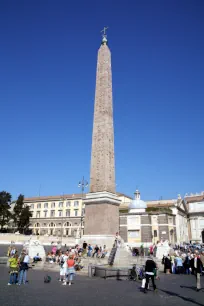
In 1589, pope Sixtus V had the Egyptian obelisk of Sety I moved from Circus Maximus to the center of the square. The 23.2-meter-tall (73 ft.) obelisk was originally built around 1300 BC and stood at the Sun Temple in Heliopolis. In 10 BC, the Roman Emperor Augustus had the obelisk transported all the way to Rome. The obelisk was erected at the Circus Maximus to commemorate the conquest of Egypt.
In 1815 to 1816 Giuseppe Valadier redesigned the Piazza del Popolo by adding walls around the square, giving the piazza its current oval shape. He also added the central fountain and the four Egyptian lions around the obelisk. The walls are adorned with statues of sphinxes, created by the Italian sculptor Giovanni Ceccarini.
Fountains
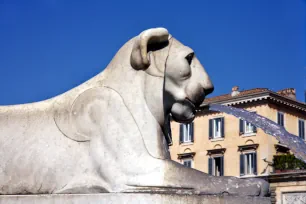
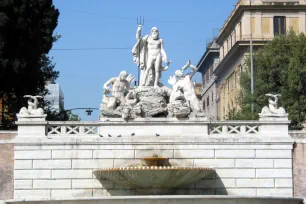
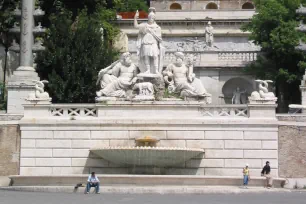
It is thought that Valadier also designed two fountains that were integrated into the walls around the Piazza del Popolo. Ceccarini was again responsible for the creation of the marble sculpture groups, and he worked on the statues from 1818 to 1824.
The fountain on the western end of the square is the Fontana del Nettuno (Neptune Fountain) and shows Neptune accompanied by Tritons.
The fountain opposite the Neptune Fountain, at the foot of the Pincio Gardens, is known as the Fontana della dea di Roma (Fountain of the goddess of Rome). The central figure is the goddess Rome, flanked by allegorical figures representing the rivers Tiber and Aniene. Below the goddess is a statue of a she-wolf, suckling Remus and Romulus, founder of Rome.
Symmetrical Churches
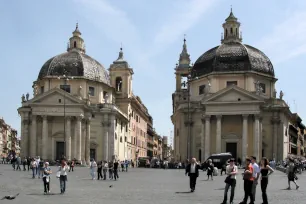
At the southern end of the square are two symmetrical churches on either side of the Via del Corso, a street leading straight through the heart of Rome to Piazza Venezia. The churches, the Santa Maria dei Miracoli and the Santa Maria in Montesanto were commissioned by pope Alexander VII in 1658. They were both designed by Carlo Rainaldi.
The churches are not identical, since the surface area of the plot provided for the Santa Maria in Montesanto (on the left) was smaller. In order to give the impression of symmetry, Rainaldi created an oval dome for this church and a circular dome for the Santa Maria dei Miracoli.
Santa Maria del Popolo
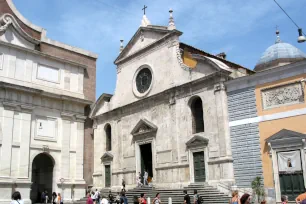
There’s yet another church at the Piazza del Popolo, the Santa Maria del Popolo. It is located right near the Porta del Popolo where it was built in 1477 at the site of an eleventh-century chapel.
The church contains many impressive works of art, including Rome’s oldest stained-glass windows and two famous paintings by Caravaggio. The Chigi chapel – created by Raphael – and the Della Rovere chapel – embellished with fifteenth-century frescoes – are particularly noteworthy.