


Built more than 1800 years ago, the magnificent Pantheon still stands as a reminder of the great Roman Empire. The name Pantheon refers to the building’s original function as a temple for all the gods.
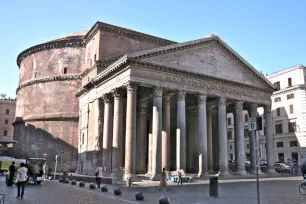
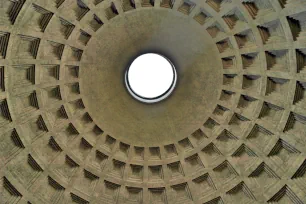
With its thick brick walls and large marble columns, the Pantheon makes an immediate impression on visitors. But the most remarkable part of the building is the more than forty-three meter high dome. It was the largest dome in the world until 1436 when the Florence Cathedral was constructed.
At the top of the dome is a large opening, the oculus, which was the only source of light. The front portico has three rows of columns; the first row has eight columns, while the other two have four each. A huge bronze door gives access to the cylindrical building. Its diameter equals the interior height of 43.3 meters.
Earlier Temples
Before the current Pantheon was built, two other buildings occupied the same site. The first one, a traditional rectilinear, T-shaped structure, was built in 27-25 BC by general Marcus Agrippa, son-in-law of Emperor Augustus. The temple was dedicated to the gods Mars and Venus. It burned down in 80 AD, but was rebuilt by Emperor Domitian. In 110 AD, the building was struck by lightning and burned down again.
In 118 AD Emperor Hadrian ordered for the Pantheon to be rebuilt again but this time in a totally different, circular design. It was completed seven years later, in 125 AD. This latest version of the Pantheon would stand the test of time much better: it is still standing almost intact today.
The Building
The Portico
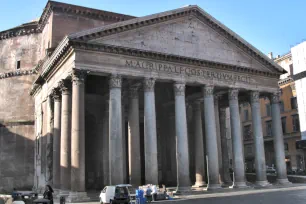
The portico’s sixteen huge, sixty tons weighing columns were quarried in Egypt. They were transported all the way to Rome using barges and vessels. The columns, each one with a diameter of 1.5 meters, support a pediment with an inscription attributing the Pantheon to Marcus Agrippa even though it was built by Hadrian. In Ancient Times, the pediment was decorated with statuary in gilt bronze. These were removed on the orders of Pope Urban VIII to create the baldachin in the St. Peter’s Basilica.
The Dome
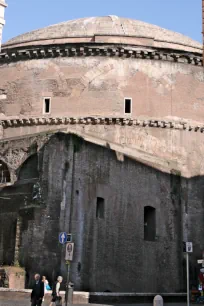
The most important problem the Romans faced during the construction of the Pantheon was the massive weight of the large dome.
In order to support it without proper reinforcement, as is common today, the thickness of the walls was gradually decreased as the height increased. The Romans also used a different type of concrete for the dome than for the walls. At the base, very thick (6 m. / 20 ft.) walls were constructed. At the top of the dome, a lighter type of concrete was used and near the oculus it is only 7.5 feet or 2.3 meters thick. The use of coffers in the ceiling and the opening at the top also helped reduce the weight of the dome.
The Interior
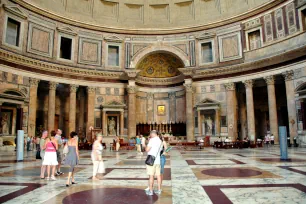
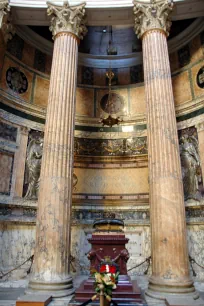
Originally a temple for all pagan gods, the temple was converted into a church in 609. The Pantheon now contains several altars and shrines, as well as the tombs of the famous Renaissance artist Raphael (†1520) and that of two kings: King Victor Emmanuel II (†1878) and his son King Umberto I (†1900). The high altar dates from the early eighteenth century and features a seventh-century Byzantine icon of the Virgin and Child.
The ecclesiastical interior design contrast with the temple’s structural design, but the marble floor – which features a design consisting of a series of geometric patterns – is still the ancient Roman original.
Piazza della Rotonda
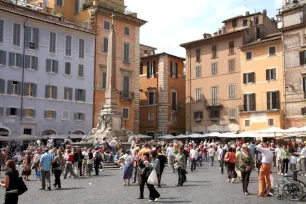
The Pantheon borders Piazza della Rotonda, a rectangular square with at its center an ornate fountain, that was first installed here in the sixteenth century. Little remains of the original fountain, since in 1711 Pope Clement XI asked the Baroque sculptor and architect Filippo Barigioni to integrate an ancient, six-meter-tall obelisk into the fountain. This resulted in the elaborate design we see today.
The constantly crowded square is situated in the historic center of Rome, not far from the Piazza Navona, one of Rome’s most beautiful squares.
- Next: Vatican Museums
- More Rome Ancient Sights
- More Sights & Attractions in Rome