


In 28 BC, Augustus, the first Roman emperor, built a monumental family tomb at the Campus Martius, an area north of the Capitoline Hill. Today, only ruins remain of what was once one of the most venerable buildings of the Roman Empire.
The Monument
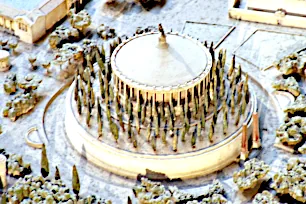
The circular monument had a diameter of almost 88 meters (290 ft.) and was about 44 meters high. It consisted of four layered concentric circles covered with soil. The outer circle’s wall was 5 meters (16 ft.) thick. A corridor led to the burial chamber in the inner circle, which had 4.3-meter-thick walls. Between those two walls were a number of enclosed chambers.
The bottom layer was planted with Cypress trees. On the top layer at the central part of the monument, the Romans built a tumulus topped with a large bronze statue of Augustus.
The entrance was marked by a bronze door flanked by two Egyptian obelisks (now located at the Piazza del Quirinale and the Piazza dell’Esquilino – near the Basilica of St. Mary Major). The mausoleum’s outer walls were covered with white marble.
The Ashes
The ashes of the cremated emperors and family members buried in the mausoleum were put in golden urns, placed in niches inside the burial chamber at the center of the monument. The ashes remained untouched until the fifth century when barbarians broke through the bronze door, stole the urns and threw out the ashes.
People Buried at the Mausoleum
The first person buried in the mausoleum was Marcellus, Augustus’s nephew, in 23 BC.
Many emperors were buried here, among them Augustus himself, Tiberius, Caligula and Claudius. The last person to be buried in the mausoleum was Emperor Nerva in 98 AD. The next emperor, Trajan, was buried at the base of the Column of Trajan and his successor, Hadrian, built a new mausoleum, now the Castel Sant’Angelo.
Today’s Ruins
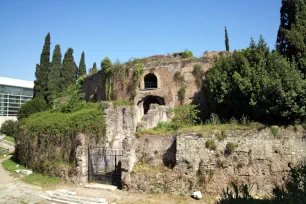
Today, only the brick core is left of what was once one of the most sacred of all monuments in Rome. The ruins are even overgrown with plants. This is the result of several sackings, neglect and its use in the Middle Ages as a fortress by the Colonna family. It was later even used as a vineyard, garden and theater. Archaeological excavation only started in 1936, largely led by Mussolini, who identified himself with Augustus.