


This Baroque structure, a model for the architecture of the counter-reformation, is the world’s oldest Jesuit church. The church’s interior is designed to impress with plenty of stucco, sculpture, marble and magnificent frescoes.
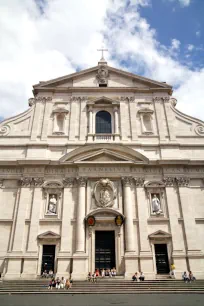
Officially known as «The Church of the Most Holy Name of Jesus», the church most often referred to as simply «Gesù» was the first church built by the Jesuits, a religious order founded by Ignatius of Loyola. The order was recognized by Pope Paul III in 1540 and was one of the driving forces of the counter-reformation.
Construction
Funds for the construction of the church were provided by the duke of Gandia, one of the early Jesuit followers. Michelangelo designed the first plans for the church and construction started in 1554, but was soon halted due to papal opposition.
After the death of Loyola a new design was created by Giacomo Barozzi da Vignola, the favorite architect of cardinal Alessandro Farnese, a grandson of Pope Paul III. Construction resumed in 1568. After Vignola’s death in 1573 the Gesù church was completed by the Jesuits Giovanni Tristano and Giovanni de Rosis. The church was consecrated in 1584. Its design became the model for many other Jesuit churches built around the world.
Architecture
The floor plan, in the form of a Latin cross, measures 76 meters (250 feet) long and 34 meters (110 feet) wide, with a 25 meter-wide nave (82 ft).
The architect’s creation closely followed the rules outlined by the Council of Trent, which stated that there would be no narthex for “lingering” and a single nave with no aisles so that the congregation would all be focused on the high altar. Instead of aisles, there are a series of identical interconnecting chapels.
The original design for the facade created by Vignola was never realized. Instead, a new design was created by Giacomo della Porta in collaboration with Tristano and de Rosis. The statues in the niches were added later, in the nineteenth century. The facade features mostly Baroque elements mixed with Renaissance influences, a style that became known as the Jesuit style.
Interior
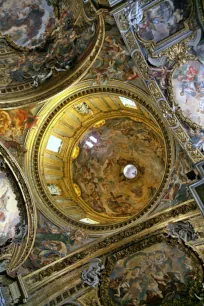
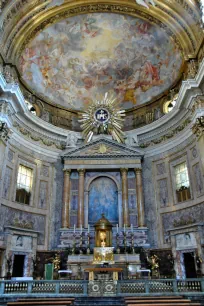
The interior, with a central dome, extended nave and barrel vaults, is finished in white stucco and decorated with frescoes and marble sculptures. The lavish interior is clearly meant to impress visitors.
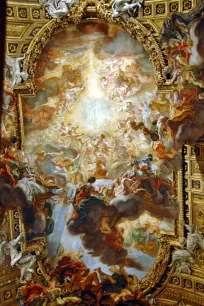
The most eye-catching feature is the frescoed ceiling by artist Giovanni Battista Gaulli (aka Baciccio), entitled «Triumph of the Name of Jesus». Baciccio also painted the apse and dome.
The high altar was created in the nineteenth century by Antonio Sarti and replaced the original altar created by Giacomo della Porta. Each of the chapels is quite unique. In the chapel dedicated to St. Andrew, visitors can view frescoes by Agostino Ciampelli. The ceiling fresco is entitled «The Glory of the Virgin» and the altarpiece represents the martyrdom of St. Andrew.
In the chapel called Cappella della Passione (Chapel of the Passion), guests can view frescoes and paintings depicting scenes from the Passion of Jesus by artists including Giuseppi Valeriani and Gaspare Celio. Several past Jesuit leaders are also memorialized inside this chapel.
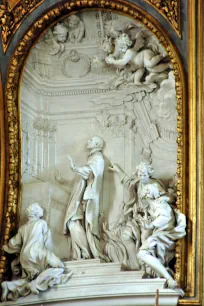
Other chapels are dedicated to St. Francis Xavier, the apostles, the Nativity, and the Trinity. The largest and grandest of all the chapels is the one dedicated to the founder of the Jesuits, St. Ignatius of Loyola. Designed by Andrea Pozzo in 1696, it houses the saint’s tomb. A huge silver statue of St. Ignatius, crafted by Pierre Legros, is flanked by four lapis lazuli-veneered columns. The statue is a replica; the original was melted on the order of Pope Pius VI as war guilt for Napoleon.
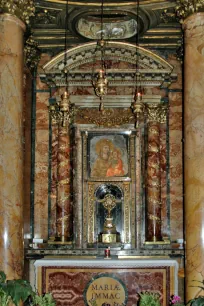
Also of note is the Chapel of the Madonna della Strada, decorated with scenes from the life of the Virgin, painted by G.P. Pozzi and Giuseppe Valeriani. At its center is a venerated icon of the Madonna della Strada, the patroness of the Jesuits.