


Established in the late fifteenth century, Rome’s Capitoline Museums provide an impressive look at Roman art and archaeology. The museums are housed in two palaces designed by Michelangelo.
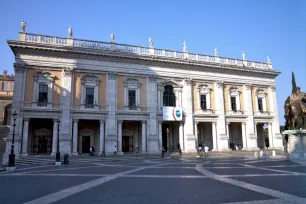
Situated at the Piazza del Campidoglio on top of the Capitoline Hill – thus their name – the Capitoline Museums are a must-see for visitors who are entranced by ancient Roman history and welcome the chance to view some of the city’s best treasures. The museums are housed in two palaces facing each other: the Palazzo dei Conservatori (Conservators Palace) and the Palazzo Nuovo (New Palace). They were designed by Michelangelo Buonarroti in 1536 and completed over a period of more than one hundred years. The museums are connected via an underground tunnel, which also leads to the ancient Tabularium.
The Museums’ Origins
The origins of the museums can be traced a little further back – to 1471 – when pope Sixtus IV donated a collection of ancient bronzes to the city, which placed them near the Conservators Palace for public viewing.
Later they were moved inside the building together with other archaeological finds. In around 1650 the New Palace was completed, and the collections were spread over the two buildings. The museums are now owned by the city.
Conservators Palace (Palazzo dei Conservatori)
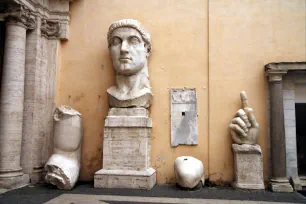
Starting in the courtyard of the Conservators Palace, you can see fragments of the colossal statue of Emperor Constantine that once stood in the Basilica of Maxentius (or Constantine) on the Roman Forum. Only the marble parts of the fourth-century statue have been preserved. The rest of the statue – the torso, legs and arms – was made of bronze and wood and covered with cloth. Inside, the most famous statues can be found in the Conservators Apartments, nine attractive rooms that are decorated with frescoes, paintings and tapestry. These rooms were used as offices by the conservatori (magistrates). The largest is the Hall of the Orazi e Curiazi, which is decorated with frescoes depicting scenes from Rome’s history and which also contains Bernini’s statue of pope Urban VIII.
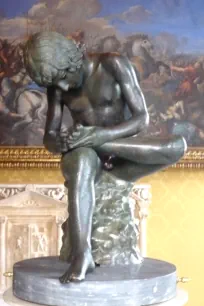
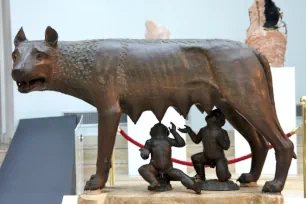
One of the most famous statues in the Conservators Palace is the Spinario, a statue of a boy who tries to remove a thorn from his foot. It is a bronze copy from the first century BC after a Greek original from the fifth century BC. Another iconic statue is the Etruscan She-Wolf from the fifth century BC. Remus and Romulus, the mythical founders of the city, were added much later, in the fifteenth century.
After the Conservators Apartments, the collection continues in the Palazzo dei Conservatori Museum, which boasts more ancient statues. In the Halls of the Horti Lamiani is a bust of Commodus as Herculus from the late second century AD, which was discovered in 1874 in the Lamiani Gardens.
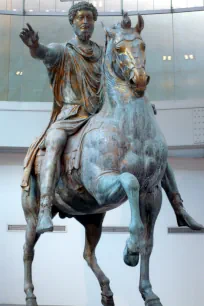
Further on is the Marcus Aurelius Exedra, a modern glass extension of the museum built to house the equestrian statue of Marcus Aurelius. This ancient bronze statue used to stand at the center of the Campidoglio Square, but in 1981 it was replaced by a replica. The original was moved here to shield it from the elements.
The second floor of the museum is home to the picture gallery, which holds paintings from the fourteenth to the late seventeenth century. It contains works by fine masters such as Velázquez, Titian, Rubens, van Dyck, Tintoretto and Caravaggio. Among the highlights are the Fortune-teller by Caravaggio; a young John the Baptist, also by Caravaggio; the Portrait of a Crossbowman by Lorenzo Lotto and a portrait of two painters by Anthony van Dyck.
Finally, also on the second floor of the Conservators Palace, one finds a collection of porcelain and on the other side of the building, in the Palazzo Caffarelli, there is a coin cabinet with a collection of coins, medals and jewelry owned by the city of Rome.
New Palace (Palazzo Nuovo)
The New Palace was built in the mid-seventeenth century after a design by Michelangelo to complement the Conservators Palace, and opened to the public in 1734. It offers two floors of ancient Roman artifacts including statues, sarcophagi, busts, and intricate mosaics.
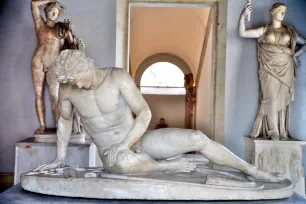
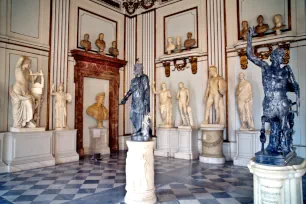
Several notable sculptures can also be viewed in this section of the Capitoline Museums. The most famous is probably the ‘Dying Gaul‘ (or Dying Galatian), a statue that was discovered in the gardens of Caesar together with the statue of the Galata Suicide that is now in the Altemps Palace.
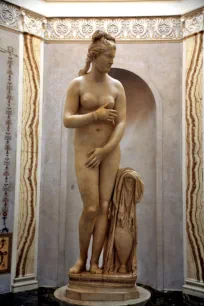
Another notable statue in the New Palace is the extremely well-preserved Capitoline Venus, a Roman statue derived from a Greek original. And in the middle of the Hall of the Faun is a red marble statue of a drunken faun from the second century AD.
In the Great Hall, the largest room of the New Palace, are several more interesting statues, including two statues of centaurs found in the Villa of Hadrian in Tivoli. They are known as the Old Centaur and the Young Centaur. From the same villa is the Doves’ Mosaic, a beautiful mosaic from the second century AD. A large collection of over one hundred busts from the antiquity are displayed in the Hall of the Emperors and the Hall of the Philosophers.
Epigraphic Gallery and Tabularium
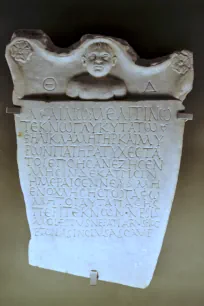
In addition to the two main museum buildings, there is the Galleria Congiunzione, which links both palazzos underground. The underground tunnel houses the Galleria Lapidaria, a collection of ancient epigraphs.
The tunnel is linked to the Tabularium, a building from the antiquity which used to house the official records of Rome. In the Middle Ages, the Palazzo Senatorio (Senators’ Palace) was built on top of the Tabularium. Some remains of the ancient temples can still be seen here. The Tabularium Gallery also offers great views over the Roman Forum.
Centrale Montemartini
A selection of the ancient sculptures of the Capitoline Museums is now on display in the Centrale Montemartini, a former thermoelectric power station. In 1997 the Capitoline Museums complex was being renovated, so a selection of the sculptures were temporarily displayed in the power station. The exhibition was such a success that it was decided to keep the sculptures there permanently in a new museum, the Museo Centrale Montemartini.