


The name «Campo de’ Fiori» translates into «field of flowers», and the reason for that name is that this square was once a meadow. Today, Campo de’ Fiori is best known for its daily, lively market. A statue reminds us of the square’s gruesome history as a site of public executions.
History of the Square
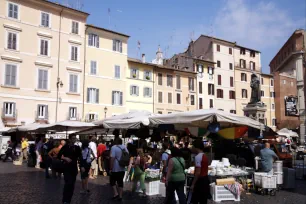
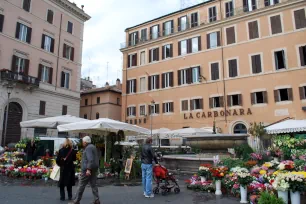
The square known as Campo de’ Fiori sits on the unused space that was between Pompey’s Theater and the Tiber River in Ancient Rome. Because the river was prone to flooding, the area was undeveloped for many centuries. It wasn’t until the first centuries of our chronology that it became populated.
The piazza as we see today only began to take shape during the fifteenth century. The first building that appeared there was a church known as Santa Brigida a Campo de’ Fiori, which now faces Piazza Farnese, part of the old Campo de’ Fiori. In 1456, as part of a city improvement project, the area was paved. The project was initiated because several important buildings had already been constructed in the area, including the Orsini Palace and the Palazzo della Cancelleria.
The architecture was never really formalized for Campo de’ Fiori as it was for many public squares in Rome, so there isn’t a lot of continuity in the buildings that surround the square. Instead, the square has always remained a focus for commercial and street culture, though the area around Campo de’ Fiori was at one time quite a wealthy neighborhood.
Giordano Bruno Statue
For centuries, public executions took place at Campo de’ Fiori. Criminals and so-called heretics were often tortured and executed here. Many were burned at the stake, while others were hanged; some were even thrown in kettles with boiling oil or faced even more gruesome fates.
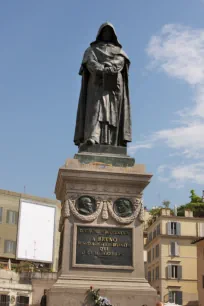
One of the more well-known figures executed on this square was the Italian philosopher Giordano Bruno, who in the year 1600 was burned at the stake by the Roman Inquisition because the ideas he spoke of were “dangerous”. The Dominican friar was one of the first to realize that stars are actually suns in the universe.
In 1887, sculptor and Freemason Ettore Ferrari designed a statue of Bruno. It was placed in the piazza, facing the Vatican, as if in defiance of all it stands for. Bruno is now considered an advocate and martyr of the right to free speech. Medallions on the pedestal show relief busts of eight other so-called ‘heretics’ and ‘free-thinkers’, including Jan Hus and John Wycliffe.
Fontana della Terrina
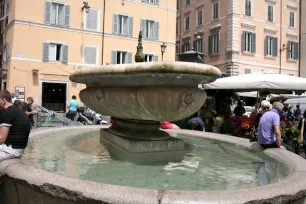
In 1590 a fountain was erected on Campo de’ Fiori to provide the neighborhood with fresh water supplied by a branch of the Aqua Virgo aqueduct. The fountain was designed by Giacomo della Porta. Due to its resemblance to a terrine, it later became known as the Fontana della Terrina.
At the end of the nineteenth century, the fountain had to make way for the monument to Giordano Bruno. In 1925, it was moved to the piazza in front of the Chiesa Nuovo where it still stands today. Around the same time, a copy of the fountain was made for the Campo de’ Fiori. The fountain, which occupies a spot on the west side of the square, is almost identical to the original except that this one does not have a lid on it (a later addition to prevent people from throwing trash into it), hence it looks more like a bowl than a terrine.
The Market
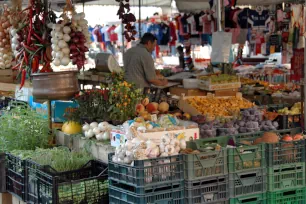
Today, the square is much more peaceful than in its heyday during the Middle Ages. It’s still a lively place, though, especially when the daily vegetable market is held here (every morning except Sundays). You can buy fresh produce at the market, as well as fish, meat, flowers and spices.
The market’s history goes back to medieval times, when it was located at the Forum Olitorium. It then moved to the foot of the Capitole Hill, and later to the Piazza Navona until it finally settled here at Campo de’ Fiori in 1869.
- Next: Janiculum
- More Sights & Attractions in Rome