


Piazza del Campidoglio is one of Rome’s most beautiful squares, designed in the sixteenth century by Michelangelo and laid out between two summits of the Capitoline Hill, the most important of Rome’s fabled seven hills.
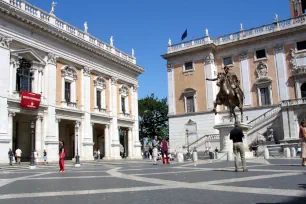
From the founding of Rome until its fall almost one thousand years later, the Capitoline Hill symbolized the epicenter of Rome’s might, and many of the city’s most important buildings stood on this hill. Later, during the Middle Ages, the site continued to play an important part in Rome’s history. The senate of Rome assembled here and even today it still has some political significance since the city hall is located here.
Michelangelo’s Design
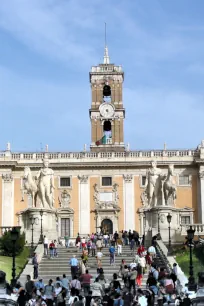
When Emperor Charles V planned a visit to Rome in 1536, the muddy Capitoline Hill was in such a derelict state that pope Paul III Farnese asked Michelangelo to design a new square, the Piazza del Campidoglio (Capitoline Square). The project also included a redesign of the existing buildings surrounding the square. Michelangelo came up with an original, trapezoidal design for the square with an intriguing oval-shaped ground pattern. He rebuilt the Palazzo Senatorio, seat of the Roman senate, and redesigned the facade of the Palazzo dei Conservatori.
Additionally, a new building, the Palazzo Nuovo, was to be constructed just opposite the Palazzo dei Conservatori. Both palazzos were positioned at a slight angle so that it changes the perspective in such a way that the square seems larger than it actually is. Finally, Michelangelo’s ambitious plans for the square also included the creation of an elegant staircase, the Cordonata.
Construction of the square started in 1546, but only the staircase at the entrance of the Palazzo Senatorio was realized when Michelangelo died in 1564. The project was finally completed in the seventeenth century according to Michelangelo’s designs.
Cordonata
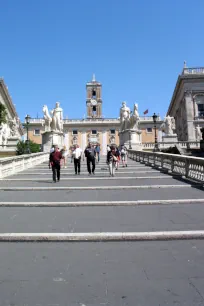
The grandiose, slow rising staircase that leads from the bottom of the Capitoline Hill to the piazza is known as the Cordonata, Italian for ‘graded ramp’. Construction of the staircase started in 1548, but work dragged on and even came to a standstill after Michelangelo’s death. It was finally completed in 1582 by Giacomo della Porta.
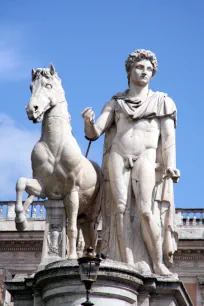
The two lions in basalt that flank the foot of the Cordonata are authentic Egyptian statues. The two large classical statues of the Dioscuri Castor and Pollux that adorn the top also date back to antiquity. They originally stood near the Temple of Castor and Pollux and were placed here in 1583. Statues on the balustrade near the Dioscuri depict Emperor Constantine and his son Constantine II.
Statue of Marcus Aurelius
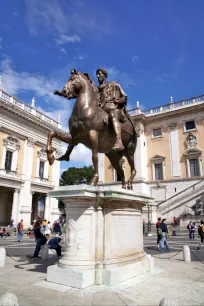
In the center of the square stands an equestrian statue of the Roman Emperor Marcus Aurelius. The statue is a replica; the original was replaced in 1981 and moved to the Capitoline Museums to protect it from the elements.
The bronze gilded statue only survived because it was thought to depict Emperor Constantine, the first Christian emperor. It wasn’t until the fifteenth century that its real identity was discovered. If it had been discovered any sooner, the statue most likely would have been melted down, like so many ancient statues of ‘pagans’.
The Palazzos
Palazzo Senatorio
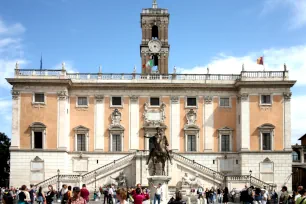
The oldest of the three buildings around Piazza del Campidoglio is the Palazzo Senatorio, the Palace of the Senators. The name is derived from its position as seat of the Senate, which it held until 1870 when the palazzo became the seat of the city of Rome.
It was originally built in the eleventh century as a fortress on top of the ancient Tabularium and rebuilt again in the thirteenth and fourteenth centuries. The current design is a slightly adapted version of the sixteenth century design by Michelangelo.
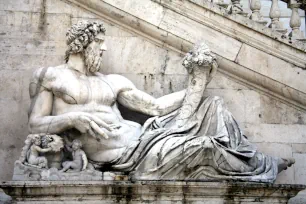
The monumental staircase in front of the Palazzo Senatorio is also a creation of Michelangelo. The statues on either side of the double staircase represent the Nile (left) and the Tiber (right). The latter originally represented the river Tigris, but it was modified (the tiger near the large allegorical statue is now a wolf). Both statues were created in the first century AD and were found in the ruins of the Baths of Constantine. The statue of the goddess Minerva in the central niche was also modified to symbolize Roma, the personification of the city of Rome.
Palazzo dei Conservatori
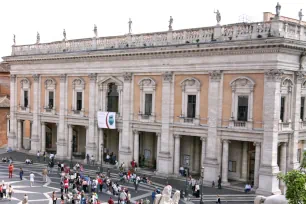
The building on the right is the Palazzo dei Conservatori, the Palace of the Conservators. It was the seat of the so-called Conservatori, magistrates who administered the city together with the senate. The palazzo was built in 1563 at the site where once stood the Temple of Jupiter Optimus Maximus, one of the most important temples in Ancient Rome.
The palazzo is now part of the Capitoline Museums, which has an important collection of art from the antiquity, including numerous statues as well as mosaics and tombstones. Some notable works are the she-wolf suckling the twins Remus and Romulus and pieces of a giant statue of Emperor Constantine II.
Palazzo Nuovo
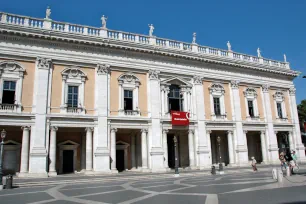
Opposite the Palazzo dei Conservatori is the Palazzo Nuovo (New Palace). The building was designed by Michelangelo as a virtual mirror image of the Palazzo dei Conservatori. It was finished by the brothers Carlo and Girolamo Rainaldi in 1654. In 1734, pope Clement XII made the art collection in the palazzo open to the public, thus creating the world’s first public museum.
Now part of the Capitoline Museum complex, the Palazzo Nuovo contains mostly classical sculpture, including the ‘Dying Gaul’, large statues of the Roman gods Minerva and Mars and the aforementioned statue of Marcus Aurelius.