


The Baths of Diocletian were the largest thermae ever built in Rome. The complex, constructed in the early third century, could accommodate an estimated three thousand people.
Parts of the bath complex have survived thanks to their incorporation into newer structures.
The Thermae
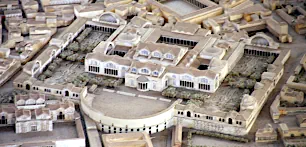
The baths were built between 298 and 306 AD by Maxentius who had the complex named Thermae Diocletiani, after Diocletian, an emperor who has been cast in a bad light by religious historians for his persecution of Christians but in fact was actually a very capable and fair ruler.
The Bathing Ritual
For Romans, bathing was a social event, and the huge bathing complexes reflected their importance in Roman society. A visit to a bath complex like that of Diocletian started in the apodyterium, where visitors stored their clothes. They then progressed to the frigidarium (the cold water), the tepidarium (warm water) and the caldarium (hot water). Some visitors went to the sudatorium (sauna) before going to the caldarium. Men and women bathed separately.
But a visit to the baths was more than just about getting clean and relaxed. People came here to socialize, discuss politics, recount daily events and gossip. It was also a fitness and leisure center: there was a swimming pool, a massage room and complexes like that of the Baths of Diocletian boasted amenities such as sporting facilities, libraries and meeting halls.
The Bathing Complex
The Baths of Diocletian measured 356 meters long and 316 meters wide (about 1200 x 1000 ft) and were the largest of the approximately nine hundred bath houses in Rome. The enclosed complex was structured similarly to the Baths of Trajan and Baths of Caracalla, with a central axis around which the actual baths were located. Water was led to a large water basin via the Aqua Iovia, a branch of the Aqua Marcia aqueduct. The water basin was situated near the current Termini train station, which derived its name from the thermae.
The Baths Today
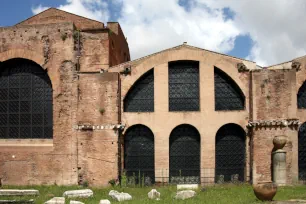
After invading Goths destroyed the aqueduct in 537 AD, the baths were soon reduced to ruins. Later the remains of the complex had to make way for the expanding city, but parts have been preserved as they were incorporated into new buildings such as the pantheonesque San Bernardo alle Terme church and the Aula Ottagona, an octagonal hall. Another church, the Santa Maria degli Angeli, also reused a section of the ancient bath complex.
Santa Maria degli Angeli e dei Martiri
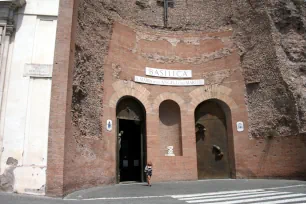
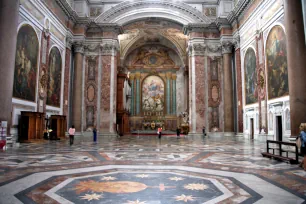
The church of Santa Maria degli Angeli is situated on the northeast edge of Piazza della Repubblica (a traffic circle formerly known as Piazza delle Terme). The church was the last structure built by Michelangelo; the renowned artist was 86 years old when construction started in 1561.
The church was constructed at the site of the former frigidarium of the Diocletian Baths and incorporates several elements of the former thermae. The vestibule occupies the former tepidarium and the imposing entrance is an exedra of the caldarium. The rest of the caldarium was demolished by Pope Sixtus V as part of his urban redevelopment plans.
Inside the church are massive granite columns that support the vaulted roof of the frigidarium. The columns have a circumference of 5.2 meters, which makes them the largest in Rome.
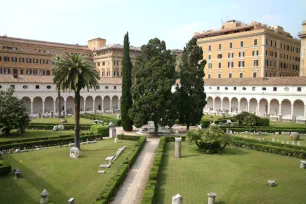
The design of the beautiful adjoining cloisters of the Carthusian monastery is also attributed to Michelangelo, even though it was only completed in 1565, one year after his death.
Museo delle Terme di Diocleziano
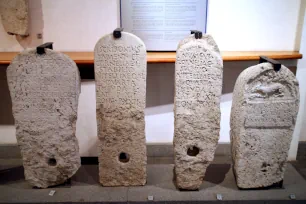
The monastery is now home to the Museo delle Terme di Diocleziano, a department of the Museo Nazionale Romano (National Roman Museum), one of the world’s most important museums of antiquity.
The museum has a large epigraphic collection which provides us a glimpse into the daily lives of people in Ancient Rome. There are more than 10,000 inscriptions and epigraphs, as well as other historic artifacts.
Another collection housed here is the Protohistoric collection of the National Roman Museum, which contains objects found in the area around Rome that date back to the eleventh to sixth centuries BC.
- Next: Hadrian's Villa
- More Rome Ancient Sights
- More Sights & Attractions in Rome