


Inadvertently unearthed during an excavation project ordered by Benito Mussolini, the fascinating Area Sacra dell’Argentina is one of the best sites to see the remains of Roman architecture from the Republican era.
Discovering the Site
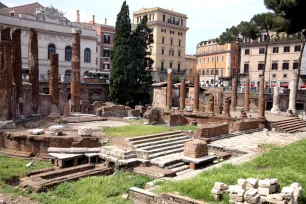
A project meant to demolish one of Rome’s old quarters resulted in one of the finest archaeological finds of the twentieth century. In 1926, during demolition work for construction of a new building, workers began to discover the remains of four distinctly different temples.
After some unsophisticated excavations in the late 1920s and more complete investigations in later years, what emerged was some of the best examples of Republican Roman architecture. For years, little was known about the site and the newly-located temples were merely named by the letters of the alphabet. Today, a bit more is known about each of the structures.
The Temples
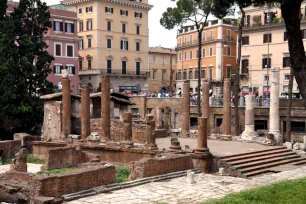
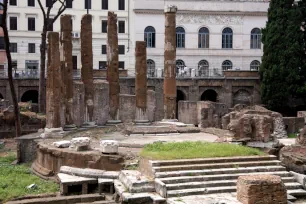
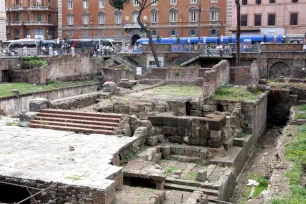
The four temples of the Area Sacra dell’Argentina date from the fourth to second centuries BC. The remains we see now are the result of renovations by Emperor Domitian. The temple complex was part of an area at the center of the Campus Martius (Field of Mars) that also included the more recent Theatre of Pompey, the Hecatostylum (a portico with one hundred columns) and the Thermae Agrippae (Baths of Agrippa).
Temple A, now referred to as the Temple of Juturna, is believed to have been built in the middle of the third century BC by Gaius Lutatius Catulus after his victory over the Carthaginian. It was hexagonal and peripteral – that is, surrounded on all sides by a single row of columns. Most of the Corinthian columns in travertine have been preserved.
Temple B was built by Quintus Lutacius Catulus in 101 BC after his victory over the Cimbri. The temple is now known as the Aedes Fortunae Huiusce Diei (Temple of Fortune of This Day). A flight of steps leads to the altar at the center of this circular temple. Six Corinthian columns, made of tufa stone, remain.
Temple C is the oldest of the four, built between the end of the fourth and beginning of the third century BC. It was probably dedicated to the roman deity Feronia. In 1935, archaeologists discovered an altar at the site of Temple C, dated 180 BC, though they believe this was a replacement for an earlier altar.
Temple D is the largest and is still partially buried under the Via Florida. Originally built at the beginning of the second century BC, it was rebuilt at the end of the Republican era. This might be the temple of Lares Permarini, although there is no consensus among archaeologists yet.
More Ancient Remains
Directly behind Temples B and C sits the back wall of the Curia of the Porticus of Pompey, a building annex of the Theatre of Pompey. It was in this area that Julius Caesar was killed on March 15, 44 BC. After his death, the Curia was sealed. Later it was converted into a “monumental latrine” – one of two built during the imperial era.
Cats and More Cats
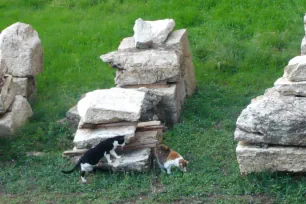
Shortly after excavation of this area was completed, stray cats began to take up residence there, protected from traffic at this site that sits below street level.
Today, there’s an animal sanctuary at the site, and it’s now home to an estimated several hundred cats. Visitors, however, will only see a few while roaming the ruins during the daylight hours.