


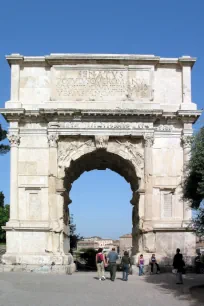
The Arch of Titus is the oldest of the two remaining arches on the Roman Forum. The triumphal arch was built in 81-85 AD to commemorate the capture of Jerusalem over the Jewish Zealots.
Jewish Revolt
In 66 AD, Jewish Zealots started a revolt against the Roman occupation of Judea. Vespasian was sent from Rome to suppress the revolt. After Vespasian became emperor, his son Titus took over command of the besieging troops. Titus captured Jerusalem in 70 AD with four legions, and the revolt was completely crushed after the fall of the Masada fortress in 72 AD.
Emperor Titus
In 79 AD, Titus succeeded his father as emperor of the Roman Empire. He died just two years later, in September 81 AD. The popular emperor was soon deified by the Roman Senate. Emperor Domitian, Titus’s brother and successor, commissioned the construction of the Arch of Titus that same year to honor his late brother and to commemorate the victory in the Jewish War. The arch was dedicated in 85 AD with large festivities.
The Arch
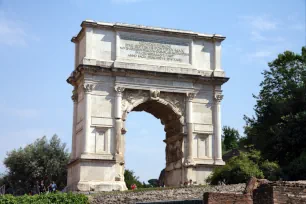
The fifteen meter (about 50ft) tall arch is located at the Roman Forum, at the highest point of the Via Sacra. It is the oldest surviving example of a Roman arch.
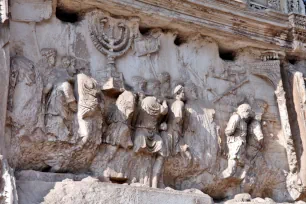
At the inside of the arch are two panels with reliefs. One depicts the triumphal procession with the spoils taken from the Second Temple in Jerusalem – the seven-branched candelabrum or Menorah, the silver trumpets and the Table of the Shewbread. The other one shows Titus in a chariot, accompanied by the goddess Victoria and the goddess Roma.
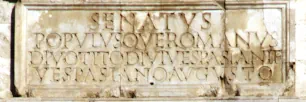
The inscriptions in the frieze which mean ‘The Roman Senate and People to Deified Titus, Vespasian Augustus, son of Deified Vespasian’ were originally in bronze. The reliefs were also colored, and the arch was topped by a bronze quadriga.
Preservation
In the eleventh century, the Arch of Titus was integrated into a fortress built by the Frangipani family, which helped the preservation of the monument. In 1821 the arch was restored by Giuseppe Valadier. Sections of the outer sides were rebuilt between 1822 and 1823 in travertine instead of marble, so they would be distinguishable from the original.
- Next: Circus Maximus
- More Rome Ancient Sights
- More Sights & Attractions in Rome