


The arch of Septimius Severus was built in 203 AD in honor of the Roman Emperor Severus. It is one of two remaining triumphal arches on the Roman Forum, the other being the Arch of Titus.
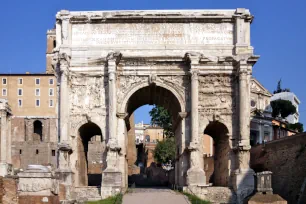
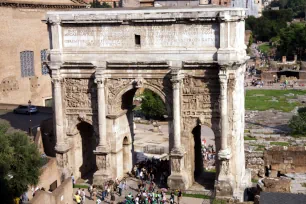
The triumphal arch was built to commemorate the victories of Emperor Septimius Severus in Parthia (now partly Iran and Iraq).
The Arch
The arch measures 23 meters high and 25 meters wide (75 x 82 ft.). It has three arched passages: the central one is 12 meters high and the others 7 meters 80 cm. Originally, a flight of stairs passed through the central archway. It was only replaced by a road in the fourth century.
Relief Panels & Inscriptions
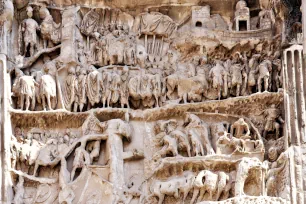
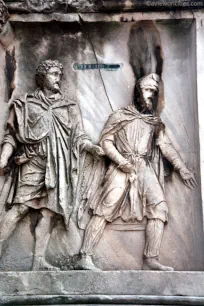
The relief panels at the top depict various stages of the war between the Romans and the Parthians. Other panels show Romans capturing barbarians.
Initially, the arch was topped by a bronze quadriga with statues of Emperor Severus and his two sons, Caracalla and Geta. Bronze inscriptions in the attic dedicated the arch to Septimius Severus and both of his sons, but soon after Septimius’s death, Caracalla killed his brother Geta and had his name removed from the arch.
Preservation
The arch of Septimius Severus is one of the best preserved monuments on the Roman Forum thanks to its incorporation in an old church in the Middle Ages.
The church later moved to another location, but it was still owner of the arch, thus protecting it from destruction. While parts of other monuments like the Colosseum were used for the construction of Renaissance palaces, the Arch of Septimius Severus was left untouched.
During the Middle Ages and until the eighteenth century, when the excavation of the Roman Forum started, a large part of the arch was covered in soil and debris. Today it is one of the most intact and spectacular Roman monuments on the ancient forum.
- Next: St. John Lateran
- More Rome Ancient Sights
- More Sights & Attractions in Rome