


Castle Square was laid out in the Middle Ages right in front of the Prague Castle. A number of magnificent palaces from the sixteenth to the eighteenth century border the historic square.
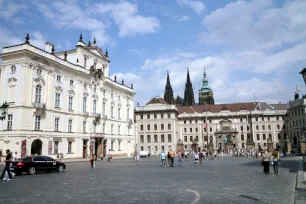
Unfortunately, many tourists hardly take notice of the magnificent buildings as they head straight to the castle. Don’t follow the herd and take your time to admire the Renaissance, Baroque and Rococo buildings or visit one of the museums.
Mary Column
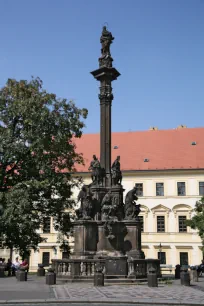
At the center of the Castle Square stands a monument erected to celebrate the end of the plague after the city of Prague had been hit one last time by an outbreak of the bubonic plague in 1713-1714.
The Mary Column, also referred to as the Plague Column, was built between 1726 and 1736 after a design by Ferdinand M. Brokoff – best known for his creation of several statues on the Charles Bridge. After he died in 1731 the monument was completed by his pupil Ignaz Franz Weiss.
The monument’s base is decorated with a number of statues of saints, including St. Vitus and St. John Nepomuk. A statue of the Virgin Mary adorns the top of the central column.
Palaces
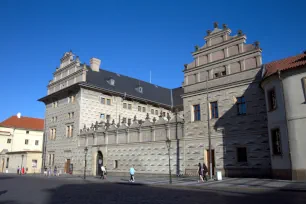
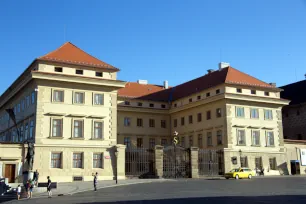
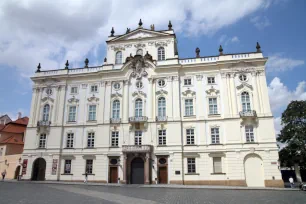
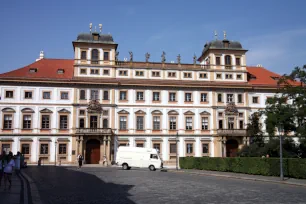
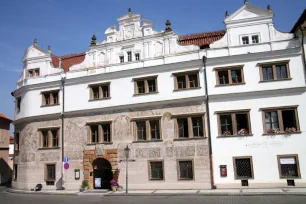
After the great fire of 1541 wiped out large parts of the castle district, many of the Bohemian nobility chose to build new palaces here, close to the political center of power at the Prague Castle.
Schwarzenberg Palace
One of the first palaces that were erected here was the Schwarzenberg Palace, one of the district’s largest. The palace was built in 1545-1563 in a Renaissance style after a design by the Italian architect Agostino. The palace, which is easily recognizable thanks to its diamond-patterned sgraffito façade, is now a museum with paintings and sculptures from the Renaissance and Baroque era.
Salm Palace
Adjacent to the Schwarzenberg Palace is the classicist Salm Palace. The origin of the building goes back to the Middle Ages, but its current appearance dates from a reconstruction completed in 1811. Near the palace, facing Prague Castle, stands a statue of Tomáš Garrigue Masaryk, the first president of Czechoslovakia. The three-meter-tall statue (10 ft.), unveiled in 2000, was created by sculptors Jan Bartoš and Josef Vajce.
Archbishop’s Palace
Opposite Salmov Palace stands the Archbishop’s Palace. It was originally built in 1538 by Florian Grispek. Ferdinand I purchased the palace in 1562 as a residence for the archbishop and had it reconstructed after a design by Bonifaz Wolmut. The elegant Rococo façade was created in 1760, when archbishop Prichovsky commissioned Jan Josef Wirch with the renovation of the palace.
Sternberg Palace
A small alley along the Archbishop’s palace leads to the Sternberg Palace, an early eighteenth-century Baroque palace which houses an impressive collection of European paintings spanning the fourth to the eighteenth centuries, including works from old masters such as Rubens, Rembrandt, El Greco and Goya. The museum also has an interesting collection of porcelain on display in the Chinese Kabinet.
Tuscany Palace
At the other end of the square, facing Prague Castle, is the Tuscany Palace, a Baroque palace built at the end of the seventeenth century for Michael Oswald Thun. The palace is named after the next owner, Gian Gastone de’ Medici, Grand Duke of Tuscany.
Martinic Palace
To the right of the Tuscany Palace is the more picturesque Martinic Palace, a Renaissance building erected in the sixteenth century. The graceful sgraffito façade depicts a biblical scene of Potiphar and Joseph. The sgraffito, which also embellishes the courtyards, was discovered during a restoration project in 1966 – 1972.