


The Jardin des Tuileries is one of Paris’s most visited gardens, thanks to its central location between the Louvre and Place de la Concorde. As such, the Tuileries are part of a grand central axis leading from the Louvre all the way to La Défense, the city’s business district.
History
Palais de Tuileries
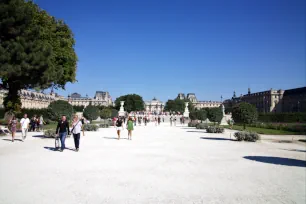
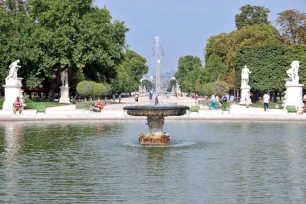
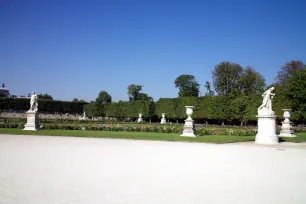
In the early sixteenth century, the area was a clay quarry for tiles (tuilerie in French, hence the name). After the death of her husband Henry II in 1559, Catherine de Médicis had a palace built at the tuileries: the Palais des Tuileries. The palace featured a large garden in Italian style, reminding her of her native Tuscany.
Le Nôtre’s design
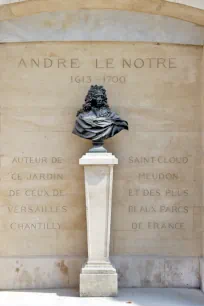
Between 1660 and 1664 the garden was redesigned in French formal style by André Le Nôtre, the celebrated gardener of the Sun King, who is honored with a bust in the garden  . Le Nôtre is best known for his design of the gardens at the Versailles Palace, but he also designed the gardens of the Palace of Saint-Cloud, Chantilly and several others. Here at the Tuileries Palace, he built a terrace along the riverbank and opened up a central axis, which he extended three years later with the creation of the Champs-Élysées.
The Jardin des Tuileries was one of the first parks to open to the public, and it quickly became a place to see and be seen. Even in the eighteenth century the park featured amenities such as cafés, kiosks, deck chairs and public toilets.
The Palais des Tuileries, situated near the Arc du Carrousel, was razed in 1871 by the Communards, opening up the view from the Louvre to the Arc de Triomphe.
Pedestrian bridge
Despite several renovations over the years, Le Nôtre’s formal design of the Tuileries garden has been kept intact. The park is now also separated from car traffic. Many modern sculptures were added and in 1999 the Passerelle de Solférino (now the Passerelle Léopold-Sédar-Senghor), a footbridge across the Seine opened, linking the Tuileries with the Musée d’Orsay.
Sights


Like the Jardin du Luxembourg, Jardin des Tuileries is one of those parks where you can grab a chair for free and sit wherever you like. It also features several fountains, two large basins, numerous sculptures and two museums.
Museums
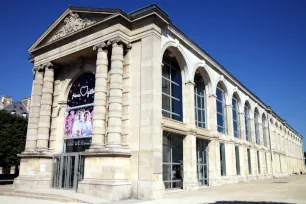
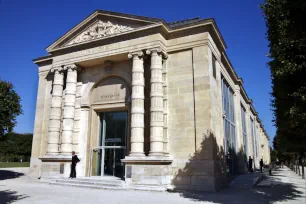
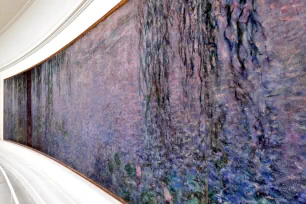
The museums are housed in two buildings that are the only remainders of the original Tuileries Palace. A pavilion on the north side houses the Galerie Nationale du Jeu de Paume , an arts center dedicated to photography and video images. The former orangery in the south-east corner is home to the Musée de l’Orangerie , which displays impressionist art, and is particularly popular thanks to its room dedicated to Claude Monet’s large water lily paintings.
Statues
Thanks to its abundance of statues – there are over seventy – the Tuileries is also a veritable open-air museum. Quite a few of the statues found here are replicas of famous statues on display in the nearby Louvre Museum, while others are originals.



Classical statues
The bulk of the statues in the Tuileries consists of classical statues. Most of these are placed along the central axis that leads from the Louvre to the Place de la Concorde.
> Historical figures
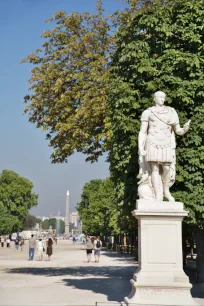
One of the main themes is historical figures. The most famous figure represented here is likely the Roman Emperor Julius Caesar, who is honored with two statues. The first one was commissioned in 1688 and was sculpted in Rome by the Italian sculptor Ambrogio Parisi, who modeled it after the statue of Caesar in the Capitoline Museums. The three-meter-tall statue is still original and part of the collection of the Louvre. The other representation of Caesar  was commissioned a year earlier, in 1687, and is the work of Nicolas Coustou, who is best known for his sculpture group known as «The vow of Louis XIII» in the Cathedral of Notre Dame.
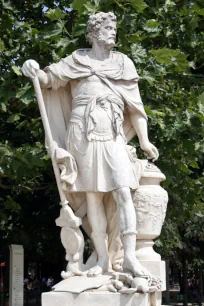
Just across the path from Coustou’s Caesar stands Hannibal , Rome’s most iconic adversary (albeit from centuries earlier), is also represented here with a statue by François Girandon. The statue was completed by Girandon in 1704, but the model was created by Sébastien Slodtz in 1687, which explains his name on the pedestal. In 1872 the original moved to the Louvre; the one on display is a replica.
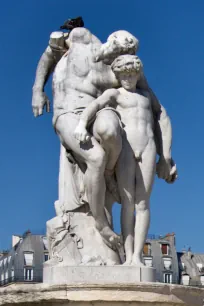
Another historical figure from the Roman era eternalized here in the Tuileries is Spartacus , the gladiator who led a slave uprising against the Roman Republic. The French sculptor Louis-Ernest Barrias decided to portray Spartacus as a young boy supporting an older man who was crucified on a tree, vowing to avenge him.
> Mythological figures
Another popular theme is mythological figures. One famous mythological figure is Hercules (the Roman version of the Greek hero Heracles). His statue was originally created in 1670 by Giovanni Comino and was modeled after the antique Farnese Hercules that is now in the archeological museum in Naples. The one we see now in the Tuileries is a cast from 2010. Another well-known hero from antiquity is Theseus, the legendary king of Athens. His statue  shows the hero defeating the minotaur. It was created in 1821 by Jules Ramey.
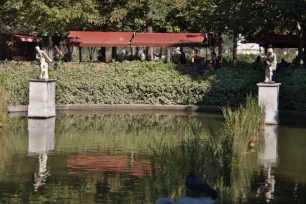


There are two statues of the Greek and Roman god Apollo. A bronze from Paul Belmondo  shows a modern, rigid version of the god installed here in 1988, while the other, more lively statue from 1714 shows him chasing Daphne
  , a Greek mythological figure. Another duo of statues shows the protagonists of the ancient myth of Atalanta and Hippomenes.
Apollo isn’t the only god who is featured twice in the Tuileries. This honor also goes to Diana, goddess of the Hunt. One statue depicts her as Diana Huntress  and was created in 1869 by Edmond Lévêque. The other was created in 1710 by Guillaume Coustou the Elder and shows Diana with a Doe
  . Another goddess statue depicts Flora
  , the Roman goddess of flowers and spring. It was created in 1676 by Antoine André, who based his work on the Flora Farnese, a statue from antiquity.
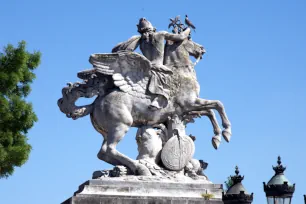
To close the mythology chapter in style, go to the west end of the main axis passing through the Tuileries. Here are two large statues featuring Pegasus, the winged horse from Greek mythology. They guard the main entrance at the Place de la Concorde. The one north shows Mercury riding the winged horse , while the other one carries Fame  . Both statues were made in 1700-1702 by Antoine Coysevox, and are some of the most impressive works of art in the Tuileries.
> Animal sculptures


There are two more statues on the border between the Tuileries and the Place de la Concorde: two lion statues  overlook the vast square from their elevated position on top of the tall pedestals that mark the northern and southern end of the perimeter wall enclosing the Tuileries. Both lion statues were created around 1806 by the Italian sculptor Giuseppe Franchi.
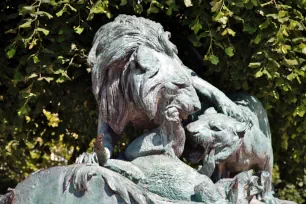
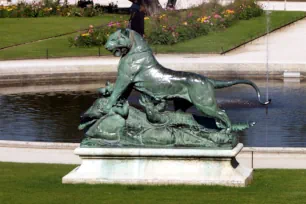
There are plenty more animal statues in the Tuileries. Auguste Cain, a French sculptor specialized in animal sculptures, created no less than four. The two tiger statues near the easternmost fountains are from his hand (1869-1873), and in 1882 he also created «Rhinoceros attacked by a tiger»  and «Lion and lioness fighting over a wild boar» , two large works located opposite one another near the northern entrance at the rue de Castiglione. There is one more large lion statue in the Tuileries, situated on the southern terrace: it is called «Lion with snake»
  and was made in 1832 by Antoine-Louis Barye.
At the south-eastern corner of the Tuileries you can also see a statue of a mythological creature that is part human, part animal: a sphinx  . In fact, there are two: there’s another identical one across the street. Both statues were taken from the staircase of the naval library in Sevastopol in 1855, during the Crimean War. Napoleon III decided to place them here, appropriately right near the Louvre Museum.


Allegorical statues
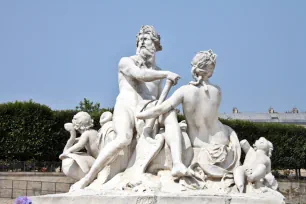
Another popular theme in the Tuileries is allegory. A cluster of these can be found between the main western entrance and the octagonal basin. The first two show elaborate sculpture groups representing French rivers: the one on the north side represents the Seine and its tributary the Marne , while the one opposite represents the Loire and its tributary the Loiret. Next to those sculpture groups are two more allegorical statues of rivers: the one on the north side shows the Tiber  , the one opposite represents the River Nile. A bit further, near the octagonal basin, stand four statues that represent the four seasons
  .
.
Modern sculptures
Bridging the gap between classical and modern art is the work by Auguste Rodin, who is featured here with The Kiss  , one of the French artist’s most famous works.
There are also a number of modern statues that were placed here around the year 2000. It includes works from artists such as Roy Lichtenstein, Henry Moore, Max Ernst and the aforementioned Paul Belmondo. Even more modern statues can be found in the adjoining Jardin du Carrousel which features almost twenty statues by French sculptor Aristide Maillol, that were installed here in 1964.
Monuments
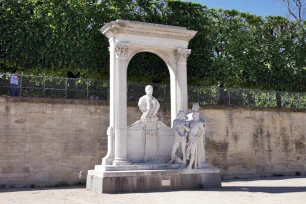
There are also a couple of monuments in the Tuileries. One honors Charles Perrault  , a French author from the seventeenth century. The other two honor French politicians: Pierre Waldeck-Rousseau , prime minister of France from 1899 until 1902, and Jules Ferry
  , prime minister from 1880 to 1881 and again from 1883 to 1885.
Map of Jardin des Tuileries
