


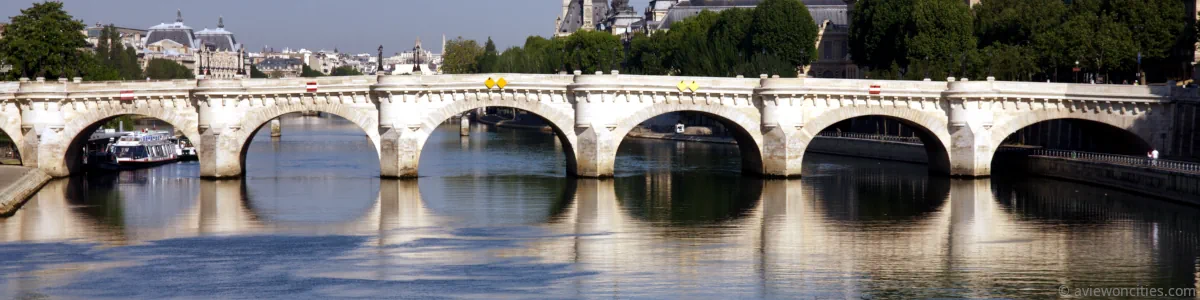
Paradoxically, the Pont Neuf (French for ‘New Bridge’) is the oldest bridge in Paris. The Pont Neuf is also Paris’s best known bridge and, together with the Pont Alexandre III, one of its most beautiful.
History
In the middle of the sixteenth century, only two bridges crossed the Seine river. Since they were in a bad state and constantly overcrowded, King Henry III decided in 1578 to construct a new bridge.
It wasn’t until 1607 before the bridge was officially opened by his successor, King Henry IV, who named the bridge «Pont Neuf» (New Bridge).
Progressive Design
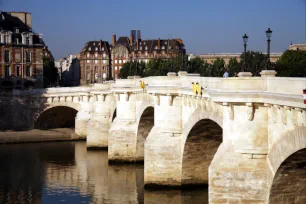
For its time, the 232-meter-long (761 ft.) and 22-meter-wide (72 ft.) Pont Neuf was a modern bridge with several innovations. The Pont Neuf was the first bridge in Paris without houses built on it. This wasn’t part of the original plan: It was only in 1599 that Henry IV decided to have no buildings on the bridge. By that time the cellars for the houses had already been built, but they were later sealed off.
The Pont Neuf was also the first bridge with pavements, which made it an immediate hit with the Parisians, who used the bridge as a meeting place. The semicircular areas over the bridge piers near the pavement in particular were ideal for socializing.
Bridge Spans
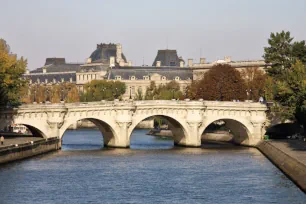
The Pont Neuf actually consists of two different bridge spans that are at a slight angle. There is one on each side of the Île de la Cité, where the Place du Pont Neuf connects the two spans. The bridge has a total of twelve arches, with one span of seven arches joining the right bank and another span of five arches connecting Île de la Cité with the left bank.

Statue of Henry IV
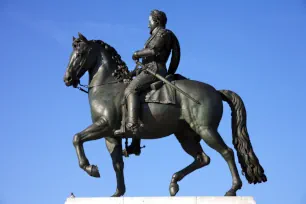
In 1614, four years after his assassination, an equestrian statue of King Henry IV was erected at the center of the bridge, on the Place du Pont Neuf. It was created by the Italian sculptors Giambologna and Pietro Tacca. They depicted the king on horseback, and in full armor. In 1618 the corners of the pedestal were decorated with statues of four prisoners of war.
The bronze statue was knocked over and melted down in 1792, during the French Revolution, but it was replaced by an exact replica in 1818, created by the French sculptor François-Frédéric Lemot. The pedestal is much more modest than its predecessor. Two of its sides feature bas-reliefs that show scenes in the life of Henry IV. The other sides feature inscriptions in Latin. The frontal one condemns the destruction of the statue during the ‘Troubles’, and celebrates the reconstruction in 1818. The inscription on the back attributes the completion of the original monument to King Louis XIII and Cardinal Richelieu.
- Next: Place des Vosges
- More Paris Bridges
- More Sights & Attractions in Paris