


The Palais Royal (Royal Palace) was built in 1629 by Cardinal Richelieu, an influential French minister from 1624 to 1642.
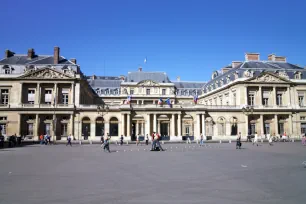
At the time, the palace was known as the Palais Cardinal; it became a royal palace after the cardinal bequeathed the building to King Louis XIII. Louis XIV, the Sun King, spent his youth here before moving to the nearby Louvre and later to Versailles.
History
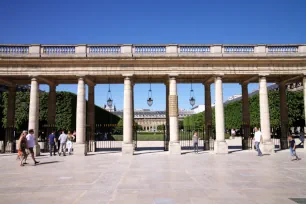
Between 1871 and 1874, Louis-Philippe d’Orléans, cousin of King Louis XVI, expanded the palace by adding arcades and shops. At the time the Galerie d’Orléans, the colonnaded space that separates the garden from the Cour d’Honneur also housed gambling dens, cafés and there were even prostitutes of both sexes.
The Palais Royal was mobbed during the revolution of 1848 and was almost destroyed by fire in 1871. Fortunately, the basic structure survived. After its restoration in 1876 the building was handed over to the government. It currently houses the Council of State and other government offices.
Cour d’Honneur
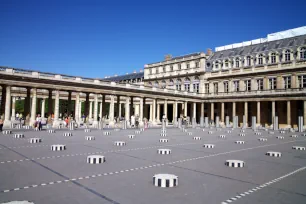
The palace is not open to the public, but you can visit the courtyard and the garden. The courtyard, known as Cour d’Honneur, is dominated by a large sculpture by Daniel Buren, installed in 1986. The sculture, entitled «Les Deux Plateaux», is better known as the «Columns of Buren». It consists of 280 black and white striped truncated columns.
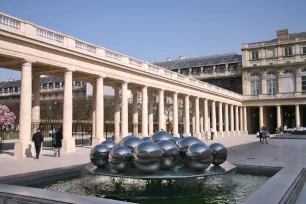
Adjacent to the courtyard is the Galerie d’Orléans, a courtyard flanked by two colonnades. It is home to «Les fontaines à boules», two modern fountains created by the Belgian sculptor Pol Bury and installed here in 1985. The fountains feature metal balls that reflect the surrounding buildings.
Jardin du Palais Royal
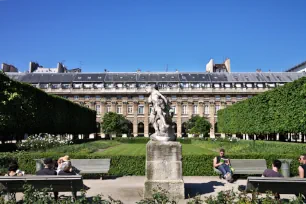
The Galerie d’Orléans leads to the Jardin du Palais Royal, the palace garden, which offers a quiet and beautiful refuge in the heart of the city. The garden is formally laid out around a central fountain, with a double avenue of lime trees on either side.
The current garden is somewhat smaller than originally designed in 1630 for Cardinal Richelieu, due to the construction of sixty arcaded buildings on three sides of the park by Louis-Philippe d’Orléans in 1874. The buildings around the garden now house restaurants, deli shops and galleries.
- Next: Madeleine
- More Sights & Attractions in Paris