


While it is not the largest cathedral in the world, the Notre-Dame Cathedral might well be the most famous one. The Gothic masterpiece is located on the Île de la Cité, a small island in the historical heart of the city.
A religious site
The site of the Notre-Dame Cathedral is the cradle of Paris and has always been the religious center of the city. The Celts had their sacred ground here, and a pillar from a Roman temple of Jupiter was found on this spot.
A first Christian church was built here as early as in the fourth century. In the sixth century it was enlarged into a Christian basilica, which was later turned into a cathedral dedicated to Saint Stephen. The last religious structure before the Notre-Dame construction started was a Romanesque cathedral.
Construction
In the early 12th century Paris experienced rapid population growth so the need for a larger cathedral was obvious to the Bishop of Paris Maurice de Sully, who initiated construction of a new cathedral in 1163, which he dedicated to Our Lady (Notre Dame in French). The cathedral was to be built in the new Gothic style and had to reflect Paris’s status as the capital of the Kingdom of France. It was the first cathedral built on a monumental scale and became the prototype for future cathedrals in France.
During construction, the old Romanesque cathedral was gradually demolished. The cathedral was already fully functioning in 1250 but it took until 1345 before the new cathedral was in the state we can see today because the design was significantly altered during construction: Renaud de Corbeil, at the time the bishop of Paris, decided to enlarge the nave of the cathedral and remodel parts of the building to bring the design in line with contemporary architectural preferences.
Exterior
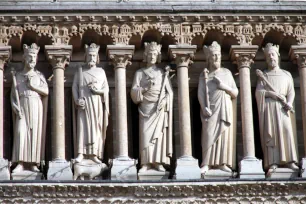
Almost two hundred years of construction resulted in an overwhelming structure, measuring 127 meters long, 40 meters wide and 33 meters high (417 x 131 x 108 feet) with two towers reaching a height of 69 meters (226 feet). The floorplan is in the shape of a Latin cross. The spire over the crossing, which marks the church’s highest point at 96 meters or 315 feet, was a nineteenth-century addition by Viollet-le-Duc.
Front facade
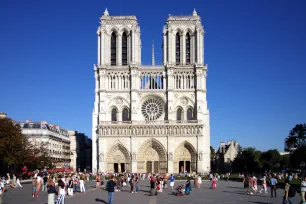
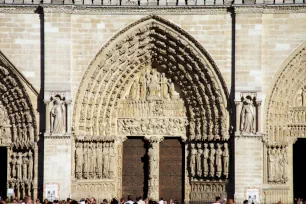
The front facade, facing west, features three large portals. The central and widest one is the portal of the Last Judgment. The sculptures on the tympanum, which were created in the early 1200s, depict the Last Judgment. The bottom part shows the dead rising from their graves. Above them is Archangel Michael, who weighs the souls on the scale of justice. At the top Jesus, presiding over the divine court, is joined by two angels, Mary, and St. John.
The left portal is the portal of the Virgin. This portal was made around the same time as the main portal. It was heavily damaged during the Revolution but was faithfully restored in the 19th century. At its center sculptures show Mary lying on a sheet above a tomb with angels holding the sheet. The portal on the right is the portal of Saint Anne, dedicated to Mary’s mother. The sculptures on this portal were mostly recycled from the previous church, from the mid-12th century, and are thus older than the church. The tympanum depicts scenes from the life of Saint Anne and Mary.
Right above the portals is the gallery of kings, a row of 28 statues of Judean Kings preceding Christ – each 3.5 meters tall (11 ft.).
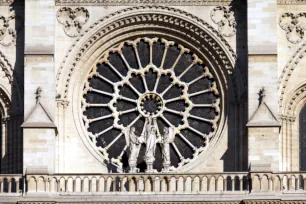
The rose window in the west facade measures an impressive 9.6 meters in diameter (32 ft.). In front of the rose window is the Gallery of the Virgin Mary, which shows statues of Mary flanked by two angels symbolizing sin and redemption.
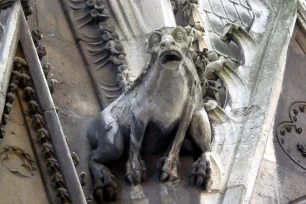
The gallery of grotesques above the rose window features many of the cathedral’s gargoyles and grotesques, which were made famous by Victor Hugo, who featured them in his novel «The Hunchback of Notre-Dame», in which Quasimodo – the story’s protagonist – befriends several gargoyles. While the gargoyles – which serve as drain pipes – are original, the grotesques are a nineteenth-century addition.
The iconic towers that define the west facade seem identical but the left tower, completed in 1250, is wider than the right one, which was completed ten years earlier. The intention was to crown the towers with spires, but this idea was scrapped in 1240. The towers house ten bronze bells. The two largest ones are in the south (right) tower; the other eight are in the north (left) tower. Each bell has its own name. The largest bell, known as the Bourdon Emmanuel, was mounted here in 1686. It is the second-largest bell in France, after the bell of the Sacré-Cœur’s campanile. The top of the towers are open to visitors, who have to overcome 422 steps to be rewarded with magnificent views over the center of Paris.
Transept
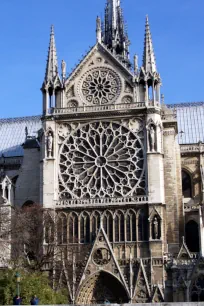
The portal of Saint Stephen in the south transept was built in the thirteenth century. Reliefs on the tympanum depict scenes in the life of Saint Stephen, who is venerated as the first Christian martyr. The enormous rose window has a diameter of over 13 meters (43 feet). We now see a heavily restored version from the nineteenth century.
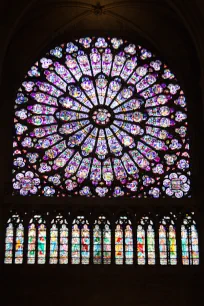
The rose window on the opposite, north side, is just as large as that on the south transept, but this one is still the original from the 13th century. The central pillar of the portal below the rose window – known as the portal of the cloister – features a childless Mary: the statue of the infant Jesus was destroyed during the French Revolution. Four scenes on the tympanum depict events from Jesus’s childhood.
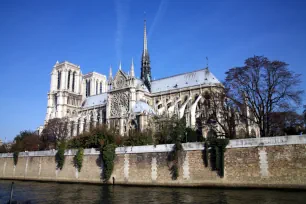
The tallest point of the Notre-Dame Cathedral is the spire over the cross-section of the transept, which reaches a height of 96 meters (315 ft.). The current spire was built in 1859 after a design by Viollet-le-Duc. The original, 78-meter-tall spire (256 ft.) from the thirteenth century was demolished at the end of the eighteenth century after decades of neglect had rendered it in a dilapidated state.
Flying buttresses
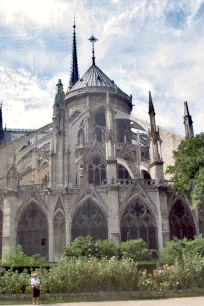
The semi-circular apse on the east side of the cathedral is surrounded by spectacular-looking flying buttresses, each 15 meters wide (49 ft.). There are many more along the nave and the transept. These buttresses – architectural supports that bear the load of the roof – are characteristic for Gothic buildings. They allowed architects to build much higher buildings with larger windows.
Interior
Nave
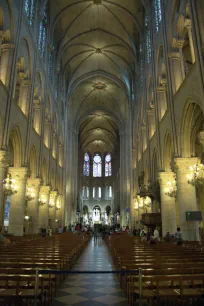
The 60-meter-long nave features five aisles and rises up to a height of 33 meters (108 feet) towards a stone vaulted ceiling that is supported by 75 columns and pillars. On either side of the nave are seven chapels, embellished with paintings and statues. The lancet windows in the chapels look old but they are from the 1960s and feature a geometric design devoid of figures.
Many of the large paintings in the chapels were created as part of the so-called 50 Mays of Notre-Dame: from 1630 until 1707, every year on the first of May, a large canvas, measuring 4.50m x 3.50m, was commissioned and then put on display in the cathedral. Only thirteen of these remain in the cathedral, the oldest of which hangs in the first chapel on the left. It was painted in 1634 by Jacques Blanchard and depicts the «Descent of the Holy Spirit».
The pulpit on the south side of the main aisle is from 1868 and was created after a design by Viollet-le-Duc. It is decorated with sculptures showing apostles, evangelist symbols and angels sounding the trumpet.
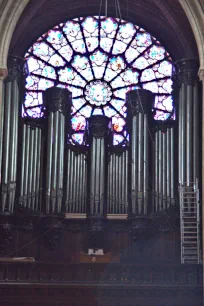
The great organ right below the west rose window was originally built in 1733 by François Thierry, but has since been rebuilt and restored several times. The organ has almost 8,000 pipes and 115 stops, digitally controlled by a console with five keyboards.
The west rose window, which is partly obstructed by the great organ, is with its diameter of 9.6 meters (32 ft.) the smallest of the three rose windows. Most of the glass panels date from the 19th century, when the church was renovated by Viollet-le-Duc. At its center is the Virgin Mary, surrounded by prophets. The outer circles show zodiac signs, allegorical representations of virtues, and the months of the year.
Transept
Two more magnificent and enormous rose windows can be admired in the transept. The north rose window is centered around the figure of Mary. Around her are kings, high priests, judges and prophets from the Old Testament, joined by several angels in the bottom. The south rose window features Christ in the center, surrounded by apostles and two circles of saints. On the outer edge are angels holding either a crown, candle or incense. The south rose window retains only a part of the original panes but the one in the north transept is almost completely original, and dates from the 13th century.
One of the most important paintings in the cathedral is «Saint Thomas Aquinas, Fountain of Wisdom», on display in the north transept. It was painted in 1648 by Antoine Nicolas. It depicts Saint Thomas Aquinas in the garments of the Dominican order. Dominicans crowd around the Fountain of Wisdom in front of the saint and fill their bowls with water from the fountain.
There are also several statues on display in the transept. The most important of these is a late Gothic statue of the Virgin and Child in the crossing, near a pillar at the entrance of the choir. The statue was created in the 14th century and measures 1.8 meters tall (6 ft.). Interesting is that Jesus is not depicted as an infant, but as a miniature adult. Mary is dressed like a queen and wears a crown.
Choir
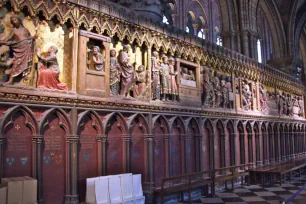
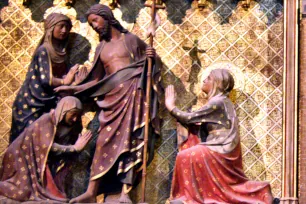
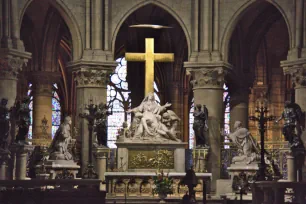
The choir – the area where the choir and clergy were seated – is flanked by church stalls from the 18th century. Right above the stalls are large wooden bas-reliefs. And above these reliefs, on the north side of the choir, is the choir organ. The original organ from 1863, made by Joseph Merklin, was deemed irreparable in 1966 and replaced with a modern one three years later. After suffering significant damage during the fire of 2019, the organ was almost completely rebuilt.
Originally the choir was completely enclosed, but this changed during a drastic remodeling in the 18th century. The east side was expanded towards the chancel and the oldest, 13th-century choir screen, which separated the choir from the nave over its entire width, was destroyed in the process. Only the choir screens on the south and north side, which separate the choir from the ambulatory, survived. The screens are decorated with beautiful wooden carved figures that depict scenes from the life of Christ. The figures are dressed in medieval attire and painted in bright colors. The north screen is the oldest, dating back to the late 13th-century, and depicts the early life of Christ, while the panels on the 14th-century screen on the south side of the choir depict Christ after his resurrection.
Another highlight in the Notre-Dame Cathedral is the Pietà in the apse at the eastern end of the choir. The Pietà – a statue of Virgin Mary holding the mortal body of Christ after his descent from the cross – was created in 1723 by Nicolas Coustou. The 2.8-meter (9 ft.) large marble sculpture sits behind the altar and is flanked by two statues, also made out of marble: on the right King Louis XIII and on the left his son, King Louis XIV. The statue of Louis XIV was made in 1713-1715 by Coysevox, uncle of Nicolas and Guillaume Coustou. It shows the king kneeling with his hand on his heart. The statue of Louis XIII is shown on both knees offering his crown and scepter to the Virgin Mary. It was also completed in 1715 and was the work of Guillaume Coustou, brother of Nicolas Coustou. Kings Louis XIII and XIV were responsible for the many modifications made in the choir during the 18th century: King Louis XIII put the plans for the remodeling in a vow and his successor realized them with the help of his architect Robert de Cotte.
Ambulatory
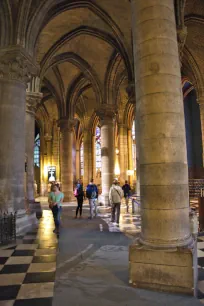
The double ambulatory around the chancel and choir is one of the most interesting parts of this historic cathedral. The radiating chapels contain magnificent stained-glass windows and interesting tombs. Despite its prominence, the Notre-Dame is not the burial place of the French Kings – that role is reserved for the Basilica of Saint-Denis – but you can still find some interesting mausoleums here.
Starting at the south end of the choir, the first chapel on the right after the sacristy is dedicated to Saint-Denis. It contains the mausoleum of Denys Affre, an archbishop of Paris who was killed during the revolution of 1848. The mausoleum was created in 1860 and shows a statue of him dying while holding aloft a green branch as a sign of peace.
A bit further, in the chapel of Saint-Guillaume, is a much older mausoleum from 1457. It shows colorful stone statues of a praying Jean Juvenal des Ursins, advisor to the king, and his wife. This chapel is also home to «The Visitation», one of the most beautiful and important paintings in the cathedral. The large canvas was created in 1716 by Jean Jouvenet and is part of a series of eight artworks painted in the 18th century to decorate the choir.
Nearby stands one of the largest mausoleums in the cathedral. It consists of a white marble monument that shows the emaciated Count of Harcourt climbing out of his tomb, accompanied by Death and a guardian angel. His widow is shown mourning below. The mausoleum was created in 1776 by Jean-Baptiste Pigalle who, unfortunately, had the original colorful stained-glass window removed since it clashed with his bright white monument.
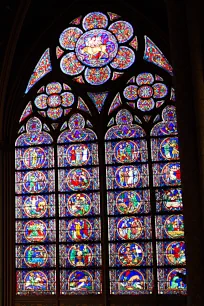
The next chapel features a large fresco depicting Saint George defeating a dragon, painted in 1870 by Louis Steinheil. In front of the fresco stands a statue of Archbishop Darboy, who was executed in 1871 by Communards. At the other end of the chapel you can see a statue of Saint George, to whom the chapel is dedicated. This chapel is also home to a couple of magnificent stained-glass windows that look medieval but in fact date from the 19th century. The first one depicts the life of Saint Eustace, the second one that of Saint Louis, King of France from 1226-1270. Finally, you can also see the crucifix and candlesticks from the coronation of Napoleon I, an event that took place in this cathedral on December 2, 1804.
The following chapel, dedicated to the Virgin, is home to three huge stained-glass windows from the 19th century, created in a medieval style.
Treasury
The treasury of the Notre-Dame Cathedral is housed in the sacristy, just south of the choir. The treasury was completely destroyed and pillaged during the French Revolution but it has rebuilt its collection since with reliquaries, manuscripts and other treasures.
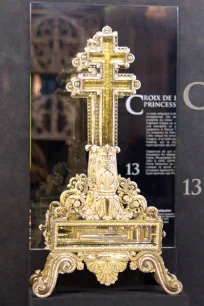
The most important item in the treasury is the Palatine Cross, named after Princess Palatine, a previous owner of the reliquary. The cross is made of gilded wood and is said to hold a nail and a piece of the True Cross.
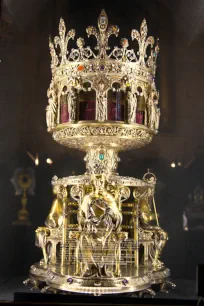
Another valuable item in the treasury is a very elaborate gilded bronze reliquary that is purported to hold a piece of the holy Crown of Thorns. It was created in the 19th century and is decorated with seated sculptures of Saint Helena (mother of Constantine I), Baudouin II (who sold the crown in 1238), and Saint Louis (the French King who bought the crown from Baudouin II).
Restorations
During the Revolution, many of the cathedral’s sculptures, gargoyles and interior were removed or demolished. Even the gallery of Kings was severely damaged because the revolutionaries thought the statues represented French Kings. The original heads of these statues are now on display in the Musée de Cluny.
By the end of the reign of Napoleon I, the church was in such a dilapidated state that there were calls to demolish the building. It was saved thanks in part to the novelist Victor Hugo, who with his book “Notre-Dame de Paris”, made the Parisians realize the cathedral was worth restoring, so the government decided to launch a major restoration project.
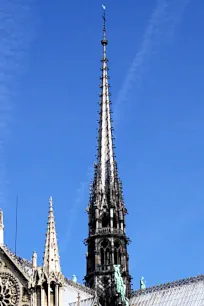
This project finally started in 1844 under the lead of architect Eugène Viollet-le-Duc and lasted twenty years. Viollet-le-Duc made drastic and controversial modifications to the building: he added a new spire, the gallery of grotesques, as well as new buttresses and modern windows.
The cathedral was restored again between 1991 and 2001, but this time the historic architecture was carefully preserved.
On March 15, 2019, a catastrophic fire engulfed the Notre-Dame Cathedral and destroyed the central spire, the centuries-old wooden roof and part of the interior. Restoration started soon after, and the new spire was completed in December 2023. The cathedral reopened just a year later, on December 7, 2024.
Location
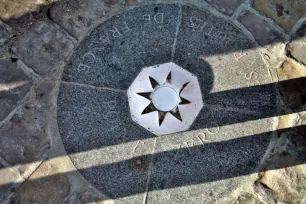
The Notre-Dame Cathedral is located on Île de la Cité, a small island in the Seine River. It is at the very heart of Paris, as evidenced by the Point Zéro mark in the middle of the square in front of the cathedral. This “zero point” is the spot from where all distances to other cities in France are measured.
The easiest way to get to the Notre-Dame Cathedral is by taking the metro. There is only one metro station on the island which is “Cité”. From there a short walk, about 300 meters in the eastern direction (about 1,000 feet) will bring you to the front of the cathedral. More convenient is the metro station “Saint-Michel Notre-Dame” on the south bank of the Seine. From there it is also a mere 300-meter walk to the cathedral but it’s much easier to orient yourself since you can see the cathedral from the exit of the station. Both stations are on the same metro line #4.
- Next: Louvre
- More Paris Churches
- More Sights & Attractions in Paris
- Related articles: