


The Musée de Cluny is lauded for its magnificent collection of medieval art, displayed in a unique setting, part Gallo-Roman ruins, part medieval mansion.
The Museum
Also known in France as the Musée National du Moyen Âge (National Museum of the Middle Ages), the Musée de Cluny sits in Paris’s 5th arrondissement.
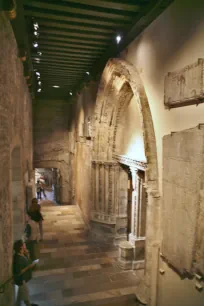
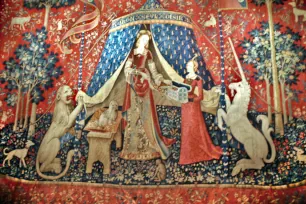
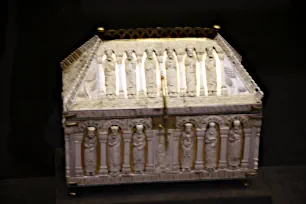
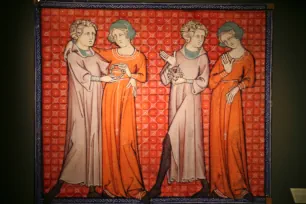
The museum houses many notable medieval artifacts, including sculptures from the seventh and eighth century, important manuscripts, gold and ivory pieces, and many antique furnishings. The museum also owns a fine collection of tapestries of that era, including “The Lady and the Unicorn”, a series woven in Flanders and made of wool and silk. These are often considered among the finest works of art from medieval Europe.
The Building
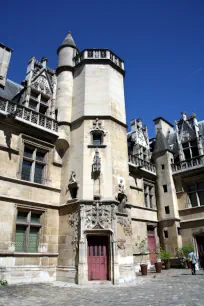
The museum is housed in a building known as the Hôtel de Cluny. Not a hotel in its most commonly known form (i.e. a place to lodge) but rather a luxurious house in the city, the Hôtel de Cluny was – in the early fourteenth century – owned by the abbots of Cluny, who headed a powerful Benedictine order. The complex also once included a college for religious education, but that is no longer standing.
The monks of Cluny owned the structure for about one hundred years, after which time it was taken over by Jacques d’Amboise, Bishop of Clermont, who used it as his residence and rebuilt it with many Gothic and Renaissance elements. It is this remodeled hotel that is still standing today.
In addition to the bishop, it is said that a number of notable personalities lived in the house at one time or another, including Mary Tudor, who was sent there after her husband Louis XII died, so that the new king of France could keep an eye on her and determine whether or not she was pregnant with an heir.
Later Years
In 1793, the state assumed ownership of the Hôtel de Cluny, and it was used for several different functions. According to the Paris Michelin Guide, the upstairs chapel – done in flamboyant Gothic style – was once used as a dissection room by a Paris doctor.
But the collection inside the Cluny Museum began when the art collector Alexandre du Sommerard moved in. He already owned an impressive collection of medieval and Renaissance objects that he brought with him to the house, and when he died in 1842, he donated them to the state. A museum opened just a year later.
Baths of Cluny
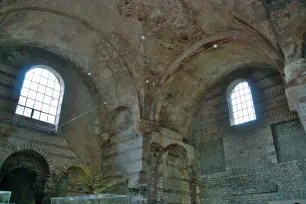
Visitors to Cluny Museum can also view the ruins of the Gallo-Roman Baths of the 3rd century, on top of which the Cluny complex was partially constructed. The museum includes some of the remains of the baths, known as the Thermes de Cluny (Baths of Cluny). The baths were built at around 200 AD, but were destroyed around one hundred years later by invading barbarians.