


The complex known as the Hôtel des Invalides was founded in 1671 by Louis XIV, the Sun King. He wanted to provide accommodation for disabled and impoverished war veterans.
Design & Construction
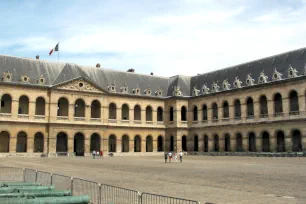
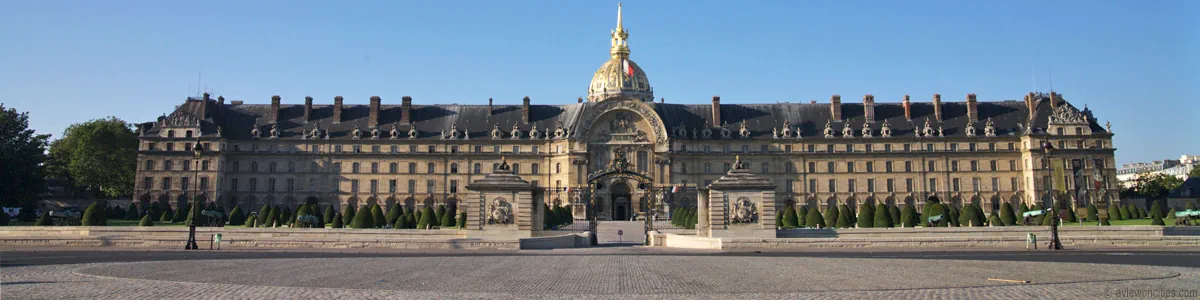
Originally only a number of barracks were planned, but King Louis XIV chose a design by architect Liberal Bruant which consisted of a large, impressive building with a royal courtyard and church.
The front facade facing the Seine river is 196 meters long (643 ft.). The whole complex features no less than fifteen courtyards, the largest being the Cour d’Honneur (court of honor). This courtyard was used for military parades.
The building was completed in 1676 and housed up to 4,000 war veterans. A wide, 500-meter-long (1640 ft.) esplanade designed by Robert de Cotte separates the Hôtel des Invalides from the late nineteenth-century Alexandre III Bridge and the Seine River.
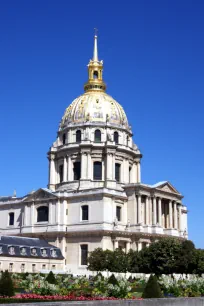
Church of Saint-Louis
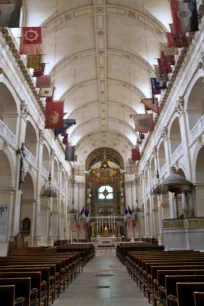
Starting in 1676 on request of the Sun King’s war minister, the church of Saint-Louis was added as an annex to the complex.
It was built by Jules Hardouin Mansart after the design by Libéral Bruant, the architect of the Hôtel des Invalides. The church, then known as the Pensioners’ Choir but later referred to as the Soldiers’ Church, opened for the soldiers in 1679. They were required to attend the daily mass here.
Dôme des Invalides
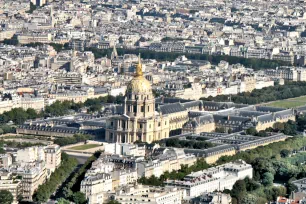
The church is connected directly with the Royal chapel, better known as the Dôme des Invalides. This chapel with a 107-meter-high dome (351 ft.) was for exclusive use of the royal family. Construction of the dome was completed in 1708, 27 years after the first stone was laid.
Plans to bury the remains of the royal family here were set aside after the death of King Louis XIV, and in 1840 King Louis-Philippe repatriated the remains of Emperor Napoleon from St. Helena – where he had been buried after his death 19 years earlier – to have him entombed here. The Dôme des Invalides now also houses the tombs of several other military leaders like Turenne, Vauban and Marshall Foch.
Museums
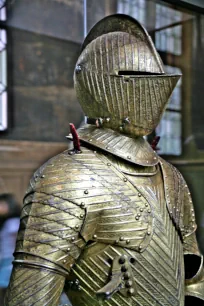
The Hôtel des Invalides is now home to several museums:
- The Musée de l’Armée (Army Museum) is a large military museum located on both sides of the Cour d’Honneur. It covers military history from the early Middle Ages to the Second World War. It features weapons, uniforms, maps and banners, not only from the western world, but also from countries like Turkey, China, Japan and India.
- The Musée des Plans-Reliefs (Relief Maps Museum) displays detailed scale models of French fortresses and fortified cities, going back to the seventeenth century.
- The Musée de l’ordre de la Libération (Museum of the Order of the Liberation) is dedicated to the liberation of France in the Second World war and to its leader, general Charles de Gaulle.
Location
The Hôtel des Invalides is located in the 7th arrondissement, south of the Seine river, just east of the École Militaire.
- Next: Opéra Garnier
- More Sights & Attractions in Paris