


The Château de Vincennes is a castle at the eastern edge of central Paris. It was used as a royal residence from the twelfth century until the eighteenth century, when the king moved to the Versailles Palace.
Origin
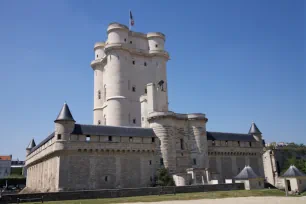
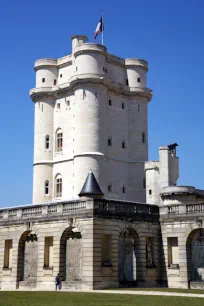
The origin of the castle go back all the way to 1150 when King Louis VII built a hunting lodge here which was soon expanded. The actual castle – originally a fortress – was built about a century later, including the impressive donjon. At 52 meters, it is still Europe’s tallest Donjon.
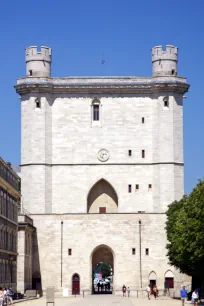
In 1410 the fortress was walled in by an enclosure no less than 1,200 meters long, lined with nine towers, originally up to 42 meters tall. By that time, construction of a chapel – modeled on the Sainte-Chapelle – was started. The chapel with magnificent stained-glass windows was completed after a long 182 years, in 1552.
Royal Residence
While the Louvre was their main residence, royals often sojourned at the Château de Vincennes. It was the site of many important occasions such as royal marriages, and no less than three kings were born here. The king often resided in an apartment in the Donjon, especially during troubled times such as the religious wars and the One Hundred Years’ War.
During the sixteenth and seventeenth century, the Vincennes castle continued to be expanded, with an emphasis on turning the fortress into a residential palace. During this period, several residential pavilions were added to the south of the Donjon and the royal court now often resided in Vincennes. This however changed in 1671, when King Louis XIV decided to move to the just completed Versailles Palace. The Louvre Palace in the center of Paris was abandoned a year later.
After the royals

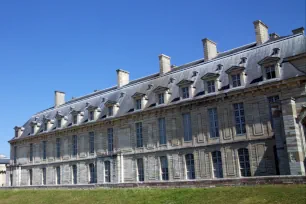
When the château was abandoned by the royal family, it became the site of the Vincennes Porcelain factory and then served as a state prison, housing such infamous personalities as Diderot and the Marquis de Sade. Napoleon used it as an arsenal, in 1840 it was in use as a military fortress. Most of the tall towers around the castle were leveled off during that period.
Today, the Château de Vincennes is a museum. Its grounds can be freely accessed, while the buildings can be visited on a guided tour.
Bois de Vincennes
The Bois de Vincennes was the royal hunting ground of the Vincennes Castle. In 1860 Napoleon III turned it into a 10 sq. km. large public park.