


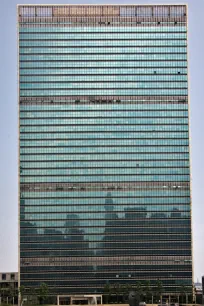
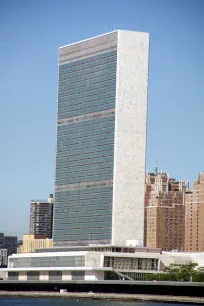
The headquarters of the United Nations in New York were developed by an international team of architects. The main building, the Secretariat, was one of the city’s first skyscrapers in International Style.
The Plot
In 1946, the United Nations (UN) were looking for a location for their new headquarters in New York. The original plan was to use the grounds of the 1939 World Fair in Flushing Meadow Park in Queens. But when a project known as X-City on Manhattan’s eastern border failed to materialize, John D. Rockefeller Jr. bought the 18 acre (7 ha.) plot and donated it to the United Nations. This site was then used to build the UN’s headquarters. The whole area was converted into international territory and officially does not belong to the United States.
Design
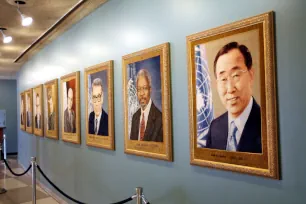
The design for the United Nations complex was drawn by an international committee of architects, the United Nations Board of Design. The most notable of the architects were Oscar Niemeyer, Le Corbusier and Wallace K. Harrison, who headed the board. Some renowned architects including Mies van der Rohe and Walter Gropius were excluded due to their historical links with Germany, the instigator of the Second World War.
The international style was chosen by the board members as it symbolized a new start after the war. A plan by Le Corbusier, known as project 23A, was taken as the basis for the design. After many months of heated discussions, mainly between Le Curbusier and the other architects, the final plan 23W, drawn up by Oscar Niemeyer, was adopted by all members of the board. It consists of a complex with four buildings: the Secretariat building, the General Assembly building, the Conference building and the Dag Hammarskjöld Library.
UN Secretariat
The largest of the four buildings is the Secretariat building, home of the UN’s administration. The large, 39-story, 544-ft-tall (166 m.) slab has become a worldwide symbol of the United Nations. The green glass-curtain tower, the first of its kind in New York, contrasts starkly with the 1920s buildings of Tudor City nearby.
Construction of the Secretariat started in September 1949 and was completed in 1950. The complex as a whole was only finished two years later. The Secretariat building dwarfs the adjacent five-story General Assembly building, actually the most important part of the complex.
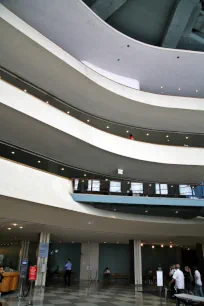
In the General assembly hall, which has a seating capacity of 1,800, meetings between representatives of all UN members take place. The conference building behind the Secretariat and General assembly buildings houses the Security Council and the Economic and Social Council.
The Park
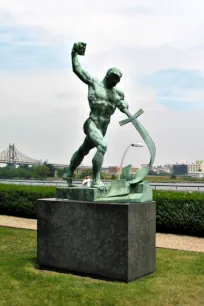
Adjacent to the United Nations complex is a small public park bordering the East River. It is littered with artwork donated by many countries, including ‘Let Us Beat Swords into Plowshares’ by Evgeniy Vuchetich, donated by the Soviet Union in 1959 and a section of the Berlin Wall.
Along First Avenue in front of the United Nations Headquarters is a display of flags from each member of the UN. It starts with Afghanistan at 48th street and ends with Zimbabwe at 42nd street.