


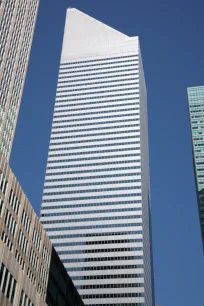
At 915 feet / 279 meters, the aluminum and reflective glass clad tower known as the Citigroup Center is one of the tallest building in Midtown Manhattan. But what really makes this skyscraper stand out are the triangular rooftop and the four massive columns on which the building rests.

The Plot
Those columns were the result of an agreement between Citibank and the St. Peter’s Lutheran Church. The church owned a valuable property in Midtown, occupying one third of a city block on Lexington Avenue and 54th street. In the 1960s, the church faced financial problems and wanted to sell its property.
At the same time, Citibank, which was located just across the street, was looking to expand. Thus, the church sold its property to Citibank, but only on the condition that the bank would build a new church replacing their 1904 Gothic Revival church. The two parties also agreed that the new St. Peter’s church had to be a distinctive building, not incorporated in the office tower.
A Building on Pillars
As a result, the architects faced a problem: they needed to build an office tower on the block while at the same time providing enough space at the base for the construction of a church building. The solution was raising the building on four 114-feet (35-meter) tall columns and a supporting core. The columns were placed at the center of each side rather than at the corners. This way, the design opened enough space in the northwest corner for the new St. Peter’s Church.

After the purchase of the property of the St. Peter’s church, five more years were needed for Citibank to buy the rest of the block. The purchases were done by different companies, since property prices would rise dramatically if the owners found out a large bank planned to develop the site. Construction of the tower started in 1972 by Hugh Stubbins & Associates, assisted by Emery Roth & Sons. The skyscraper opened in 1977 as the Citibank Center. With the company’s expansion, the building was first renamed Citicorp Center and later Citigroup Center.
The Advent of Postmodernism
The Citigroup Center was the first tower in Manhattan that parted with the then prevalent Internationalist Style. Instead of a flat top, the designers gave the building a distinctive angled roofline. The original plans to construct setback penthouses on the roof were abandoned due to zoning restrictions. It was then intended as a solar panel, but never used as such.
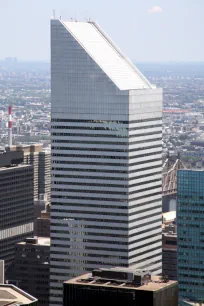
The rooftop now houses the building’s mechanical equipment, including a computer controlled tuned mass damper. This four hundred ton block of concrete slides on a thin layer of oil. The inertia of the damper reduces the swaying of the building by up to forty percent.
The construction of the Citigroup Center revitalized the area, and several office towers were built in its vicinity. The most notable of these is probably Philips Johnson’s nearby postmodern Lipstick Building.
The Plaza
The Citigroup Center includes a large sunken plaza and a seven-story atrium at the base of the tower with three stories of restaurants and shops. The plaza and atrium are directly accessible from one of New York’s busiest subway stations.
- Next: Coney Island
- More Sights & Attractions in New York