


The one street you shouldn’t miss on your trip to Madrid is the Gran Vía, a showcase of early twentieth-century architecture.
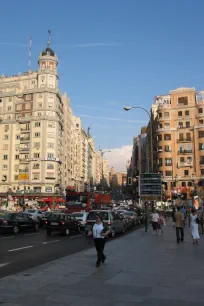
The lively street is one of the city’s most important shopping areas. It also contains many hotels and large movie theaters. But what makes this street so special is the architectural design of many of the large buildings. While walking through this crowded street, make sure you look up once in a while and admire the often lavishly decorated grand ‘edificios’.
Conception
In the mid-nineteenth century, Madrid’s urban planners decided that a new thoroughfare had to be created, connecting the Calle de Alcalá with the Plaza de España. The project required many buildings in the center of the city to be demolished. Decades after the first plans were made, construction still hadn’t started, and the media ridiculed the project, cynically calling it the ‘Gran Vía’ or ‘Great Road’. Finally, in 1904 it was approved and construction started a couple of years later. The last part of the street was completed in 1929.
Grand Edificios
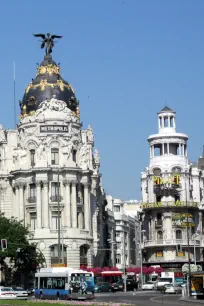
The new road created opportunities for architects, who had the ability to create large buildings in the latest architectural styles. The first eye-catching building starting from the Calle de Alcalá is the most famous of all, the Edificio Metrópolis or Metropolis building. The landmark was built between 1907 and 1911 after a design by the architects Jules & Raymond Février. The original statue was replaced in 1975 by a statue of a winged Goddess Victoria.
A bit further along the Gran Vía, on the left-hand side, is another landmark, the Edificio Grassy, another corner building with a small tower. It was built in 1917.
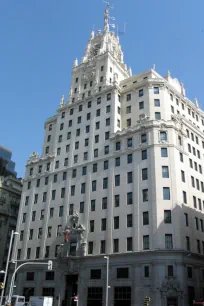
From the Edificio Grassy, you can already see the tower of the Telefónica building, a skyscraper built between 1926 and 1929 for the Spanish telecommunications company. The 88 meter-tall (290 ft.) building was the largest in Madrid and would have been a good fit in Chicago. Not surprisingly, the architect of the Telefónica building was an American: Louis S. Weeks.
Plaza del Callao
If you walk further in the direction of the Plaza de España, the Gran Via crosses a small square, the Plaza del Callao. This square is the heart of cinematic Madrid, with about six movie theaters. One of them, the Capitol, is located in a beautiful Art Deco building.
Plaza de España
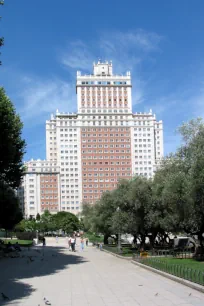
The last part of the Gran Vía, constructed between 1925 and 1929 leads to the Plaza de España, a large square dominated by two skyscrapers built in the 1950s, the symmetric Edificio de España and the Torre de Madrid. Here the Gran Vía becomes the Calle de Princessa, leading north to the Arco de la Victoria.
- Next: Alcala Gate
- More Sights & Attractions in Madrid