


Westminster Abbey’s history goes back over a thousand years. It is as much a historical site as it is a religious site: This has been the coronation site of English kings and queens since 1066 and many lie buried here in opulent sepulchral monuments.
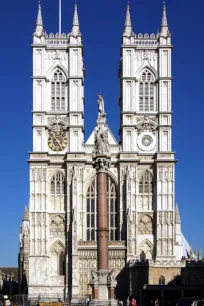
The church also serves as the burial ground for numerous politicians, poets, scientists and artists. It is crammed with tombs, statues and monuments; so little space is left that some coffins even stand upright. In total, approximately 3,300 people are buried in the church and cloisters. Some of the most famous include Charles Darwin, Isaac Newton and David Livingstone.
Edward the Confessor
The first person to be enterred here was King Edward the Confessor, who built an abbey church on this location in 1050. During his 24-year-long reign, Edward was so pious that his subjects considered him more as an abbot than a king, hence his nickname ‘the Confessor’. In 1161 he was even declared a saint by Pope Alexander III. His shrine became a pilgrimage destination, drawing devout people from all across the country to the abbey church.
Royal Coronations
The church gained even more prominence thanks to William the Conqueror’s decision to – just one year after its completion – use this church as his coronation church after his conquest of England in 1066. Since then, all English kings and queens have been crowned here, with the exception of Edward V (who was locked up and probably murdered in 1483 in the Tower of London at the age of 13) and Edward VIII (who abdicated before his coronation). King Charles III was the 40th reigning monarch to be crowned here, on May 6, 2023. Other recent coronations took place here in 1953 (Queen Elizabeth II), and 1838 (Queen Victoria).
History
The early history of this great coronation church is rather murky. According to a legend, the first church at this site was rather miraculously consecrated in the early seventh century by St. Peter the Apostle, who was brought here by a fisherman. It is more likely that a church was built here as early as in the eighth century, during the reign of King Offa. However, there is no solid proof of this.
The church of Edward the Confessor
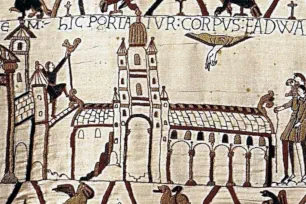
What we know for certain is that a Benedictine abbey stood here at least since around 960. King Edward, now known as Saint Edward the Confessor, drastically increased the size of the abbey’s church in 1050. The building was completed sixteen years later in the Norman style, and was consecrated just eight days before the death of Edward the Confessor. Edward did not leave an heir, which led to the conquest of William the Conqueror of England, who was promptly crowned here on December 25, 1066. It is thanks to the immortalization of his conquest on the tapestry of Bayeux that we have an idea of what this church looked like.
The church of Henry III
In the thirteenth century King Henry III decided to rebuild the abbey church and design it around the shrine of St. Edward the Confessor. Construction started in 1245 after a Gothic design by Henry of Reyns, who based his work on the great Cathedral of Reims in France. In 1269 the body of Edward the Confessor was moved to a new shrine at the center of the church.
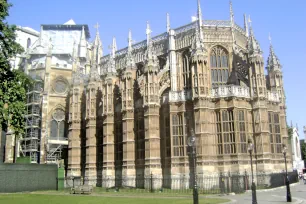
By the time of Henry III’s death in 1272, the east side of the church was completed, but only a small part of the nave was finished – the old Norman nave was still attached to the church. It wasn’t until 1376, that the nave was built by Henry Yevele, who opted to follow Henry of Reyns’s Gothic design, which resulted in a uniform architecture. Construction would last for another 140 years, before it was finally completed in 1517.
The Lady Chapel at the east end was rebuilt in 1503 by King Henry VII as a monument to his predecessor Henry VI and as a final resting place for himself. The chapel was completed in 1512 in a magnificent late Gothic style.
Dissolution of the monasteries
In 1540, as part of Henry VIII’s dissolution of the monasteries, the monks were expelled from the abbey. Two thirds of the estate was sold off but the church’s status as a royal coronation church saved it from the pilfering that other abbeys were subjected to. And in 1556, Queen Mary I restored the Benedictine monastery. However this didn’t last long: in 1559 Mary’s nemesis and successor Elizabeth I designated Westminster Abbey as a collegiate church, expelling the monks for good.
Final construction
The final phase of the construction of Westminster Abbey took place in the 18th century, when Nicholas Hawksmoor built the 225-foot-tall (69 meters) West Towers, which were completed in 1745. Despite being a leading figure of the English Baroque movement, Hawksmoor designed the towers in a Gothic style that is harmonious with the rest of the church.
The Church
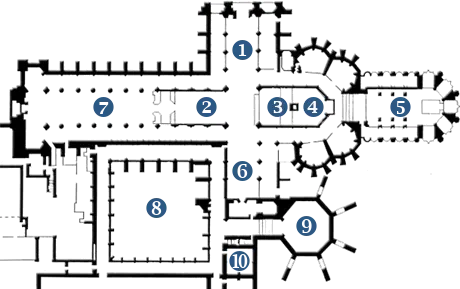
The plan of the church is cruciform, with a long narrow nave intersected by a three-aisled transept. The focal point of the church is the shrine of St. Edward the Confessor, just behind the sanctuary. Around it, five chapels radiate from the ambulatory. The largest of these is the Lady chapel on the east side, which boasts five side chapels of its own. The area between the high altar and the choir screen is also of particular importance as it is the site of the royal coronations.
The design of the church was based on the great French cathedrals, in particular that of Reims, but the execution is decidedly English Gothic in style. The chapel of Henry VII in particular is a masterwork of English Gothic architecture.
Transept
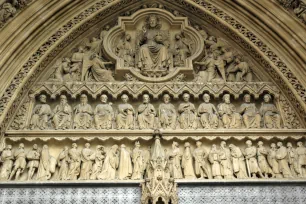
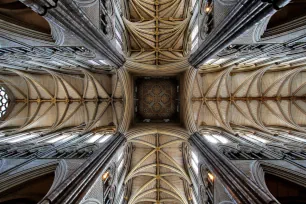
The transept (the part of the church that crosses the nave) has three aisles. The choir and sanctuary in the center of the church divide the transept into two sections: the north transept and the south transept.
North Transept
You enter Westminster Abbey through one of the three large portals in the north transept  . This area, known as Statemen’s Aisle is full of monuments for 19th-century politicians, but make sure to take a look back towards the north rose window, a design by James Thornhill from 1722 that depicts Christ and the Apostles. On the east side of the north transept is the chapel of St. John the Evangelist, with some beautiful sepulchral memorials such as the monument for Francis Vere (†1609), one of the most accomplished soldiers in the army of Elizabeth I. His tomb is at the bottom while four figures hold a bier on which his armor lays, to indicate that he did not die in battle.
Nearby, in the Chapel of St. Michael, is another remarkable memorial created by the French sculptor Louis Francois Roubiliac in 1761. It shows Elizabeth Nightingale (†1755) in the arms of her husband who tries to defend her against a skeletal figure representing death.
South Transept
There is another magnificent rose window in the south transept  , also by James Thornhill. It symbolizes Christ triumphant, who is shown surrounded by all his witnesses including the twelve apostles with one exception – Judas.
The most popular area in the south transept is the so-called Poets’ Corner, where you find many graves and memorials of famous poets. The first poet to be buried here was Geoffrey Chaucer, in 1400, not because he was a poet, but because he lived on the grounds of the abbey. Another poet, Edmund Spenser (†1599), wanted to be buried near Chaucer’s grave. Other famous poets and writers followed, including Ben Jonson (†1637), John Dryden (†1688) and Charles Dickens (†1870). But it’s not just writers who are memorialized in Poets’ Corner: German composer Georg Friedrich Händel (†1759), who worked in London for most of his career, and actor David Garrick (†1779), a popular actor who is depicted with a final bow for the audience, are also buried. There are also memorials for people who were not buried here, such as William Shakespeare (†1616), who was buried in Stratford-upon-Avon. His life-size statue in Westminster Abbey was carved in 1749 – more than 100 years after the playwright’s death – by the Flemish sculptor Peter Scheemakers to a design by William Kent. A copy of this iconic monument stands in Leicester Square.
Sanctuary and Choir
Between the north and south transept are the choir and the sanctuary, where royal coronations take place.
Sanctuary
The gilded High Altar in the sanctuary  is a Neo-Gothic design by George Gilbert Scott from 1868. Behind the altar is a mosaic glass depicting the Last Supper, created by the Italian family firm of Antonio Salviati.
In front of the High Altar is the magnificent medieval Cosmati Pavement. The Cosmati were a Roman family famous for their intricate floor mosaics. The pavement they created in 1268 in Westminster Abbey contains over 93,000 colorful pieces that create an intricate geometric pattern of colored stones.
Coronation Chair
During coronations the Coronation Chair is placed on the Cosmati Pavement in front of the High Altar. The two-meter-tall oak chair, with a gable at the back, was made in 1300-1301 on the order of King Edward I. The king had a special compartment made at the bottom of the chair to hold the 152-kg-weighing (335 pounds) Stone of Scone, which he had captured during his invasion of Scotland in 1296. The stone had a high symbolic value since it had been used for centuries in the coronation of Scottish monarchs. In 1996 the stone was handed back to Scotland; it is now in Edinburgh Castle.
Choir
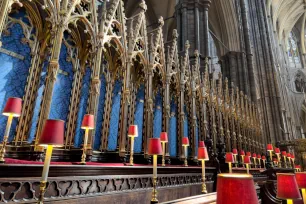
To the west of the sanctuary sits the choir  , the place where the liturgical singers take place. It is separated from the nave by a large Neo-Gothic choir screen that was installed in 1839. It was designed by Edward Blore, who was also responsible for the choir stalls that date from 1844-1848.
Chapel of St. Edward
To the east of the sanctuary is the Chapel of St. Edward  , which is separated from the sanctuary by a stone screen from the 15th century. The chapel holds the shrine of Saint Edward the Confessor. This part of Westminster Abbey can only be visited with a guide. The top section of the shrine holds the saint’s coffin. Below his marble tomb are six niches in which pilgrims would kneel to pray. The shrine rests on a beautiful Cosmati pavement which is usually covered with a carpet. It is surrounded by tombs of Edward’s successors: Henry III (†1272), Edward I (†1307), Edward III (†1377), and Richard II (†1400). And nearby, in a chantry, lies the tomb of King Henry V (†1422) – the warrior king, decorated with an impressive sculpture showing him riding a horse into battle.
The four side chapels around the Chapel of St. Edward contain several more interesting tombs. One of the most impressive is the monument to Lord Hunsdon (†1596), Lord Chancellor of Elizabeth I, in the Chapel of St. John the Baptist. It is the tallest in the abbey, almost reaching the vault of the chapel with its height of 15 meters (49 feet).
Lady Chapel
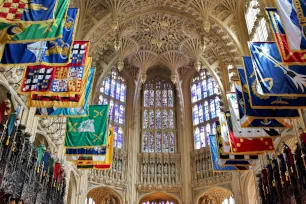
A flight of stairs leads to the Lady Chapel  , a large chapel occupying the eastern end of the church. Henry VII rebuilt this chapel in 1503-1512 hence it is now better known as the Henry VII Chapel. Its design, attributed to Robert Janyns the Younger, can be considered the apogee of English Gothic architecture. It is stunningly beautiful, in a large part thanks to the magnificent fan vault and large stained-glass windows.
The chapel is decorated with intricate stonework and almost one hundred statues. The misericords are also worth mentioning: those are wood carvings on the bottom of a hinged church seat that depict various subjects such as a mermaid, dragons, David and Goliath, a phoenix, and there’s even a depiction of a woman beating a man with a birch. Heraldic banners from the ‘Order of the Bath’, hung along the walls of the chapel, add a bit of color.
Henry VII decided to build the chapel to house the tomb of his predecessor Henry VI but his body ended up in St. George’s Chapel in Windsor. Fifteen other kings and queens are buried here, including Henry VII (†1509) himself, who lies aside his wife in a black marble tomb decorated with magnificent gilded statues. The faces of their lifelike sculptures were based on their death masks. The chapel also houses the white marble effigy and enormous tomb of Elizabeth I (†1603), which also contains the remains of her half-sister and rival, ‘Bloody’ Mary (†1558). Another adversary of Queen Elisabeth I was her cousin Mary, Queen of Scots (†1587), who was executed by Elizabeth. Her son, James I, arranged for her a monumental marble tomb with a white marble effigy of Mary.
Many more people are either buried here or honored with a memorial, such as in the Innocents’ corner, named for the children who lie buried here: Princess Mary, daughter of James I, who died at the age of two is shown resting on a pillow, while her sister Sophia, who died as a baby, is shown in her crib. Between the two sisters stands a marble sarcophagus designed by Christopher Wren with the supposed remains of Edward V and his younger brother Richard – the two ‘Princes in the tower’ who were probably killed by their uncle Richard III.
Also not to miss is the Battle of Britain memorial window, in the Royal Air Force chapel, a side chapel on the east end of the Chapel of Henry VII. The window was created by Hugh Ray Easton in 1947. It replaced an original window that was damaged during World War II, and commemorates fighter pilots and crew who died during the Battle of Britain in the Second World War.
Nave
The rather narrow main nave  of Westminster Abbey, with two side aisles, has a beautiful vault that reaches a height of 31 meters (101 feet), making it the highest Gothic vault in England. The stained glass in the great west window was created in 1735 by William Price who followed a design by James Thornhill. It shows Abraham, Isaac, Jacob and fourteen prophets.
The nave is separated from the choir by a Neo-Gothic screen from 1839, an elaborate design by Edward Blore. The screen includes a monument to Isaac Newton (†1727), a work of sculptor John Michael Rysbrack. Newton is buried in front of the screen. Nearby is the grave of another scientist, Charles Darwin (†1882), who was buried here despite the Church’s animosity towards his work. The famous Scottish explorer David Livingstone (†1873) is also buried in the nave even though his heart is buried in Africa on the spot where he died, as was the tradition in the village where he resided at the time of his death.
Near the western exit, in the middle of the nave, is the Grave of the Unknown Warrior, usually surrounded by poppies. The grave is made of black marble from Belgium and contains the body of an unknown soldier who died on the battlefields in France. He lies buried in soil transported from France. The grave commemorates the soldiers who died in the First World War and who have no known grave. Nearby is a marble memorial stone for Winston Churchill. His body is not – like many fellow prime ministers – buried in the abbey church, but in Bladon.
Other Abbey Buildings
The oldest buildings of Westminster Abbey can be found to the south of the church. Some, like the Pyx Chamber, were part of the Norman-style abbey built by Edward the Confessor.
Cloisters
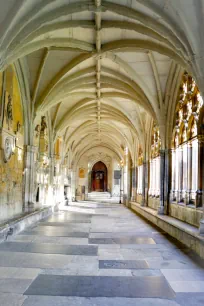
A door in the nave, close to the south transept, leads to the cloisters  , which connects the church with the other abbey buildings. The cloisters we see today are the result of a reconstruction after the original cloisters were destroyed by fire in 1298. Each cloister measures about 100 feet (30 meters) in length. Here you can find yet more memorials, some over 900 years old, like the one for Gilbert Crispin, an abbot who died around 1117.
Chapter House
The Chapter House  , situated east of the cloisters, is an octagonal hall measuring about 18 meters wide (60 feet). This is where the abbot distributed daily tasks to the monks. And until 1395 it was also the site where the King’s Council met, an early version of the English parliament.
The Chapter House was built in 1255, and was probably designed by Henry of Reyns (who also designed the church of Westminster Abbey). A central pillar fans out to support the vaulted ceiling. The room is decorated with a medieval tiled floor that is still original and the walls feature paintings from the Apocalypse. The Chapter House also features a door from the 1050s, which is claimed to be the oldest door, not just in the abbey, but in all of Britain.
Pyx Chamber
Speaking of old, the Pyx Chamber  , a vaulted room accessed from the east cloister through a heavy reinforced oak door, is one of the oldest rooms in the abbey. It was built in 1070 as part of the Norman-style abbey of St. Edward the Confessor. In the 13th century the room became a treasury, where boxes with silver and gold coins were stored. These boxes were called ‘pyx’, hence the name.