


The majestic St. Paul’s Cathedral was built by Christopher Wren between 1675 and 1711. It is one of Europe’s largest cathedrals, and its dome is only exceeded in size by that of the St. Peter’s Basilica in Rome.
History
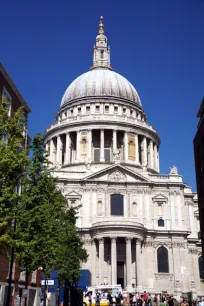
St. Paul’s Cathedral has had an eventful history. Five different churches were built at this site. The first church, dedicated to the apostle Paul, dates back to 604 AD, when King Ethelbert of Kent built a wooden church – on the summit of one of London’s hills – for Mellitus, Bishop of the East Saxons. At the end of the seventh century, the church was built in stone by Erkenwald, Bishop of London.
In 962 and again in 1087, the cathedral was destroyed by fire, but each time it was rebuilt and expanded. By that time, it had become one of the largest cathedrals in Europe. Renovations and extensions in the thirteenth and fourteenth centuries enlarged the cathedral even more.
The Great Fire
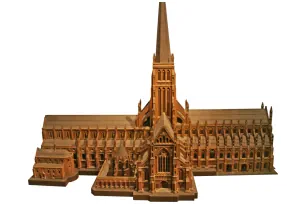
In 1665 Christopher Wren designed a plan for the renovation of the St. Paul’s Cathedral, which was starting to fall into decay. But disaster struck again on the night of September 2, 1666, when the Great Fire of London destroyed four fifth of all of London, wiping 13,200 houses and 89 churches, including the St. Paul’s Cathedral off the map.
Christopher Wren’s Masterpiece
In 1669, three years after the fire, Christopher Wren was appointed ‘Surveyor of Works’ and was tasked with the construction of a new church to replace the destroyed Gothic cathedral.
His first design was deemed too modest. In his second design, known as the ‘Great Model’, the cathedral was shaped like a Greek cross, with a portico, Corinthian columns and a striking large dome, which would be the world’s largest after Michelangelo’s dome at the St. Peter’s Basilica in Rome. This design was rejected as well; the Bishop considered it unsuitable for large processions.
Wren suggested a third design, this time with a larger nave and smaller dome, which was accepted in 1675. However, after the approval, Wren enlarged the dome and made several other adjustments so that the built cathedral now resembles the ‘Great Model’ and not the approved design.
The cathedral was built in a relative short time span: its first stone was laid on June 21, 1675, and the building was completed in 1711.
The Church
The Dome
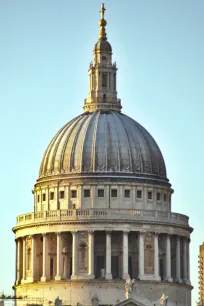
The dome reaches a height of 111 meters (366 ft) and weighs about 66,000 tons. Eight arches support the dome. On top of the dome is a large lantern with a weight of 850 tons.
560 steps lead visitors along three galleries all the way to the top of the dome. The first gallery, the Whispering Gallery, just inside the dome, is renowned for its acoustics. The second gallery, the Stone Gallery, is situated at a height of 53 meters (174 ft) on the outside of the dome, right above the colonnade. On top of the dome, at a height of 85 meters (279 ft), is the narrow Golden Gallery, which encircles the lantern’s base. From here you have a magnificent view over the City.
Interior
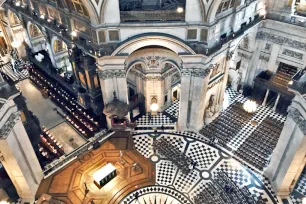
The Baroque interior is just as imposing as the exterior of the church. The mosaics on the ceiling were added in 1890 by William Richmond after Queen Victoria complained that there was not enough color in the cathedral. The baldachin above the altar was rebuilt in 1958 after it was damaged by bombardments during World War II. The design is based on a sketch created by Wren. The only monument in the church that survived the fire of 1666 is the tomb of John Donne (†1631).
Several famous people are entombed in the cathedral’s crypt. Most notable are the tomb of the Duke of Wellington (†1852) – who defeated Napoleon at Waterloo – and the tomb of Admiral Nelson (†1805), who died at the Battle of Trafalgar. There is also a tomb of Christopher Wren (†1723) himself, and a number of important artists are buried here as well.
The West Facade
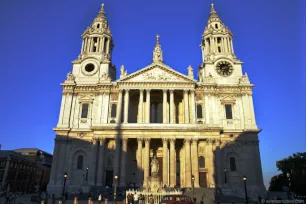
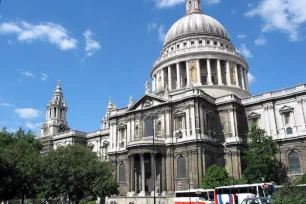
The impressive facade at the west side of the church consists of a large portico and pediment. A relief on the tympanum depicts the conversion of Paul and was created in 1706. The portico is flanked by two towers which weren’t part of the original plan. Wren added them at the last minute, in 1707.
Important Events
The church was the site of a number of important historic events, such as the funeral of Admiral Nelson in 1806 and the funeral of Winston Churchill in 1965. Prince Charles and Lady Diana Spencer married here in 1981.