


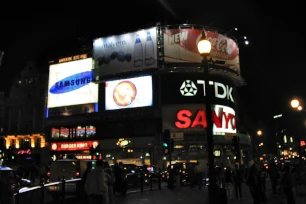
Piccadilly Circus is a busy square in the heart of London. It is famous for the fountain that was installed here at the end of the nineteenth century and for the neon advertising that turned the square into a miniature version of Times Square.
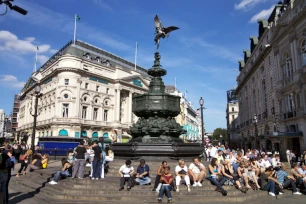
The Circus lies at the intersection of five main roads: Regent Street, Shaftesbury Avenue, Piccadilly Street, Covent Street and Haymarket. It was created by John Nash as part of the future King George IV’s plan to connect Carlton House – where the Prince Regent resided – with Regent’s Park.
Piccadilly
The name ‘Piccadilly’ originates from a seventeenth-century frilled collar named piccadil. Roger Baker, a tailor who became rich making piccadils lived in the area. The word “circus” refers to the roundabout around which the traffic circulated.
Billboards
The creation of Shaftesbury Avenue in 1885 turned the plaza into a busy traffic junction. This made Piccadilly Circus attractive for advertisers, who installed London’s first illuminated billboards here in 1895. For some time the plaza was surrounded by billboards, creating London’s version of Times Square, but currently only one building still carries large (mostly electronic) displays.
Shaftesbury Memorial Fountain
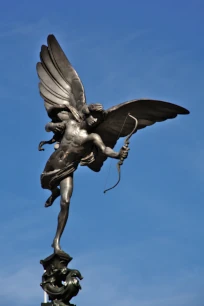
At the center of the Circus stands the Shaftesbury Memorial Fountain. It was built in 1893 to commemorate Lord Shaftesbury, a philanthropist known for his support of the poor.
The seminude statue on top of the fountain, designed by sculptor Alfred Gilbert, depicts the Angel of Christian Charity. It was later renamed Eros, after the Greek god of love and beauty. The fountain was made of bronze, but the statue is made of aluminum, at the time a novel and rare material.
Horses of Helios Fountain and the Daughters of Helios
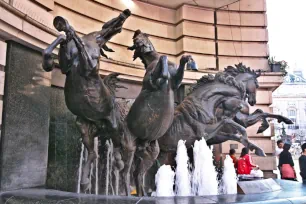
On the corner of the Criterion Building along the east side of the square, is another fountain, known as the Horses of Helios Fountain. It shows four large bronze statues of rearing horses that were created in 1991 by Rudy Weller, a local sculptor. They depict the four horses of Helios, Greek god of the sun. Unfortunately, in 2020 a screen was installed around the horses, so it’s hard to get a good view of the fountain today.
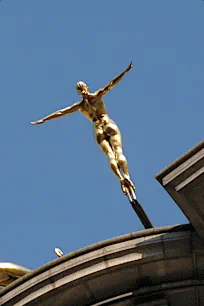
The fountain is complemented by another sculpture group on top of the roof of the Criterion Building, right above the horses. Here are three gilded statues known as the Three Graces. They depict the three daughters of Helios.
Piccadilly Circus Today
Piccadilly Circus is now partly pedestrianized and a favorite place for people to congregate before going to the nearby shopping and entertainment areas. Soho, Chinatown, Leicester Square and Trafalgar Square are all within walking distance.