


The Mosteiro dos Jerónimos is a monastery built in the early sixteenth century in a Portuguese variant of the Gothic style. It is considered one of Lisbon’s most magnificent buildings.
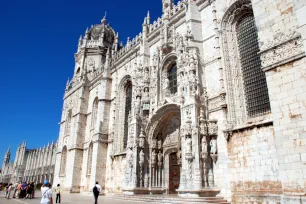
Shortly after the return of Vasco da Gama from India, king Manuel I ordered the construction of a church and cloister for the Hieronymite religious order as a token of thanks for Portugal’s good fortune.
The new building was to replace a small church dedicated to sailors. It is said Vasco da Gama prayed here before departing on his voyage to the Indies. The construction of the magnificent monastery was funded with taxes levied on the spices that da Gama’s ships brought home.
Construction
The first stone of the Mosteiro dos Jerónimos, also known as the Monastery of St Mary of Belém (Bethlehem), was laid in 1502. Construction was supervised by the Frenchman Diogo Boytac. After his death in 1517 several more architects worked on the monastery, most importantly João de Castilho and later Diogo de Torralva. Construction was finally completed in 1600 under the supervision of architect Jérome de Rouen, son of the renowned French sculptor Jean de Rouen.
The Monastery
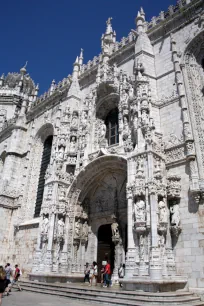
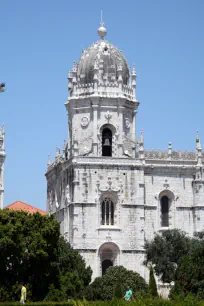
The monastery is one of the foremost examples of the Manueline style, a Portuguese variant of the late Gothic style. Named after king Manuel I, the Manueline style is characterized by its intricately carved stonework with motifs that were often inspired by nautical themes such as chains, ropes, spheres and anchors.
One of the most impressive parts of the monastery is the south portal that leads to the church. The portal, created by João de Castilho, is elaborately decorated with ornaments and statues of the twelve apostles, prophets and angels. The central figure is that of the patroness of the church, St. Mary of Bethlehem.
The western and main entrance is now partially obscured by a more modern wing. This portal was designed by the French sculptor Nicolas Chanterène and is intricately decorated with niches, emblems, coats of arms and statues depicting King Manuel I and his wife, Dona Maria of Aragon.
The Church
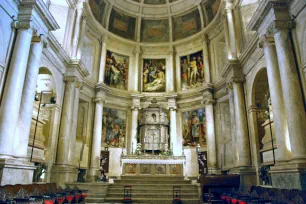
Inside the church, tall octagonal pillars decorated with reliefs separate the central nave from the two aisles.
The chancel was built in 1578 to hold the tombs of the royal family. The large tomb of king Manuel I and his wife is supported by elephant statues. King John III and queen Catherine are also entombed here.
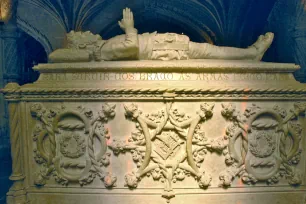
The church also contains the tombs of explorer Vasco da Gama and poet Luís de Camões and a large empty tomb commemorates king Sebastian, who never returned from the 1578 Battle of Ksar El Kebir.
The choir has skillfully sculpted wooden stalls. Also of note is the beautifully carved pulpit and the large stained-glass windows.
The Cloister
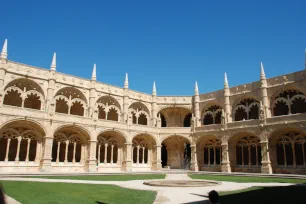
The sacristy leads to the magnificent cloister, which in itself is well worth a visit. Created by João de Castilho and completed in 1544, the two-story cloister is profusely decorated with rich Manueline motifs. Each column has unique decorations; no two columns are alike. To the west, the cloister is bordered by the refectory, decorated with eighteenth-century azulejos (ceramic tiles). Opposite the refectory is the chapter house, which holds the tomb of the first mayor of Belém.
Museums
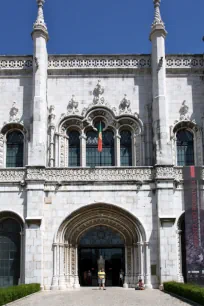
Until 1834, when the religious order was disbanded, the west wing of the Hieronymites Monastery served as the sleeping quarters of the monks. In 1850 the wing was renovated in Neo-Manueline style.
Since 1893 it has been home to the Museum of Archaeology – the country’s most important archaeological museum with an interesting collection of precious metalwork – and the Maritime museum, which highlights Portugal’s rich maritime history with a display of model ships, globes, and other objects.