


The powerful Medici family created the Boboli Garden in the sixteenth century behind the Pitti Palace. The beautiful and varied Italianesque garden is home to an abundance of statues and fountains.
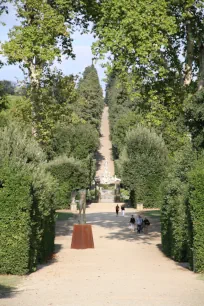
The estate was obtained by the Medici family in 1549, when Eleonora di Toledo purchased the Palazzo Pitti. Her husband, duke Cosimo I, hired the most reputed landscape gardeners of his time to lay out the expansive garden on the sloping terrain behind the palace. The result was an elegant Italian Renaissance garden with geometric patterns.
The Garden
The domain was expanded several times over the years and many statues and fountains were added to the garden, which opened to the public in 1776. Parts of the garden are laid out formally with geometric patterns, while others are more natural.
The Boboli garden offers a lot of variety thanks to its undulating topography, the varied layout of the garden and the many decorations. From the top of the terraces, you have beautiful views over Florence and the surrounding landscape.
Exploring the Garden
There are several entrances to the garden, the most popular are located at the Piazza dei Pitti and the Piazzale della Porta Romana, situated at the eastern tip of the park. Entrance to the park is not free, you can either buy a ticket for the garden or you can obtain a combination ticket which gives access to both the Pitti Palace and the Boboli Garden.
Bacchus Fountain
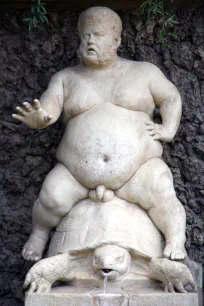
Entering the park from the Piazza dei Pitti, you’ll come across the Bacchus Fountain, one of the park’s most singular fountains. It depicts Pietro Barbino – the court jester of duke Cosimo I – as the Roman god of wine. Nearby, two Roman statues of Dacian prisoners flank the entrance to the actual park.
Grotto Grande
To the left of the park’s entrance is an artificial grotto, known as the Grotto Grande, also called Grotto del Buontalenti after the designer of the richly decorated cave. The grotto, which was built between 1583 and 1588 consists of three connected chambers which contain a number of sculptures.
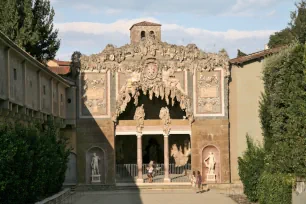
Replicas of the statues of four slaves – unfinished sculptures that were created by Michelangelo between 1521 and 1523 for the tomb of Pope Julius II – can be found in the first chamber. The statues, which seem to try to break free from the marble blocks, were installed here in 1585. The originals can now be found at the Galleria dell’Accademia.
The statue in the grotto’s second chamber is «Paris and Helena», sculpted in 1560 by Vincenzo de’ Rossi. The third chamber contains the statue of the bathing Venus, created by Giambologna in 1565. The statues in the niches of the grotto’s façade depict Apollo and Ceres. Unfortunately, the grotto is often closed to visitors.
Kaffeehaus
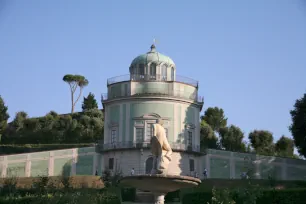
Just north of the Grotto Grande lies a terraced garden leading to the Kaffeehaus, an elegant pavilion in Rococo style that was built here in 1775. It is currently used as a coffee house. At the center of the garden below the Kaffeehaus is a small fountain, which depicts the Greek hero Ganymede climbing on an eagle.
Amphitheater
The amphitheater of the Boboli Garden is located right behind the Pitti Palace. This was originally the location of the quarry which supplied stones for the construction of the palace.
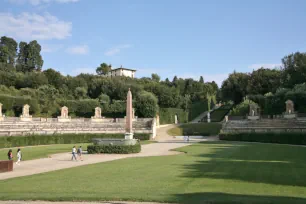
The amphitheater is decorated with a number of niches in which classical statues and urns were placed. The Egyptian obelisk at the center of the amphitheater was originally erected in Heliopolis by pharaoh Ramesses II. It was first transported to Rome, and later installed here by the Medici.
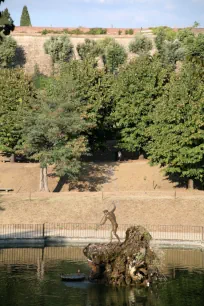
The amphitheater leads from the Palazzo Pitti towards a small pond; its central Neptune Fountain was created in 1565-1568 by Stoldo Lorenzi.
Knights’ Garden
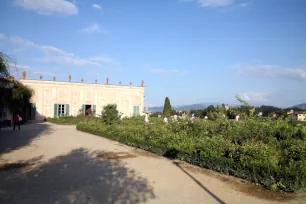
An uphill climb brings you to a terrace with a small formal rose garden, known as the Giardano del Cavaliere or Knights’ Garden. A small sculpted fountain is installed at the center of the garden. From the terrace you have a magnificent view over the surrounding area. The small building bordering the Knights’ Garden houses the Porcelain Museum.
Viottolone and Isolotto
The western part of the Boboli Garden is less formal and mostly consists of woodland. A wide central lane, known as Il Viottolone, cuts through this area.
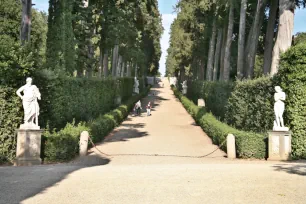
The lane, lined with cypresses and statues, leads to the Isolotto, a small island. The fountain in the middle of the island is a replica of the Oceanus Fountain that was created in 1576 by Giambologna. The original fountain is now in the Bargello. Sculptures of bizarre mythical creatures flank the entrances of small passages leading to the island.