


Navy Pier is a large pier on Lake Michigan near Streeterville, close to Chicago’s downtown. Originally known as the Municipal Pier no. 2, it is one of two piers called for in Daniel Burnham’s 1909 Chicago plan. The other pier was never built.
History
Construction
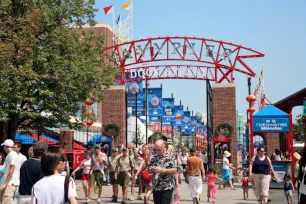
Construction started in May 1914 and in 1916 it was opened to the public. At the time it was the world’s largest pier, 292 ft. wide and 3000 ft. long (89 m. x 914 m.).
The pier was designed as a shipping and entertainment area. In its first decade, the Municipal Pier was successfully attracting both visitors and ships. It was also temporarily used as a military facility during the First World War.
Decline
By the end of the 1920s, Navy Pier’s success started to decline. The introduction of cars and the opening of movie theaters created more competition for the Pier, and the number of visitors dwindled. Shipping started to decline in the 1930s due to the Great Depression and the competition of transportation by truck.
Navy Pier
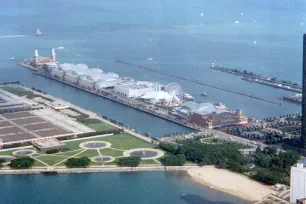
In 1927 the pier was renamed Navy Pier in honor of World War I veterans. It would turn out to be a prophetic name change, as the Navy Pier served as a naval training facility during the Second World War. After the war, it served as the Chicago branch of the University of Illinois. In 1965 the university moved to its new location and the Navy Pier started to decay.
Redevelopment
The first step in the redevelopment of the Navy Pier was the 1976 restoration by Jerome R. Butler, Jr. of the Auditorium building at the eastern end of the pier. One year later, it was designated a Chicago Landmark. Another step in the redevelopment of the Navy Pier was taken in 1989, when the city of Chicago and the State of Illinois installed the Metropolitan Pier & Exposition Authority, an organization responsible for the management of the pier.
At the same time, they committed 150 million dollar for reconversion of the pier as a recreational center. The renovation by Benjamin Thompson & associates started in 1992 and was completed in 1994.

The result is a very successful recreational center right next to Chicago’s downtown area. Thanks to its many attractions and fifty acres of parks and gardens (20 hectares) it attracts more than eight million visitors each year.
Sights & Attractions
Headhouse & Auditorium
The two major buildings on the Navy Pier, Headhouse and Auditorium – both designed by the architect Charles Summer Frost and constructed in 1916 – have survived its ups and downs.
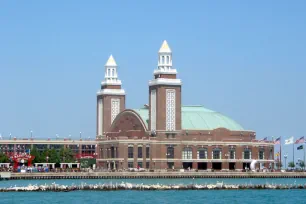
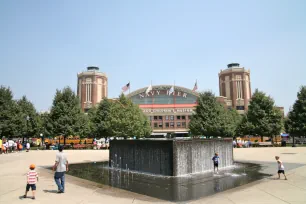
The most western building, a brick and terracotta building with two prominent towers, is the Navy Pier Headhouse. The name was derived from the area, which at the time was known as the Headlands. Each tower housed a huge two million liter tank for the fire sprinkler system.
The Headhouse is now home to Chicago’s Children’s Museum. At the western side of the building is the 19 acre (8 hectare) Gateway Park, featuring a modern, computerized granite fountain with 240 jets.
At the other end of the pier is the Auditorium, also known as the Hall. This beautiful building with a magnificent Grand Ballroom measures 138 ft. by 150 ft. (42 m. x 48 m.) and has a 100 ft. (30 m.) high half-domed ceiling.
More Attractions
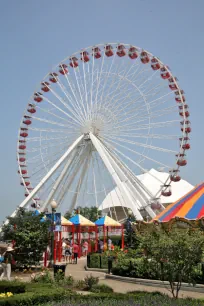
The Navy Pier is home to many attractions, some may vary depending on the season. For a comprehensive list, prices and schedules, have a look at Navy Pier’s own website: www.navypier.com. Here’s an overview of attractions found at the pier:
- The most eye-catching attraction is the 148 ft. (45 m.) high Ferris Wheel. It was modeled after the first Ferris wheel built for the 1893 World Columbian Exposition.
- Near the Ferris Wheel is a 44 ft. high musical carousel with 36 hand-painted animals.
- The skyline stage, a 100 ft. (30 m.) high vaulted roof structure, is used as an ice skating rink during wintertime and as a 1500-seat theater during summer.
- The Navy Pier is home to the Children’s museum (which planned a seemingly stalled move to Grant Park). It also used to house the Smith museum of Stained Glass Windows, which opened in 2000. Disappointingly, the latter, which displayed a magnificent collection of 143 stained-glass panels from around the world, closed in 2014.
- A seven-story Shakespeare theater complex with a 525 seat theater is an attraction of Navy Pier.
- The Navy Pier Aeroballoon, an anchored helium-filled balloon that floats above the lakefront with up to eighteen passengers, allows visitors to admire Chicago’s skyline from a height of 350 ft. (107 m.).
- Other attractions are an eighteen-hole miniature golf course, a fun house maze, a beer garden, a 40-foot-high wave swinger and an IMAX Theater.
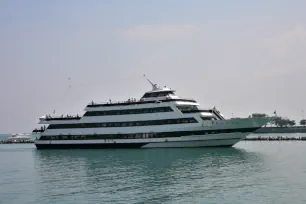
- Navy Pier is also a starting point for many boat trips. You have ample choice: You can take a trip on a 148ft high, four-masted schooner, or you can hop on one of the four Seadogs reaching speeds of up to 25 knots (www.seadogcruises.com).Architecture cruises and water taxis (www.shorelinesightseeing.com) are also available. You can also opt to take a romantic dinner cruise, and you can even charter ships.
You can also rent some of the pier’s areas, including the English Garden Tent and the Crystal Gardens, a one-acre indoor glass atrium with more than seventy palm trees.
- Next: Chicago River
- More Sights & Attractions in Chicago