


The Museum of Science and Industry is one of the most popular museums in the United States. It covers diverse areas like energy, the environment, the human body, space exploration and transportation. It is located in the South Side, not far from the University of Chicago.
A New Industrial Museum


The museum occupies a beautiful Beaux-Arts building designed by Charles C. Atwood. It was built for the 1893 World Columbian Exposition as the Palace of Fine Arts. After the fair, the building was occupied by the Field Museum. But in 1921 the Field Museum moved to its current home in Grant Park and the building, which was initially constructed as a temporary structure, started to deteriorate fast.
In 1926, Julius Rosenwald, owner of Sears, Roebuck & Co. came to the rescue. Inspired by a visit in 1911 to the Deutsches Museum in Munich featuring interactive exhibits, he wanted to bring such a museum to Chicago. Thanks to a donation of 3 million dollar, the new Industrial museum was founded as the Rosenwald Industrial Museum.
Palace of Fine Arts
When looking for a building to house the museum, the empty Palace of Fine Arts came into focus. Another 5 million dollar was spent on the restoration of the building. The plaster-clad building was reconstructed with limestone and marble.
The original exterior Beaux-Arts design, including the twenty-four caryatids, was kept while the interior was adapted to its new purpose as an industry museum. In 1928, the museum changed its name to Museum of Science and Industry, and it officially opened in 1933, just in time for the Century of Progress Exposition, a world exposition held to commemorate the one hundredth anniversary of the incorporation of Chicago as a city. The building was designated as a Chicago Landmark in 1995.
Exhibits
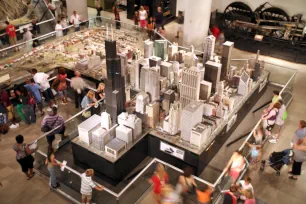

The museum has three floors, covering a total of 350,000 sq ft or 32,520 sq m. It has more than eight hundred exhibits and over two thousand interactive units. The museum attracts close to two million visitors per year.
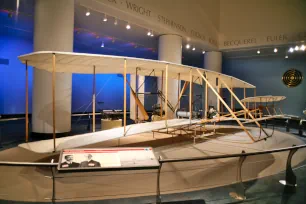
Among the many exhibits are a WWII German U-505 submarine, an Apollo 8 Commando Module (the first manned spacecraft to orbit the moon), a Boeing, a WWII British Spitfire and a replica of the plane used by the Wright Brothers for their first flight.
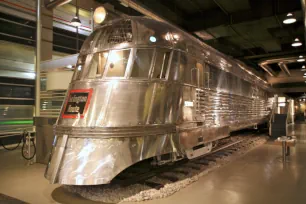
Another transportation related exhibit is the Zephyr train, which in 1934 smashed the speed record by traveling from Chicago to Denver at an average speed of 124.9 km/h (77.6 mi/h). This shaved more than twelve hours off the previous record. Another train related exhibit is the ‘Great Train Story’, a model railroad that recreates the journey between Chicago and Seattle.
The energy section includes a reconstruction of a 1933 Illinois coal mine, which allows people to descend fifty feet (15 meters) into the mine. It was the first exhibit of the museum, but it is still one of the main attractions.
The museum also boasts the world’s largest pinball machine as well as a Fairy Castle, a 9 sq. ft. dollhouse with working electricity and plumbing. Another attraction is ‘Earth Revealed, where images are projected on a 6-feet-diameter globe (1.8 meters).
Other exhibitions in the museum cover a wide array of topics including petroleum, genetics, the internet, model ships, the navy, space and architecture. A new attraction – Science Storms – opened in March 2010 and simulates seven natural phenomena: lightning, avalanches, tsunamis, fire, tornadoes, sunlight and gravity.
Attractions change over time, to get the latest information check out the website of the Museum of Science and Industry msichicago.org.
- Next: City Hall
- More Sights & Attractions in Chicago