


On the northeast slope of Gellért Hill stands a monument that pays tribute to Saint Gellért Sagredo, the eleventh-century bishop who tried to convert the Magyars to Christianity.
Saint Gellért
In the early years of the eleventh century, Gellért (Gerard in English), the Benedictine Abbot of San Giorgio Maggiore in Venice, was on his way to Palestine on a pilgrimage when he was detained by the country’s King Stephen, who asked the bishop to stay and tutor his son Imre, and to help convert the pagan Magyars to Christianity. Gellért agreed to take on the challenge and remained in the country for many years under the protection of the king.
Several years after Stephen’s death, in 1046, insurgents who wanted a return to paganism captured Gellért in Buda. According to legend, he was sent to his demise in a barrel pierced with nails and rolled down the steep hill. At the time, the hill was known as Kelen-hegy (Eastern Hill), but it was later renamed Gellért-hegy in honor of the saint.
The Monument
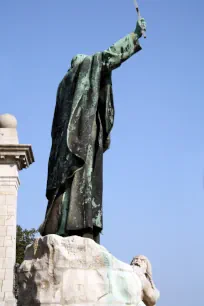
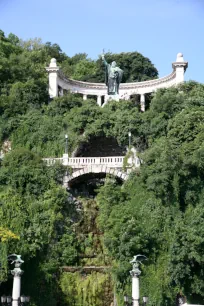
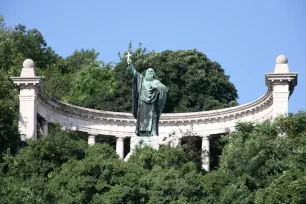
In 1904, a monument was erected at the site where Gellért met his death. The statue of the bishop, designed by sculptor Gyula Jankovits, is framed by a neoclassical semicircular colonnade. The twelve-meter-tall (39ft) statue shows Gellért victoriously holding aloft a crucifix. At his feet, a wild-looking Magyar looks up towards the bishop as if standing in awe. Below the sculpture sits a pretty man-made waterfall.
The best place from which to view the statue is from the Elizabeth Bridge. However, if you want a closer look, you can climb up to the bronze likeness of Bishop Gellért via a flight of steps that originate at the bridge.
The monument can be seen from all over Budapest, especially at night when it is illuminated.