


Once the busiest crossing in Europe, Potsdamer Platz was completely demolished after the Second World War. In 1998 the new Potsdamer Platz, full of modern buildings, officially opened.
History
In the 1920s and 30s, Potsdamer Platz was the busiest and one of the liveliest squares in Europe. It was a major public transport hub and a popular entertainment district pulsating with life: the area contained numerous bars, cafés and cinemas.
This all came to an abrupt end in 1943 when Potsdamer Platz was reduced to ruins by allied bombing. After the Second World War, the square was located between the American, British and Russian sectors and became a no-man’s land. The area was completely flattened with the construction of the Berlin Wall in 1961 when the remaining buildings on the east side of the wall were pulled down.
Redevelopment
After the fall of the Berlin Wall it was decided to rebuild the whole, almost fifty hectare (124 acre) large area. Construction started in 1994 and for many years Potsdamer Platz was the largest construction site in Europe. The square, together with several adjacent blocks, were redeveloped by renowned architects from around the world following a master plan created by the German architects Heinz Hilmer and Christoph Sattler.
The project included the construction of several office towers, a shopping arcade, an entertainment center and residential buildings as well as the necessary infrastructure such as streets and subway tunnels.
The first building completed was the Debis Tower, a high-rise designed by Renzo Piano. It is part of the Daimler-Chrysler-Areal, one of three complexes that were built around the square. It is home to office towers, a shopping arcade and an IMAX theatre. Another complex, bordering Tiergarten, is the more subdued Beisheim Center, which contains offices, hotels and residential buildings. The third and most famous complex is the Sony Center, designed by Helmut Jahn, an American architect of German descent. It features a tent-like roof inspired by Japan’s Mount Fuji.
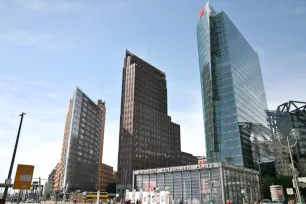
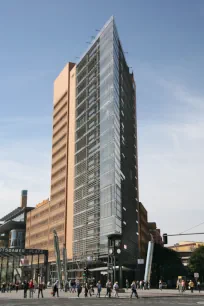
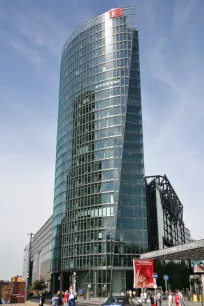
The three complexes join together at Potsdamer Platz, where three modern towers symbolize the rebirth of Potsdamer Platz. The wedge-shaped building on the left, the Forum Tower, was designed by Renzo Piano. The central brick tower is the Kollhoff-tower, named after its architect Hans Kollhoff. On the 24th and 25th floor of the tower is the Panoramapunkt, an observation deck with an open-air viewing platform. The third tower is the BahnTower, a 26-story tower with a curved glass facade, designed by Helmut Jahn and built in 1998-2000.
The square today
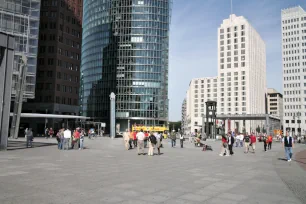
All the new development helped to bring life to the new Potsdamer Platz. The modern buildings are not everyone’s cup of tea and the square is a bit bare, but there are some sights on and around Potsdamer Platz.
Sony Center
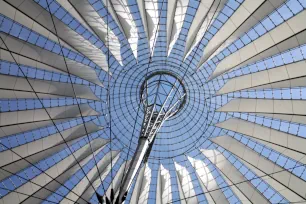
One of the crowd-pullers is the Sony Center, which opened in 2000. At the heart of the complex is a courtyard covered with a tent-like glass roof. The complex accommodates offices, apartments, bars and restaurants. The Kaisersaal, an opulent hall from the prewar Hotel Esplanade, was incorporated into the Sony Center and is now a restaurant. The Sony Center is also home to the Filmhaus Museum, a museum that recounts the history of the German film industry from the 1911 Filmstudio Babelsberg over the stars from the 1930s such as Marlene Dietrich and Fritz Lang to the contemporary German film industry.
Other Attractions
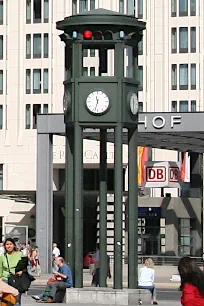
On the square, you can see a replica of the first ever semi-automated traffic light tower in Europe, which was first operated here in 1924 and stood in the middle of Potsdamer Platz.
A recent attraction is the ‘Boulevard der Stars’, Berlin’s version of Hollywood’s famous Walk of Fame. Stars in the pavement of Potsdamer Straße honor German film stars. Marlene Dietrich was the first to receive such a star, in February 2010.
Another attraction is a small section of the Berlin Wall that is on display right near the entrance of the underground railway station.
- Next: Museum Island
- More Sights & Attractions in Berlin