


Potsdam, the capital of the Brandenburg state, is not an actual part of the city of Berlin. But only 24 km from Germany’s capital, it is the most popular day trip from Berlin.
Most of Potsdam’s many sights were built during the eighteenth and nineteenth centuries, when the city was the residence of the Prussian kings. During the reign of the ‘Soldier King’ Frederick William I, Potsdam became both a garrison city and a royal seat of the Prussian kingdom. His son Frederick II built the famous Sanssouci castle and the Neues Palais in the Sanssouci Park.
Although Potsdam was heavily damaged by allied bombing in 1945, most of the palaces in the Sanssouci Park remained unscathed.
Holländisches Viertel
During the eighteenth century, Potsdam attracted a large number of foreigners. Some, like the French Huguenots, were religious refugees. At some point, one third of the inhabitants were French. Others, like the Dutch, Flemish and Swiss were attracted for their craftsmanship.
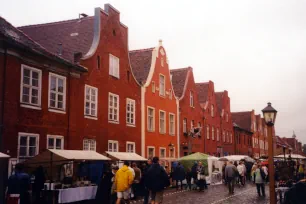
For the Dutch immigrants, a settlement of 134 red brick houses was built. The mostly three-story houses have typical Dutch style gables. The gardens in front of the houses have disappeared. This Dutch district, known as the Holländisches Viertel, is very popular with tourists.
Russian town
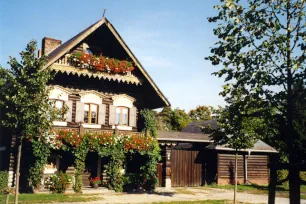
In the nineteenth century a number of Russian soldiers, part of a choir to entertain the Prussian troops, lived in the city. In 1826, Frederick William II ordered the construction of a new neighborhood for these soldiers. This ‘Russian town’ was named Alexandrowka after the Tsarina. In total, twelve picturesque wooden houses were built at the estate. A small Russian-orthodox chapel, the Alexander-Newski kirche, was added later.
Französische Kirche
Nikolaikirche
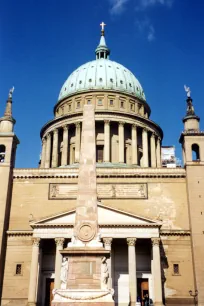
The Nikolaikirche, the most imposing church in Potsdam, dominates the Alter Markt. It was built in 1830 by Karl Friedrich Schinkel, who is also known for the Berliner Dom and the Konzerthaus at the Gendarmenmarkt. The large dome was added between 1843 and 1848. The obelisk in front of the church was constructed between 1753 and 1755.
Wasserwerk Sanssouci
Another remarkable building in Potsdam is the Wasserwerk Sanssouci. It is actually a steam pump built in 1842 for the fountains in the Park Sanssouci. The Moorish-style building has no other purpose than to hide the machinery inside. The minaret actually serves a chimney.
City Gates
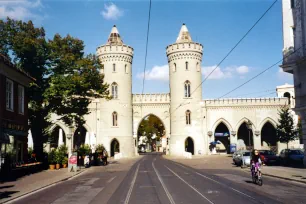
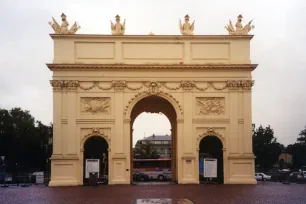
Of the five original city gates which were part of a 1733 extended wall surrounding Potsdam, three remain today. The oldest one still in its original form is the 1733 Jägertor. The Nauener Tor, which was redesigned in 1755 by Johann Gottfried Büring is built in a neo-Gothic style. The third one, Brandenburger Tor, is built as a triumphal arch. It is older than its Berlin counterpart (1770), but it is also much smaller.
Schloss Sanssouci
Potsdam is probably best known for its many castles. The 1747 Schloss Sanssouci, built as a residence for the Prussian kings, is probably the most famous. It is located in the large Sanssouci Park, west of Potsdam’s historic center. It also contains the small Schloss Charlottenhof and the large Neues Palais.
Schloss Cecilienhof
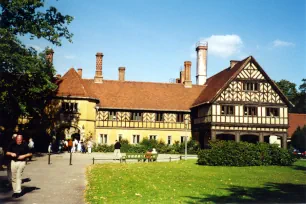
A more recent castle is the Schloss Cecilienhof, located in the Neuer Garten, a park laid out between 1787 and 1791. The castle itself was built between 1914 and 1917 as an English-style country manor and served as the summer residence of the Hohenzollern family. It is best known as the site of the 1945 Potsdam conference. This is where Churchill, Truman and Stalin met to discuss the political situation after the defeat of Germany that same year. The castle is now a hotel and restaurant.
Filmpark Babelberg
Another attraction in Potsdam is the Filmpark Babelberg. This is where some of Germany’s most famous films were created, including the 1927 masterpiece Metropolis and the 1930 The Blue Angel, a movie featuring Marlene Dietrich. At the time, it was Europe’s Hollywood. After the Nazis came to power, many actors and artists moved to the US.
You can visit the film sets from old films, including the submarine U-boat. The park also features stuntmen and a display of special effects.
- Next: Nikolaiviertel
- More Sights & Attractions in Berlin