


Granted UNESCO National Heritage Site status in the year 1999, Berlin’s Museum Island was designed to be “a sanctuary of art and science”. The island is home to no less than five of Berlin’s major museums.
The museums that make up Museum Island are located on the northern part of the Spreeinsel (Spree Island). Together, this cluster of grand museum buildings form one of the world’s greatest museum complexes.
History of Museum Island
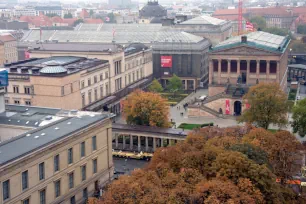
The history of Museum Island started with King Frederick William III, who, in 1810, commissioned the creation of a public museum on Spree Island.
In 1822 Karl Friedrich Schinkel drew up plans to develop the island, and a first museum building, the Royal Museum (now the Altes Museum) opened in 1830. The museum was built to allow the general public to view the royal art treasures of Prussia. It was the first such museum in the country.
But the idea for a museum island wasn’t devised until around 1841, when Friedrich August Stüler proposed the idea to create a cultural center on the island, which was lauded by all. The architect also designed the Neues Museum (New Museum), which opened in 1859 as the Royal Prussian Museum.
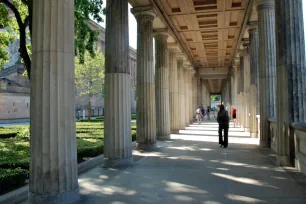
The year 1876 saw the completion of the National Gallery (now the Old National Gallery). The Kaiser-Friedrich Museum (today the Bode Museum) was added in 1904 and the final museum, the Pergamon, was completed in 1930.
Sadly, nearly seventy percent of the buildings were destroyed during World War II and, after the war, the collections were split up between East and West Berlin. After German reunification, the collections were brought together again and a master plan was drawn up designed to not only restore all five museums but also expand and modernize the museum complex as a whole.
In 2019 the James-Simon-Galerie opened its doors on the island. This new modern building serves as the central hub for tickets and access to the museums. It was built at the site of the former customs warehouse behind the Neues Museum. The building was named after James Simon, a local entrepreneur who was a patron of Berlin museums. He is best known for donating the Nefertiti Bust to the Neues Museum, where it can still be admired today.
The Museums
Altes Museum
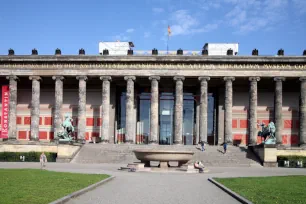
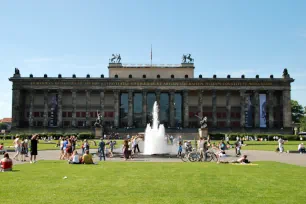
Restored and reopened in 1966 as a museum of contemporary art, the Altes Museum now houses ancient Greek and Roman antiquities, though it was originally built to display all the treasures of the royal family.
Designed by the city’s greatest architect, Karl Friedrich Schinkel, the building resembles a Greek Ionic Temple.
Alte Nationalgalerie
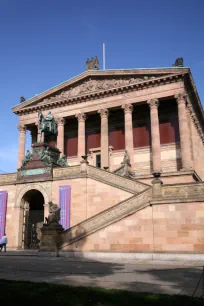
The Old National Gallery (Alte Nationalgalerie) re-opened in 2001 with much fanfare. It was the first museum to re-open after the reunification of Germany. It owns one of the largest collections of nineteenth-century sculpture and paintings in the country. Visitors will find numerous works by well-known German artists of that century here, as well as an excellent display of French Impressionist pieces.
The Nationalgalerie is the most elegant of all buildings on Museum Island. It was designed by Friedrich August Stüler as a grand classical temple built upon an enormous pedestal.
Bode Museum
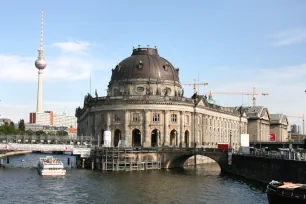
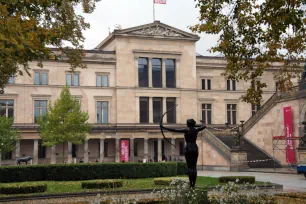
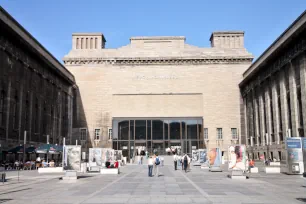
The Bode Museum reopened in 2006 after almost ten years of renovation. The museum boasts a large collection of sculptures, one of the world’s largest numismatic collections and a selection of paintings from the Gemäldegalerie. The building is situated at the northern tip of the island, and looks like a ship’s bow plowing through the river Spree.
Neues Museum
The Neues Museum reopened in 2009 and houses a collection of prehistoric, early history and Egyptian works of Art. The most famous piece of art is the bust of Queen Nefertiti.
The museum was originally built between 1843 and 1859 to a design by Friedrich August Stüler. Of all the museums on the island, this was the most damaged. While the others were at least partially restored in the years after the war, this building was left in ruins until the reunification of Germany.
Pergamon Museum
The crowd puller of Museum Island is the monumental Pergamon Museum, where you’ll find a collection of Greek, Roman and Babylonian antiquities. Highlights include impressive monuments such as the Ishtar Gate of Babylon, the market gate of Miletus and the enormous Pergamon Altar.
More Sights
There’s more than just museums on Museum Island. The island was long a center of ecclesiastical and worldly power in Berlin: both the cathedral and palace were built here.
Dom
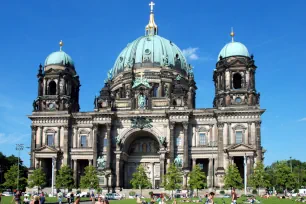
The Dom, Berlin’s main cathedral, was built at the end of the eighteenth century as a protestant counterpart of the St. Peter’s Basilica in Rome. The cathedral is lavishly decorated in the Baroque style. The basement of the cathedral holds the Hohenzollern family crypt. It contains more than ninety sarcophagi, including that of Frederick William, the Great Elector.
Lustgarten
The garden in front of the cathedral is the Lustgarten. The garden was originally created as an exotic garden for Princess Luise, spouse of the Great Elector. King Frederick William I, the so-called ‘Soldier-King’, turned the garden into a military parade ground.
In 1997 the garden was laid out to a nineteenth-century design by Schinkel. As part of the remodeling, a modern fountain was installed in 2000 in the middle of the garden. The fountain, designed by Hans Loidl, spouts water up to ten meters high and attracts the attention of passers-by.
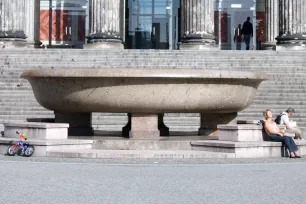
More interesting however is the huge Graniteschale (granite bowl) in front of the Altes Museum. It was commissioned in 1826 by King Frederick III and was created from a large, 700 tonnes weighing, red granite rock found just outside Berlin.
The bowl was designed by Christian Gottlieb Cantian in the style of the great porphyry bowl from Emperor Nero’s Golden House (now on display in the Vatican Museums). When it was completed in 1828, it was the world’s largest bowl, measuring 6.91 meters (23 ft) in diameter and weighing over seventy tonnes. It was to be placed in the rotunda of the Altes Museum, but due to a miscalculation the bowl was too large, so instead it was placed outside.
Stadtschloss
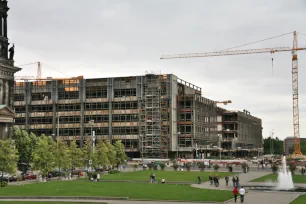
Museum Island proper technically ends just south of the Lustgarten, but there are some other buildings on the Spree Island that are not to be missed: the former palace and royal stables.
Right next to the cathedral stood the Berlin Palace, also known as the Stadtschloss (city palace), an enormous palace that was the main residence of the Prussian kings. Until 1930 no building in Berlin was allowed to be taller than the dome of the Stadtschloss. In 1950, the building – which was considered a symbol of Prussian militarism – was demolished by the East German authorities.
In 1976 the Prussian palace was replaced by the Palast der Republik, a bafflingly ugly building with orange reflective glass windows. Shortly after German reunification, asbestos was discovered in the building, so in 2006 it was demolished as well. The following year, a project to rebuild the Berlin Palace was approved by the German parliament. Construction started in 2017 and was completed three years later. Unfortunately, only the outer walls were rebuilt to their original design; the interior is, disappointingly, all modern. The palace is now home to two former museums: the Ethnological Museum of Berlin and the Museum of Asian Art, which were brought together under one umbrella with the name Humboldt Forum.
Marstall
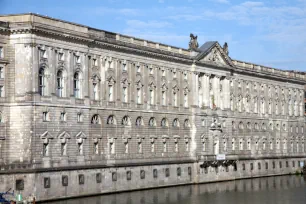
Adjacent to the former palace is the Marstall, the royal stables. The large Baroque building is just a wing of the former complex that was built in 1669 by the Dutch architect Michael Matthias Smids. The building is now used as a library and archive.
- Next: Tiergarten
- More Sights & Attractions in Berlin