


Schloss Charlottenburg is a Baroque palace situated in Berlin’s western Charlottenburg district. The eighteenth-century palace burned to the ground during the Second World War, but has been completely reconstructed.
The palace is now one of only a few buildings in Berlin that show the grandeur of the Hohenzollern dynasty, who for centuries ruled over Prussia.
History
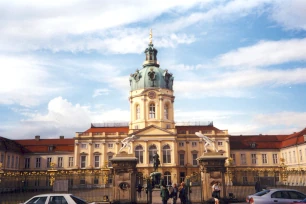
Charlottenburg Palace was originally built as a modest summer residence for Sophie Charlotte, spouse of the Elector of Brandenburg, Frederick III. Construction of the palace, which at the time was known as Lietzenburg, started in 1695 to a design by Johann Arnold Nering. The palace was relatively modest both in size and design, so when Frederick became the first Prussian King in 1701 plans were soon made for a significant and grand expansion.
The Swedish court architect Johann Friedrich Eosander von Göthe supervised the expansion. The architect had just returned from trips to Paris and Rome, which inspired him to crown the palace with a monumental 48-meter-tall dome topped with a statue of the goddess Fortuna. He also significantly expanded the wings, which included the construction of an orangery at the west wing.
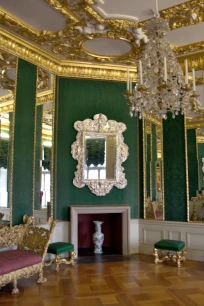
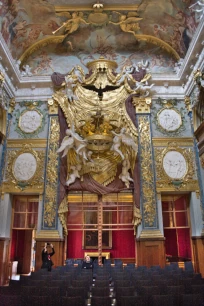
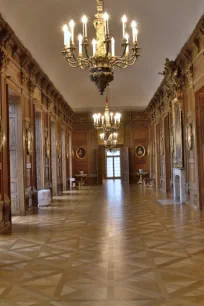
Frederick’s son, the ‘Soldier King’, wasn’t interested in architecture, so when he ascended the throne in 1713 all construction work was halted. It was only in 1740 that construction continued when Frederick the Great commissioned the Prussian architect Georg Wenzeslaus von Knobelsdorff with the expansion of the east wing (the Neuer Flügel or New Wing) to complement the larger west wing. It was completed six years later.
In 1943, during a British air raid, the palace was hit by a bomb, which caused a fire that completely destroyed the building. After the war there were plans to demolish the palace, but after the East German government demolished the main palace of the Hohenzollern in 1950, West German authorities decided to restore Charlottenburg Palace, a project that took more than sixty years to complete.
The Palace
Altes Schloss
The central and oldest part of the palace is the domed Altes Schloss (Old Palace), which is also called the Nering-Eosander-Bau after its two architects.
Here you can visit the apartments of Frederick I and Queen Sophie Charlotte. The rooms are decorated in a sumptuous Baroque style with plenty of stucco, wood paneling, gilded ornaments and frescoes. Unfortunately, not all frescoes have been restored. Some ceilings are plain white, since restorers don’t know what the frescoes originally looked like.
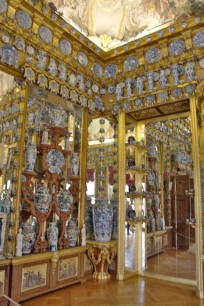
One of the highlights in the Old Palace is the Oak Gallery, an oak-paneled hall with oval family portraits depicting members of the House of Hohenzollern. Other interesting rooms include the Oval Room, which looks out over the garden; the opulent Schlosskapelle, a chapel with an impressive royal box; and the Porcelain Chamber, laden with more than two thousand pieces of Chinese porcelain.
Neuer Flügel
Some of the palace’s most beautiful rooms can be admired in the Neuer Flügel (New Wing), which reopened to the public in December 2014 after a two-year restoration of the approx. 150 meter long facades. Inside you can visit the lush private living quarters of Frederick the Great and the less pretentious but stylish apartments of Frederick William II. Frederick the Great was an admirer of French painting, and a large part of his collection of eighteenth-century paintings is on display in the private rooms. One remarkable painting shows Napoleon leading his army through the Swiss mountains. It was brought here from Paris after Napoleon’s defeat at Waterloo.
The most impressive rooms in the New Wing are the two large halls: the Weisser Saal (White Hall), a magnificent dining room, and the Goldene Galerie (Golden Gallery), a 42-meter-long (138 ft) ballroom decorated with mirrors and gilded Rococo-ornaments. Also don’t miss the collection of marble statues from the nineteenth century, on display in the vestibule of the New Wing.
The Palace Garden
Charlottenburg park
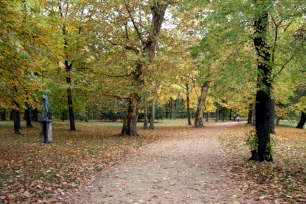
The park behind Charlottenburg Palace was originally created between 1697 and 1701 by Siméon Godeau, a pupil of André Le Nôtre, the creator of the magnificent palace gardens of Versailles. Godeau created a formal garden in French Baroque style, with parterres and hedges trimmed in geometric patterns.
In the eighteenth and nineteenth centuries, the park was converted into a less formal, English style landscaped garden. After the Second World War, a section of the garden behind the old palace was recreated in French Baroque style, while the rest of the garden has a more natural layout.
Neuer Pavillon
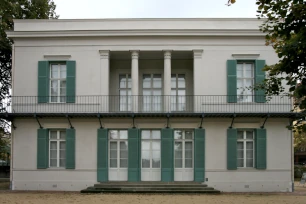
In the idyllic park you’ll find a number of interesting buildings. The rectangular building near the New Wing is the Neuer Pavillon (New Pavilion), also named Schinkel-Pavillon after its architect, the great Karl Friedrich Schinkel. Schinkel built the pavilion in 1825 for King Frederick William III, who wanted to use the building as a small retreat. The king had it modeled on the Villa Chiatamone in Naples, where he had stayed during a trip through Italy. In front of the pavilion are two columns, topped with statues symbolizing victory.
Belvedere
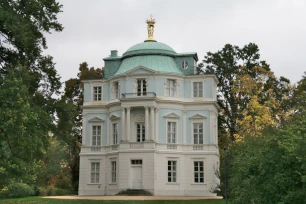
Towards the northern end of the palace garden, near the river Spree, is the Belvedere. It was commissioned by Frederick William II and built between 1788 and 1790 as a teahouse, although it has the appearance of a miniature palace. The domed building was designed in Rococo style by Carl Gotthard Langhans, who at the time was also working on the Brandenburg Gate.
The Belvedere was destroyed during the Second World War, but rebuilt between 1956 and 1960. Today it houses a collection of eighteenth-century porcelain produced by Berlin manufacturers.
Mausoleum
On the western side of the palace garden is the Mausoleum, a Doric temple built in 1810 by Heinrich Gentz as the burial place for Queen Luise. It was later expanded to include the sarcophagi of other members of the royal family, including Frederick William II, Emperor William I and Queen Augusta.
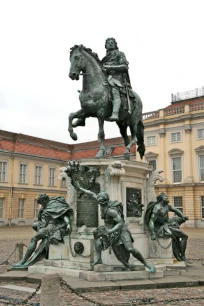
Statue of the Great Elector
At the entrance of the palace, in the middle of a courtyard, stands a large equestrian statue of the Great Elector. It was designed in 1698 by Andreas Schlüter and commissioned by King Frederick I, the elector’s son. At the base of the statue are four chained warriors, symbolizing the four temperaments (which stem from antiquity, where they were used to describe personalities).
The statue was originally located on the Kurfürstenbrücke, a bridge near the Stadtschloss (city palace) on Museum Island, but during the Second World War the statue was submerged to the bottom of the Tegeler See, a large lake in Berlin. The statue was recovered in 1952 and after a restoration it was moved here, in front of Charlottenburg Palace.
- Next: Berlin Wall
- More Sights & Attractions in Berlin