


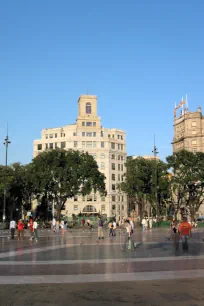
The Rambla is the most famous street in Barcelona. The wide boulevard connects the Plaça de Catalunya, a busy square, with the Columbus Monument and the city’s waterfront.
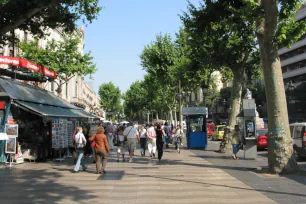
The often crowded street is popular with tourists and locals alike. The middle part of the Rambla is pedestrianized and bordered by trees. Kiosks, flower stalls and street artists are in abundance here. Traffic passes on either side of the pedestrian area.
History
The Rambla was originally a small stream flowing just outside the city walls. In the sixteenth century, convents and a university were built along the river. In the nineteenth century, the city wall was torn down and buildings were erected along the now dried up river.
The original buildings were demolished, but they are remembered in some of the names of the five different parts of the Rambla. Even though it is one continuous street, the Rambla actually consists of five ‘ramblas’. That’s why the street is also called Las Ramblas (Spanish) or Les Rambles (Catalan).
Rambla de Canaletes
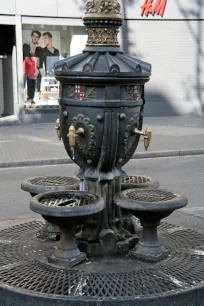
The first Rambla, starting from the Plaça de Catalunya, is the Rambla de Canaletes. The name originates from the nineteenth-century Canaleta fountain. The expression ‘he drinks water from Canaletes’ means that person comes from Barcelona. And according to local legend, once you drink from the fountain, you will keep coming back to Barcelona.
Rambla dels Estudis
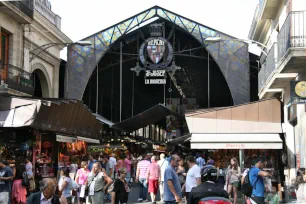
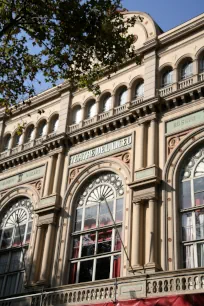
The second Rambla is the Rambla dels Estudis. It is named after the sixteenth-century university, the Estudis Generals. The building was demolished in 1843. Several important buildings are still in this area, among them the eighteenth-century Reial Acadèmia de Ciènces i Arts, since 1910 a theater. The building contains the first public clock of the city.
Rambla de Sant Josep
The next Rambla is the Rambla de Sant Josep, named after a convent which was demolished in the mid 1900s and replaced by the Mercat de la Boqueria, a colorful marketplace.
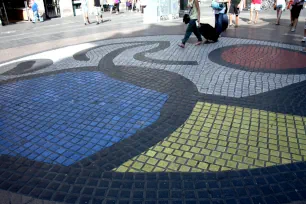
Since this part of the Rambla has many flower stalls, it is now better known as the Rambla de les Flors, or ‘Flower Rambla’. At the end of this Rambla lies a small square, the Plaça de la Boqueria. The pavement here features a mosaic by Joan Miró and a nearby shop is decorated with an Art Deco dragon.
Rambla dels Caputxins
The fourth Rambla counting towards the Columbus Monument is the Rambla dels Caputxins, yet again named after a now demolished building: a Capuchin monastery.
The most interesting building on this rambla is the Gran Teatre del Liceu, Barcelona’s opera house. The theater building, decorated in modernista style, was twice destroyed by fire: in 1861 and in 1994, but it was rebuilt each time, most recently reopening in 1999.
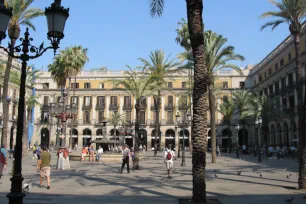
Further down the Rambla on the left-hand side is the entrance to the Plaça Reial, a lively square from the nineteenth century with tall palm trees and streetlamps designed by Antoni Gaudí.
Opposite Plaça Reial, in the Carrer Nou de la Rambla is the Palau Güell or Güell Palace, one of Gaudí’s first residential buildings. The parabolic shapes at the entrance and the rooftop chimneys are signs of things to come in his later works at the Güell Park and the Casa Milà, just to name two of the most famous works by the renowned Catalan architect.
Rambla de Santa Mònica
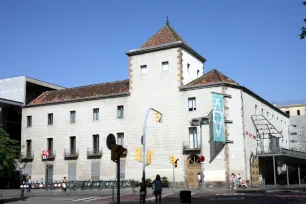
The last Rambla is the Rambla de Santa Monica, named after a convent, now converted into a museum, the Centre d’Art Santa Mònica. The rambla leads to a roundabout with a sixty-meter tall column, the Columbus Monument. It was built in 1888 for the Universal Exposition.
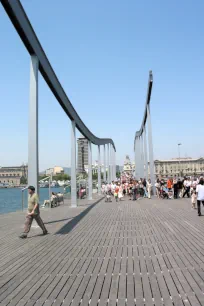
Rambla de Mar
If you continue to walk in the direction of the Port Vell a wooden walkway, now known as the Rambla de Mar or Rambla of the Sea, leads you to Maremàgnum, a complex with shops, movie theaters – including an IMAX theater – and a large aquarium.
The Rambla de Mar was designed by Viaplana & Piñon, who created a wooden suspension bridge with a wavy pattern, symbolizing the connection of the city with the Mediterranean. For decades, Barcelona had turned its back towards the sea and the extension of the Rambla, completed in 1994, symbolized Barcelona’s renewed opening towards the sea.