


The Plaça de Catalunya, a large plaza surrounded by monumental buildings, is Barcelona’s busiest square. It is located between the old city (Ciutat Vella) and the nineteenth century Eixample district.
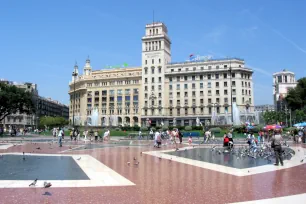
Two of Barcelona’s most famous streets, the Rambla (a wide promenade in the old city) and the Passeig de Gràcia (a grand showcase of modernist architecture in Eixample) start at the Plaça de Catalunya.
Even though the square is rather vast, it is constantly crowded with people walking to and from one of the nine streets emanating from the square.
History
Until the middle of the nineteenth century, the Plaça de Catalunya was a rural area just outside the city walls. In 1858 the central government in Madrid finally allowed the defensive walls to be demolished. It also approved construction outside the walls, so a public competition was organized for the design of a new district.
Eixample Masterplan
The first place was awarded to a design by Rovira i Trias, which consisted of a plan with streets radiating from the historic Barri Gòtic neighborhood. The central government however chose for a more modern design with a grid plan by Ildefons Cerdà.
The central government prevailed and the new Eixample district was designed according to Cerdà’s design. Barcelona’s government, however, opposed what they perceived as a lack of integration between the new and old districts. They supported Rovira i Trias’s plan of a wide esplanade leading to a plaza. Cerdà’s plan on the other hand consisted of an extension of the Rambla towards a large square to be created on the Passeig de Gràcia.
Final Design
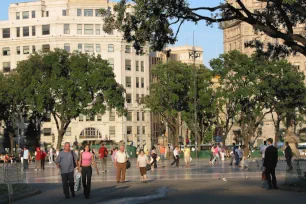
Eventually, the local and central government agreed to another plan as a compromise. The new design by the architect Puig i Cadafalch (better known for his modernist building ‘Casa de les Punxes’) resulted in the current enormous square, created between 1925 and 1927.
Plaça de Catalunya ended up not being integrated with any of the surrounding neighborhoods, but it is nonetheless surprisingly pleasant for a square this size.
The Square
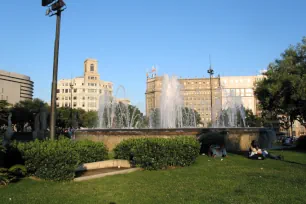
The benches at the oval-shaped center of the square are ideal for people-watching. A single row of trees surrounds this area, shielding it from the traffic heavy streets. To the north are a couple of large circular fountains that are illuminated at night.
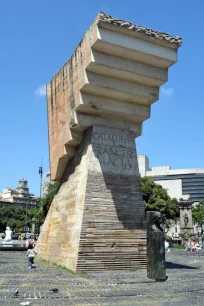
Monument a Francesc Macià
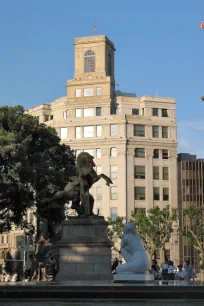
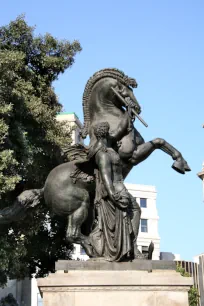
Several sculptures are planted around the central paved area, seemingly at random. The most prominent of these is the Monument a Francesc Macià, honoring the former president of the Generalitat (the Catalan government). The sculpture was created in 1991 by Josep Subirachs, a sculptor who also worked on the Passion Facade of the Sagrada Família.
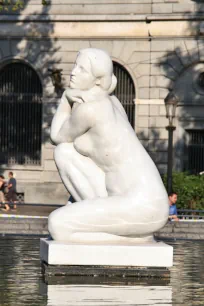
La Deessa
Another notable sculpture is an iconic statue of a female figure by Josep Clara. The statue, entitled “La Deessa o l’Enigma” (The Goddess or the Enigma) is set at the center of a pool. The white marble sculpture is a 1982 replica.
El Corte Inglés
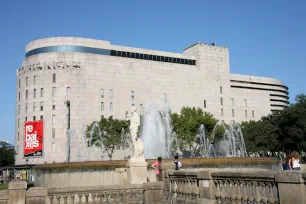
To the east, the Plaça de Catalunya is bordered by an imposing white building home to El Corte Inglés, a famous department store with branches all over Spain. The store has a wide assortment of articles ranging from food to gardening tools and electronics. The cafetaria on the ninth floor offers amazing views over the square.
Transportation Hub
The Plaça de Catalunya functions as a hub for the city’s public transportation. Below the square is the main subway junction; three metro lines and a city railway line meet here. Many of the city’s buses, as well as airport express and tourist buses, stop here at the square.