


In the center of the Barri Gòtic (Gothic Quarter), the heart of Barcelona, is the city’s Gothic cathedral, known as La Seu. The first stone of the current church was laid in the thirteenth century, but it would last until the early twentieth century before the cathedral was fully completed.
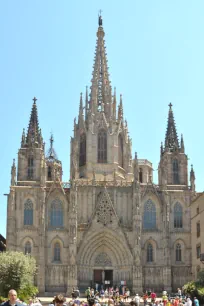
The church was named after Barcelona’s patron saint Eulalia; its official name – Catedral de la Santa Creu i Santa Eulalia – is Catalan for Cathedral of the Holy Cross and Saint Eulalia. The commonly used name La Seu refers to the status of the church as the seat of the diocese.
Earlier Churches
Already in 343 AD during the Roman Empire, a basilica was built at the site of the current cathedral on a spot formerly occupied by a Roman temple. In 985 the basilica was destroyed by the Moors. The Catalan count Ramón Berenguer I – who started his reign in 1035 when he was only eleven years old – ordered the construction of a cathedral, which was built between 1046 and 1058 in Romanesque style. A nearby chapel – the Capella de Santa Llucia – was built between 1257 and 1268 and later incorporated in the cathedral’s cloister.
Construction
Thirty years later, in 1298, construction of the current cathedral started under King Jaume II, who was known as ‘the Just’. During the construction of the cathedral, the existing Romanesque building was demolished.
Due to civil wars and the Black Death, which hit the city several times, construction only progressed slowly. It took until 1460 before the main building was completed. The Gothic facade was finished much later, in 1889, and the last part, the central spire, was completed in 1913. The design of both the facade and the spire were based on the original design from 1408 by the French architect Charles Galters.
The Building
Exterior
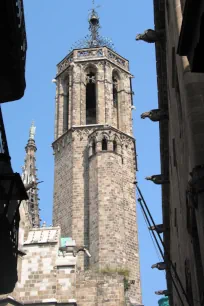
The church is 93 meters/305ft long and 40 meters wide. The octagonal bell towers reach a height of more than 50 meters. They were built between 1386 and 1393. The spire of the central tower reaches a height of 70 meters or 230ft.
The main entrance to the church – profusely decorated with statues – is reminiscent of the porches of the great French cathedrals.
Interior
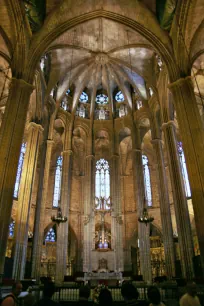
The interior consists of one wide nave illuminated by large, fifteenth-century stained-glass windows. The nave is flanked by aisles with twenty-eight side chapels. Of note here are the tombs of Count Ramón Berenguer I and his wife.
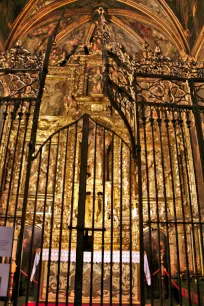
One of the highlights inside the cathedral is the crypt below the Capella Major (chancel) which contains the sarcophagus of Santa Eulalia. The cathedral also has a beautiful choir at the center of the nave with magnificently carved choir stalls. The enclosure around the choir is decorated with reliefs that narrate the life of Santa Eulalia.
Cloister
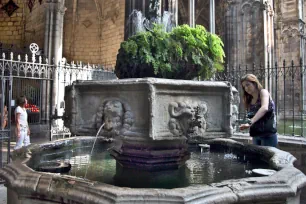
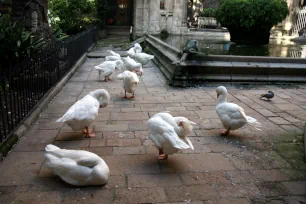
The cathedral is famous for its fourteenth-century cloisters, with a courtyard featuring a fountain which is surrounded by a marvelous Gothic portico. There are always thirteen geese in the courtyard. Each goose represents one year in the life of the martyr Santa Eulalia, a young girl allegedly tortured to death in the fourth century by the Romans for her religion. The cloister also contains a small museum with precious liturgical artifacts.