


The Ancient Agora was the commercial, social and political heart of Athens during the Antiquity. It was the center of daily activities, and people came here to shop, get entertained, and socialize.
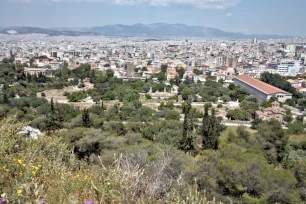
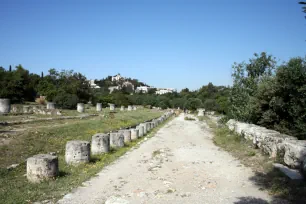
Excavation of the area, which started in the early twentieth century, revealed a large number of temples, stoas, altars and even a concert hall. Justice was spoken in the courts here, and philosophers spoke to the people who came here to shop or discuss the daily news. Schools and sports facilities were available as well.
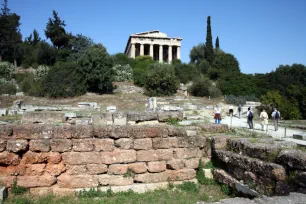
Today two large buildings are intact: the Hephaisteion – the best preserved temple in Greece – and the Stoa of Attalos, a large shopping center that was rebuilt in the 1950s. It is now home to a museum. The rest of the Agora looks like a large park with ruins of ancient buildings visible all around.
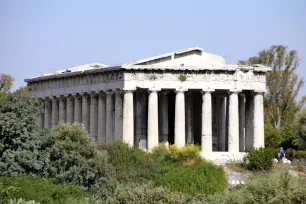
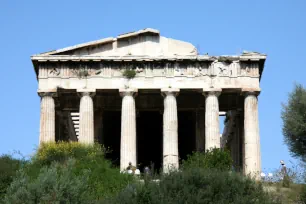
Temple of Hephaistos
Overlooking the Ancient Agora from its elevated position on the hill of Agoraios Kolonos, the Temple of Hephaistos, also known as the Theseion or Hephaisteion, was built in the fifth century BC. The temple was dedicated to the gods Hephaistos and Athena. Similar in style but smaller than the contemporary Parthenon, the temple consists of thirty-four Doric columns that support a still partially intact roof. A large frieze decorated with reliefs depicts the exploits of Theseus and Heracles. In Antiquity, large statues of Hephaistos and Athena stood in the cella.
The Hephaisteion is the best preserved temple in all of Greece, thanks to its conversion into a church in the seventh century. In 1834 the temple was declared a national monument and for some time used as an archaeological museum.
Stoa of Attalos
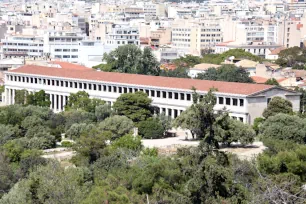
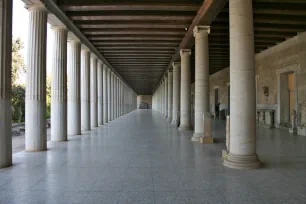
The Stoa of Attalos (or Attalus) was built in 150 BC by King Attalus II of Pergamon. The two stories tall building, 116.5 meters long and 19.5 meters wide (382 x 64 ft) functioned as a shopping mall. Each floor housed 21 stores, and customers could relax in the shade of the covered colonnade in front of the stores. The stoa was destroyed in 267 AD by the Heruli, a Germanic tribe.
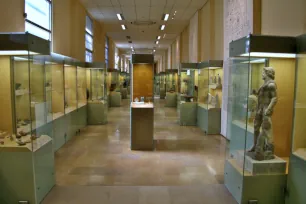
From 1953 to 1956, the stoa was rebuilt on the foundations of the ancient structure by the American School of Archaeology. Today it houses the Agora Museum, where items found on the archaeological site of the Ancient Agora are displayed.
Museum of the Ancient Agora
The museum in the Stoa of Attalos displays a varied range of objects that were found during excavation of the Ancient Agora. Statues and monuments that decorated the many temples on the agora are exhibited in the colonnade. Inside the stoa are objects that give a great insight in the daily life in Athens.
There are household items such as coins, toys, a mobile oven, kitchen tools and writing tools. There are also artifacts that illustrate the democratic process in ancient Athens, such as an excerpt of a law against tyranny from 337 BC, bronze pieces used to vote and many ostraka.
These were clay shards with the name of an individual inscribed by people who thought they were a danger to democracy. The person whose name was on the most ostraka during a ballot was banished from the city for ten years.
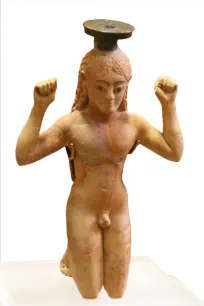
Other interesting items include a small bronze head of Nike, dated around 425 BC and once covered in gold and silver, and the Aryballus – a small statuette from 530 BC which was used as an oil bottle.
Ruins
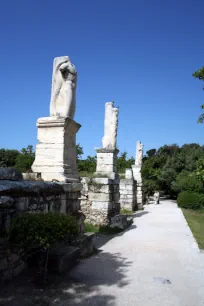
Most of the buildings at the Ancient Agora have been reduced to ruins. One such building was the Odeion of Agrippa (or Odeum of Agrippa), a large auditorium built at the center of the Agora to hold musical performances. The roof of the auditorium, with seating space for one thousand spectators, collapsed in 150 AD, after which it was rebuilt on a smaller scale, seating five hundred people. The building was destroyed by the Heruli in 267 AD. In the fifth century a large bathing complex, known as the Palace of Giants, was built on its foundations. Three of the triton statues that adorned the entrance of Odeion and later the Palace of Giants, are still visible.
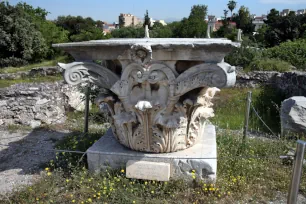
Another building of which only the foundations are visible is the Tholon, a circular structure built around 470 BC that was the seat of administration of Athens. Adjacent to the Tholon, at the foot of the Agoraios Kolonos hill, was the Bouleuterion, the council hall. In front of this building was the Monument of the Eponymous Heroes, a marble podium with bronze statues of the ten Eponymous Heroes. Wooden boards with public announcements were hung on the podium to inform people of official decisions and other information. Adjoining the Bouleuterion was the Metroon, a sanctuary of Rhea, the ‘mother of gods’. The official records of the city of Athens were stored in this building.
To the south the Agora was bounded by a large, U-shaped complex, which consisted of the East, Middle and South stoas and the Heliaia, the supreme court. The complex was more than twice the size of the Stoa of Attalos. There were several other stoa, including the stoa of Zeus Eleutherios, the Royal Stoa – seat of a magistrate – and the Painted Stoa, where philosophers used to gather.
There were also several temples and altars; a temple dedicated to Zeus stood in front of the Middle Stoa and in front of the Stoa of Attalos was a small circular Monopteros temple. Adjacent to the Stoa of Attalos was the library of Pantainos, built around 100 AD.