


Zurenborg is a neighborhood in Berchem, a district of Antwerp. The area boasts a truly unique collection of contrasting, exuberant architectural styles.
History
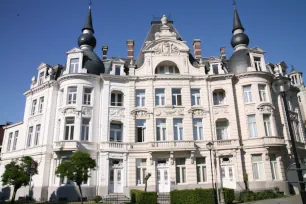
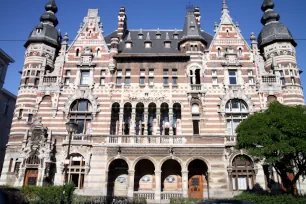
At the end of the nineteenth century, the population of Antwerp was growing rapidly, increasing from 200,000 in 1885 to around 300,000 in 1900. The port of Antwerp had become Europe’s largest. As a result, the city was developing several neighborhoods. The most prominent one being Antwerp’s south, where development started in 1875. The first paralleling plan of the Zurenborg neighborhood, at the southeast of Antwerp, was approved in 1882.
The neighborhood is split into two parts by a railway line to the Netherlands. Both parts were separately developed. The northwest part features a central square from which the main streets radiate. In the southeast part, the square was reduced to a small circular place.
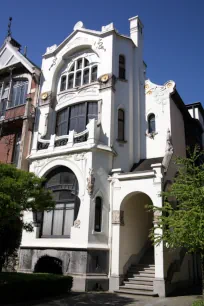
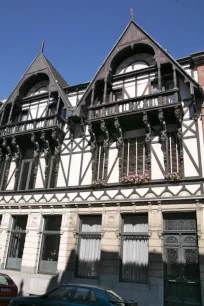
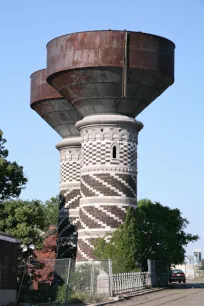
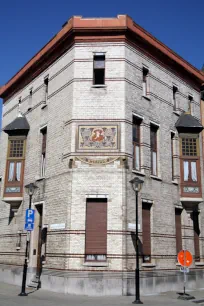
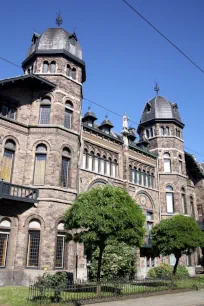
Northwest area
The northwest side of the railway features hundreds of white stuccoed houses, which attracted the new middle class. Those people with a relatively high income wanted to flee the crowded and deteriorating old center of the city. The neighborhood was developed as a ‘village in the city’.
The center of the area is the Dageraadplaats, a square from which ten streets radiate. Most of the buildings in the area are low-rise, white-stuccoed houses, which give the neighborhood a homogenous look. The neighborhood started to decline in the fifties, but has enjoyed a revival in the nineties and now attracts mostly young people thanks to its village-like atmosphere.
Southeast area
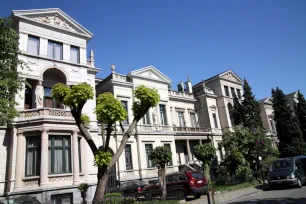
The southeast side of the railway, also known as the Cogels-Osy neighborhood, is maybe the most famous of the Antwerp neighborhood, thanks to its remarkable architecture. It attracted the very rich who, in a typically Antwerp tradition, wanted to display their wealth with opulent buildings. Each owner could choose his own architect and building style, as long as it fitted in. This created a competitive environment for architects who were able to freely use their creativity.
As a result, the Cogels-Osy is a showcase of contemporary popular architectural styles, where many ‘houses’ were turned into small palaces decorated with statues, balconies, towers and bay windows.
In contrary to the west side of Zurenborg, the east part features almost randomly placed streets, with the Cogels-Osylei as the central axis. Variety and individuality were the key to the buildings constructed in this part of the city.
The architects all used different architectural styles: Flemish Renaissance, Byzantine, Gothic, Classical, Art Nouveau are just some of the many styles used by architects. This results in an area where you find can find a Moorish style building next to an Art Nouveau house or an eclectic castle. Nowhere will you find so many confronting styles in one small neighborhood.
Most of the buildings were actually several houses with different entrances, constructed as one large villa. They are lavishly decorated; each detail of a building was taken by the architects as an opportunity to emphasize the individuality of the building.
The Cogels-Osy neighborhood is an area full of symbolic building- and street names. Cogels-Osy, the man who started the whole development project, was a defender of the Flemish and Antwerp identity. Some street names refer to the independence war of linguistic affinity: the Boer war in South Africa, e.g. the Pretoriastraat, Transvaalstraat and Krugerstraat. Others refer to the Flemish history or to wars against the Dutch and French. Several buildings were given similar symbolic names. These symbols show that the neighborhood represented a newly found patriotism, which is also reflected in the exuberance of the architecture.
Protection of the neighborhood
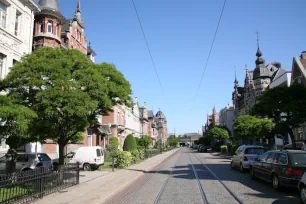
When the council of the district of Berchem, to which the Cogels-Osy area belonged since 1912, unveiled plans in the 1960s to develop a new dense and modern ‘Corbusier-type’ neighborhood in Zurenborg, this caused strong opposition from the inhabitants. Even Renaet Braem – the modernist Antwerp architect – opposed the destruction of this architecturally rich neighborhood. He filed a request to protect the entire neighborhood as a monument.
It wasn’t until 1984 before the protection came into effect, but in the meantime the original plans were never realized thanks to strong opposition by both architects and inhabitants. Currently, more than 170 buildings in the neighborhood are protected monuments.