


Zuid (South) is one of the most interesting neighborhoods in Antwerp. After several decades of stagnation, the area has seen a revival since the mid 1980s. It is now one of the most trendy neighborhoods in the city.

Early History
In the sixteenth century, the Spanish occupied Antwerp and built a citadel south of the center near the river Scheldt. The citadel, paid for by Antwerp, was used to control the city. It would also be used for the same purpose during the French and Dutch occupations. Not much changed after the Belgian independence in 1830, and the citadel was obstructing the city’s expansion. Only after forty years of bitter discussions between city and state, a compromise was reached: new military fortifications would be built, but much further from the city center.
At the citadel site, Antwerp was responsible for the development of the new neighborhood, while the government would build the new docks, railway infrastructure and quay. The city paid for 50% of the purchase cost and set up a company to develop the new neighborhood: the S.A. du Sud d’Anvers.
Street Plan
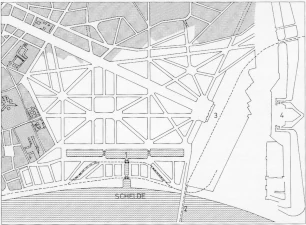
Contrary to most Antwerp neighborhoods, where the streets had developed organically, the layout of the new Zuid neighborhood was carefully planned.
Between 1870 and 1875 numerous designs left the drawing table. The final plan, approved in September 1875, is reminiscent of Paris: a star shaped street pattern with wide streets, offering beautiful views of the many monuments. Other main features of the approved plan for Zuid were the docks, located parallel with the quay, the extension of the central Boulevard (now known as the «Leien») and the central square, the Leopold de Wael square.
Cohesive Architecture
Construction of the houses started soon after the approval of the street plan in 1875. The area south of the Boulevard had cheaper lots and was partly developed into a working-class neighborhood. Initially the corporation responsible for the development of Zuid built the whole infrastructure (streets, sidewalks, sewer system) before any of the adjacent lots had been sold. After disappointing sales of lots, the corporation decided to build houses themselves.
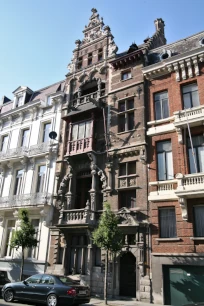
This resulted in a cohesive architectural landscape, much in contrast with another neighborhood developed at the same time, Zurenborg. Even for the buildings built independently of the corporation S.A. du Sud d’Anvers, the architects had to follow their recommendations and plans were sometimes altered to avoid contrasting styles.
Some buildings still stand out: the architect Jean-Jacques Winders built a house for himself, known as «de Passer». Constructed in 1883 in Neo-Flemish Renaissance style, this house has a traditional floor plan, but it is built as a small “palace”. Another remarkable building in the Zuid is the 1901 Art Nouveau building «the five continents». The bay window in the shape of a boat gave it the nickname «The little boat».
World Fair
To attract more interest from potential customers, the S.A. du Sud d’Anvers suggested holding the 1885 world fair in Zuid. The city agreed, but although the world fair was very successful, it did not attract many new customers. The corporation went bankrupt in 1890. In 1894 another world fair was held at Zuid, but only after the turn of the century Zuid would really start to develop.
Landmark Buildings
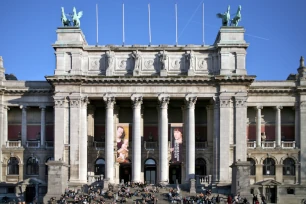
The construction of some landmark Buildings helped to bring some life to the new neighborhood. The Royal Museum of Fine Arts, built in 1894, is the most prominent building. It is located at the central square, the Leopold De Wael square. The Hippodrome, a large theater opposite the museum and the Zuid station, built around 1900 at the end of the Boulevard, were the other landmarks in Zuid.
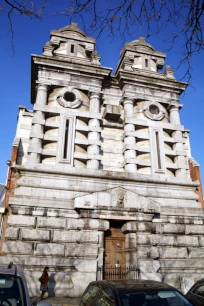
Another noticeable structure is the «Zuiderpershuis», a hydraulic power station built in 1882, installed to operate the bridges, cranes at the new docks. The twin towered Neo-Baroque building is now home to a cultural center.
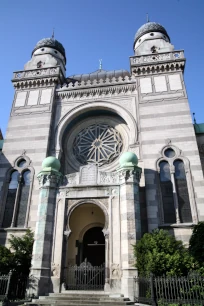
Near the Royal Museum, the Jewish community built a Main Synagogue in 1882. It is only used for special occasions; the Jewish mostly use the synagogues is the area around the City park and Central Station.
Statues and monuments
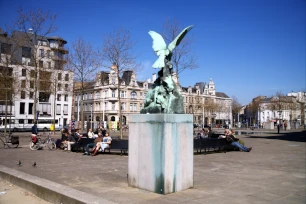
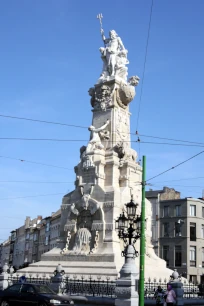
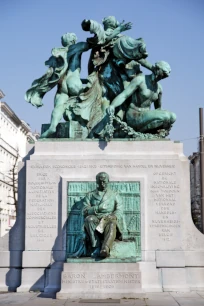
During the development of the Zuid neighborhood, several statues were built at the squares: at the center of the Marnix square stands the large «Scheldt Free» monument, built to celebrate the abolition in 1863 of the toll levied on ships sailing to Antwerp.
From another – boat-shaped – monument on the Lambermont Square, you have a view at the Gillis Square with the Porta Regia, a triumphal arch built in 1624 after a design by P. P. Rubens, the famous painter. It was built to honor the Spanish King Philips IV and was integrated in the city wall. The arch moved twice, and since 1936 it stands at it current location in a park at the site of the former docks.
Decline
Less than eighty years after the start of the development of the Zuid neighborhood, the decline started with the closure of the Hippodrome in 1958. In 1965 the Zuid railway station was demolished, in 1968 the docks were filled and in 1973 the Hippodrome building was demolished as well.
Together with the loss of landmarks and harbor activity, many people left the area, also due to the deteriorating state of the houses. In 1990, only 23,000 people lived in the area, compared to 50,000 in 1920. Fortunately, the neighborhood survived: plans designed in the seventies by Skidmore, Owings & Merrill to demolish the whole of Zuid and replace it with a cluster of skyscrapers were thankfully never realized.
Revival
The revival of the Zuid neighborhood started in the mid-1980s. Apartment prices had dropped significantly, attracting younger people. Artists had also discovered the area. Earlier, in 1981, a structural plan was approved which gave some protection for the architecture. The plan was also the signal for the city council to rehabilitate Zuid.
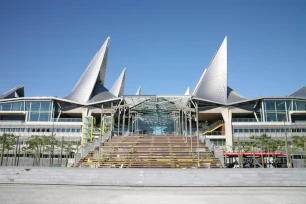
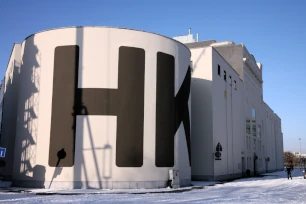
By the end of the 1980s, many buildings had been restored. In 1987, the new museum for contemporary art (M HKA), was opened in a former grain silo. Several art galleries, a new photography museum, the opening of a new cultural center in the Zuiderpershuis and the restoration of several grand buildings around the filled-in docks made Zuid more and more attractive. The crowning piece of the revival was the construction of the new Palace of Justice, which was built at the site of the former railway station.
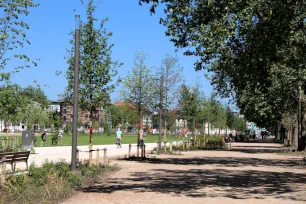
More and more people moved to the many renovated apartments and trendy cafés and restaurants opened. During the 1990s, Zuid became one of the most attractive neighborhoods in Antwerp. And in 2022 the filled-in docks were turned into a large rectangular park known as “Park Zuid”, giving the neighborhood some much-needed green space.