


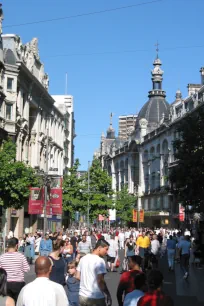
The Meir is Antwerp’s most famous street. Already a prestigious street lined by patrician mansions in the sixteenth century, the Meir today is best known as the region’s and even the country’s most important shopping street.
History
Early History
The oldest reference to the Meir dates back to 1257, when the street was not more than a low-lying swampy area with a lake just outside the city borders. This explains the street’s name: ‘meir’ is derived from the old Dutch word ‘meere’, which means swampy, soggy area.
With the rapid expansion of the city during the following centuries, the Meir becomes urbanized and in the early fifteenth century it is a wide paved street with a canal at its center. Much of the street is already lined with houses.
Sixteenth Century
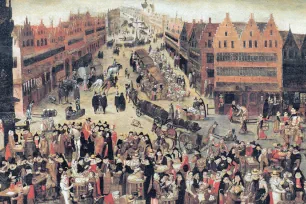
At the turn of the sixteenth century, Antwerp’s growth intensifies even more as it expands to one of Europe’s largest cities. Since the center of the city is now overcrowded, the Meir and surrounding streets become the place where rich patricians settle and build sumptuous mansions.
At the same time, a new large stock exchange is built close to the Meir, moving the city’s commercial epicenter from the riverside to the Meir. During the first half of the sixteenth century, the canal running through its center was covered over, increasing the appeal of what is now Antwerp’s most prestigious street.
The wide street is not only an important commercial street, it is also the site of many of the city’s parades and events. While the city of Antwerp loses its powerful position on the international stage during the next centuries, the Meir still appeals to the wealthy, who continue to build ever larger mansions. Some of the buildings of this period have survived, such as the Royal Palace, built in 1748.
From thoroughfare to pedestrian street
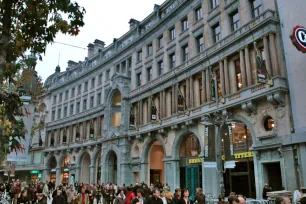
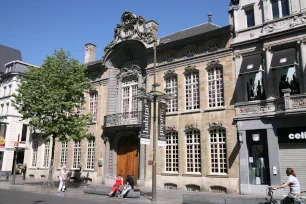
With the construction of the Central Station at the turn of the twentieth century, the Meir’s function as a main thoroughfare is now more evident than ever, as it leads from the historic city center right towards the new railway hub. To accommodate the growing traffic, the Meir is widened even more and grand buildings are erected such as the Stadsfeestzaal – an event hall – and the Innovation, a large modern department store.
At the end of the twentieth century, the Meir is still the city’s most important shopping street, but clogged with traffic. In the 1980s the tramway moved underground and in 1993, when Antwerp was designated the European Capital of Culture, the street was pedestrianized. But even without car traffic, the Meir maintained and even solidified its position as the region’s prime shopping street.
The Meir today
Today, the Meir is not much different from the prestigious street it was during the sixteenth century. Not many people live here, but the street has kept its commercial function, as it is still the city’s main shopping street. It is also still used for many events and parades.
While the earliest buildings along the Meir have not survived, the street is an interesting collection of architectural styles. Many grand buildings line the street. You should not miss the Royal Palace, the Stadsfeestzaal, the domed Innovation building and the Osterrieth House, a flamboyant mansion in Rococo style.
And the Leysstreet, which acts more or less as an extension of the Meir, is lined with one elaborately decorated building after another. Don’t forget to look up, as many of the buildings are topped with statues. And while you’re there, don’t forget to visit the Rubens House, which is just footsteps away from the Meir.
Shopping mecca
Today, the Meir is best known as THE shopping street. While the street is lined with some grand buildings, many of the people walking here only have eye for the many large shops.
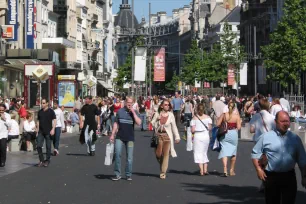
On peak days the street attracts more than 220,000 visitors who often come from neighboring provinces or even countries for a day of shopping. The reopening of the glass-vaulted Stadsfeestzaal as a shopping center in October 2007 only increased the attraction of the Meir as a shopping haven.
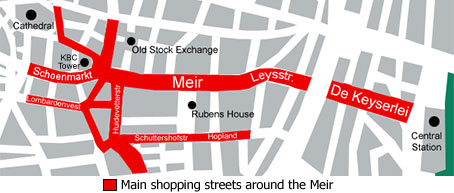
While some other downtown shopping streets have a hard time competing with the large malls on the fringe of the city, the Meir is more than ever the place to be for shoppers. It is also the center of a much larger shopping area that includes many more streets such as Hopland, Schuttershofstraat (where you find some of the top luxury stores) and Huidevetterstraat.
Location
The Meir is part of a central axis known as ‘Via Sinjoor’ that leads visitors from the Central Station through the center of the city to the river Scheldt with as minimal interaction with car traffic as possible.
- Next: DIVA
- More Sights & Attractions in Antwerp