


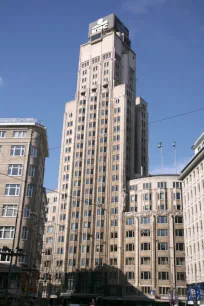
The Boerentoren (Farmers’ Tower) as it is locally known is an Art Deco skyscraper that was built between 1929 and 1932 in the historic center of Antwerp. At the time it was Europe’s tallest skyscraper.
History
In the run-up to the 1930 Antwerp World Exhibition, the first West-European skyscraper was built in the center of Antwerp. The tower, constructed at a site which was cleared by bombardments during the First World War, was to be a monumental building, but one of the requirements given by the city council was that the building should not compete with the city’s cathedral. A special council consisting of prominent architects had to give the approval before the tower could be built. Today, the requirement for not obstructing the view on the city’s 123 meter (405 ft) tall cathedral still exists in Antwerp.
Europe’s tallest
At the time construction was completed, the tower, which originally measured 87.5 meters (287 ft), was the tallest in Europe.
The skyscraper was built following the example of contemporary high-rise constructions in New York and Chicago. It was also one of the first buildings in Europe which made use of a load-carrying structural frame, also originating from Chicago.
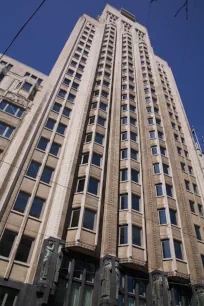
The tower has an Art Deco-style facade and contained several marvelous rooms with Art Deco decorations. Plans in the late sixties to demolish the tower were fortunately set aside and the building was restored between 1970 and 1976. After the restoration the tower reached a height of 97 meters (318 ft).
Protected Monument
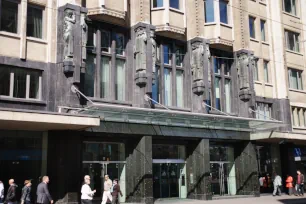
Originally the tower was built as a multifunctional building and consisted of offices as well as apartments. With the restoration, all the apartments were removed and the tower was solely used as an office building.
Also gone since the restoration in the 1970s are the café on the roof terrace of the ten stories-high wings, a tearoom and a Beer hall. In 1981, the tower became a protected monument.
From Farmers’ Tower to Culture Tower
The tower is nicknamed Boerentoren or “Farmers’ tower” as the bank’s most important shareholder at the time of construction was a farmers’ cooperation. Until recently its official name was ‘KBC tower’ as the main tenant was the KBC, the largest bank of Flanders. KBC sold the tower in 2020 to Katoen Natie, a large port operator. It plans to turn the tower into a ‘Tower of Culture’ that will house the art collection of the Phoebus Foundation.
A Modern Upgrade
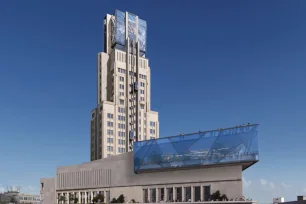
Plans for this new tower were unveiled on June 18, 2025. According to these plan designed by the American architect Daniel Libeskind, the historic tower will be kept intact but it will be crowned by a four-story glass cube that will act as an observation deck. This will increase the total height of the tower to 103 meters.
The ground floor will feature a triangular glass dome through which visitors will be able to see the glass top of the tower. A skeleton of a Tyrannosaurus Rex, known as “Trinity” will be displayed here.
One of the wings will feature a triangular glass podium that will house a restaurant with panoramic views over the city. A rooftop sculpture garden on top, which will be open to the public, should serve as a green lung in the heart of the city. The goal is to complete the renovation before the end of 2028, one century after the start of the original construction.
- Next: Vrijdagmarkt
- More Sights & Attractions in Antwerp